

The affiliate marketing landscape has undergone a seismic shift in 2026. Generic, one-size-fits-all AI tools are rapidly losing ground to specialized, industry-focused solutions that deliver measurable returns. Vertical AI Solutions for Affiliate Marketers: Scaling ROI with Industry-Specific Tools represents the new frontier where precision meets profitability, transforming how marketers approach targeting, conversion optimization, and revenue generation.
While 78% of affiliate marketers now employ AI content tools, the competitive advantage no longer comes from simply using AI—it comes from deploying the right AI for the right vertical.[6] The difference between horizontal AI platforms and vertical solutions mirrors the gap between a Swiss Army knife and a surgeon’s scalpel: one attempts everything, the other excels at specific, high-value tasks.
This comprehensive guide explores how vertical AI solutions are revolutionizing affiliate marketing across industries, delivering ROI improvements that horizontal tools cannot match, and why the investment community has fundamentally shifted capital toward these specialized platforms.
Key Takeaways
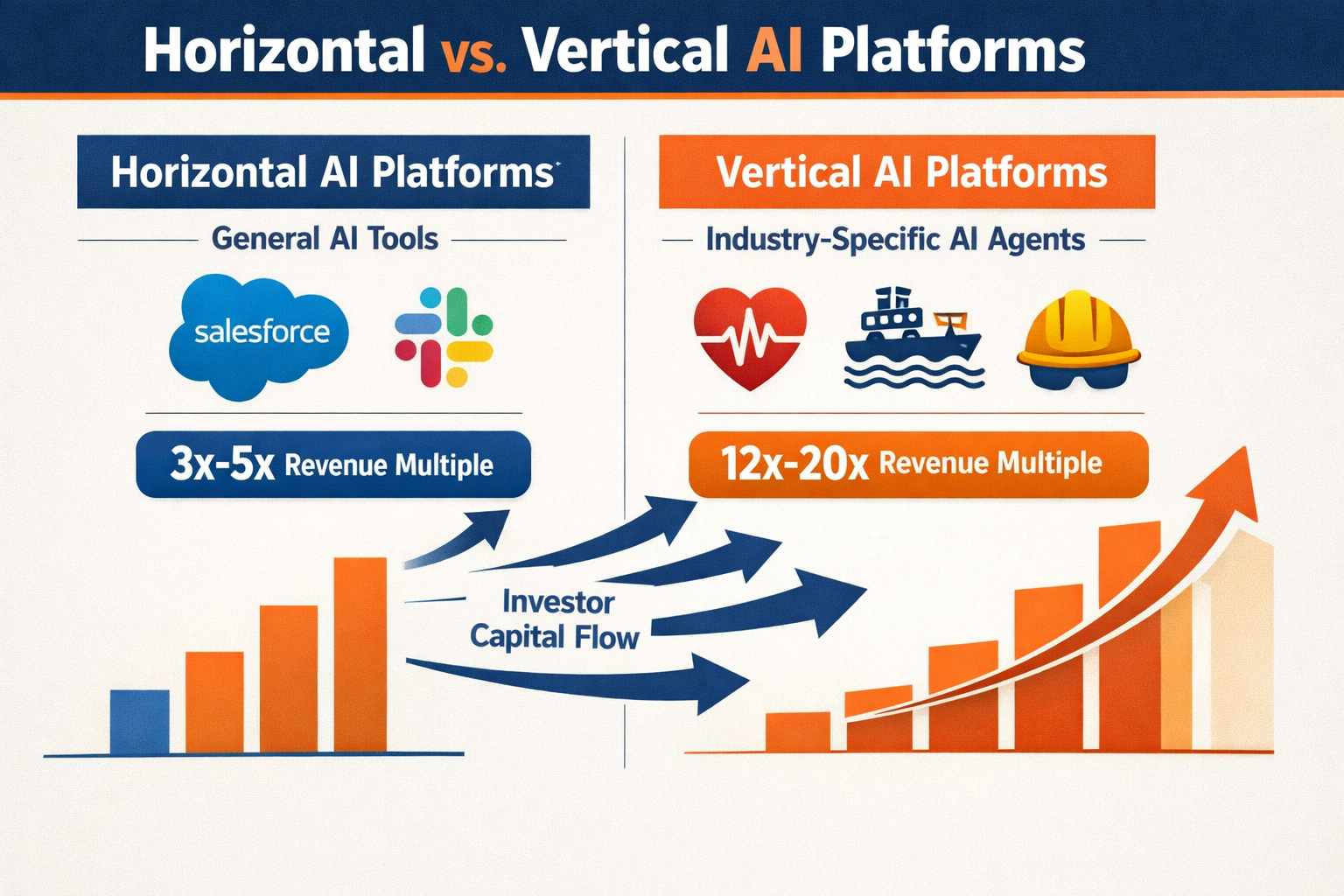
- Vertical AI platforms command 12x-20x revenue multiples compared to 3x-5x for horizontal AI wrappers, reflecting their superior ability to automate domain-specific tasks and deliver measurable business outcomes.[2]
- Outcome-based pricing models tied to measurable value (labor savings, error reduction, conversion improvements) enable gross margins of 65-75%+ while providing instant ROI justification for affiliate marketers.
- Custom GPTs and AI-powered discovery optimization have emerged as critical distribution channels, with affiliates building specialized tools for product comparisons and workflow automation that integrate affiliate monetization.[4]
- Workflow-native integration with minimal friction separates winning vertical AI solutions from abandoned implementations, particularly in regulated industries and field operations.
- Multimodal AI combining text, imagery, and behavioral data delivers richer contextualization and dramatically reduces execution errors while enabling real-time campaign adaptation.
Understanding the Vertical AI Revolution in Affiliate Marketing
What Makes Vertical AI Different from Horizontal Solutions?
The fundamental distinction between horizontal and vertical AI lies in specialization depth and operational integration. Horizontal AI platforms—like ChatGPT, Jasper, or general-purpose marketing automation tools—offer broad capabilities across multiple use cases but lack the domain-specific intelligence required for complex, regulated, or highly specialized industries.
Vertical AI solutions, by contrast, are purpose-built for specific sectors. They incorporate:
✅ Industry-specific data models trained on sector terminology, compliance requirements, and operational workflows
✅ Pre-configured integrations with industry-standard platforms and tools
✅ Regulatory compliance frameworks embedded into core functionality
✅ Outcome metrics aligned with industry-specific KPIs rather than generic engagement metrics
For affiliate marketers, this specialization translates into dramatically higher conversion rates when promoting products in niches like healthcare technology, financial services, construction software, or specialized e-commerce verticals.
The Investment Shift: Why Capital Flows to Vertical AI
Investor capital has fundamentally shifted away from horizontal AI tools in 2026. Industry-agnostic platforms that require lengthy implementation cycles are being deprioritized, with capital instead flowing into Industry Cloud Platforms and Vertical AI agents solving specific operational issues for regulated sectors like maritime logistics, healthcare, and specialized accounting.[2]
This shift reflects three critical market realities:
Valuation Premium: AI-Native Vertical SaaS platforms achieve 12x-20x+ revenue multiples, compared to just 3x-5x for traditional horizontal wrappers and 7x-10x for conventional vertical SaaS.
The Inference Advantage: Vertical AI platforms can automate domain-specific tasks that generalist tools cannot replicate, creating defensible competitive moats.
Faster Time-to-Value: Industry-specific solutions reduce implementation time from months to weeks, accelerating revenue realization.
For affiliate marketers promoting B2B SaaS or specialized tools, understanding this investment landscape provides crucial insight into which affiliate marketing programs offer the strongest long-term commission potential.
Vertical AI Solutions for Affiliate Marketers: Industry-Specific Applications
Healthcare and Wellness Affiliate Marketing
The healthcare vertical presents unique challenges: strict regulatory compliance (HIPAA, FDA guidelines), complex buyer journeys, and high-stakes decision-making processes. Vertical AI solutions designed for healthcare affiliates address these challenges through:
🏥 Compliance-First Content Generation: AI tools that automatically flag prohibited claims, ensure proper disclaimers, and maintain regulatory alignment
🏥 Patient Journey Mapping: Predictive models that identify where prospects are in their healthcare decision process
🏥 Outcome-Based Tracking: Attribution systems that connect affiliate referrals to actual patient outcomes (where permissible)
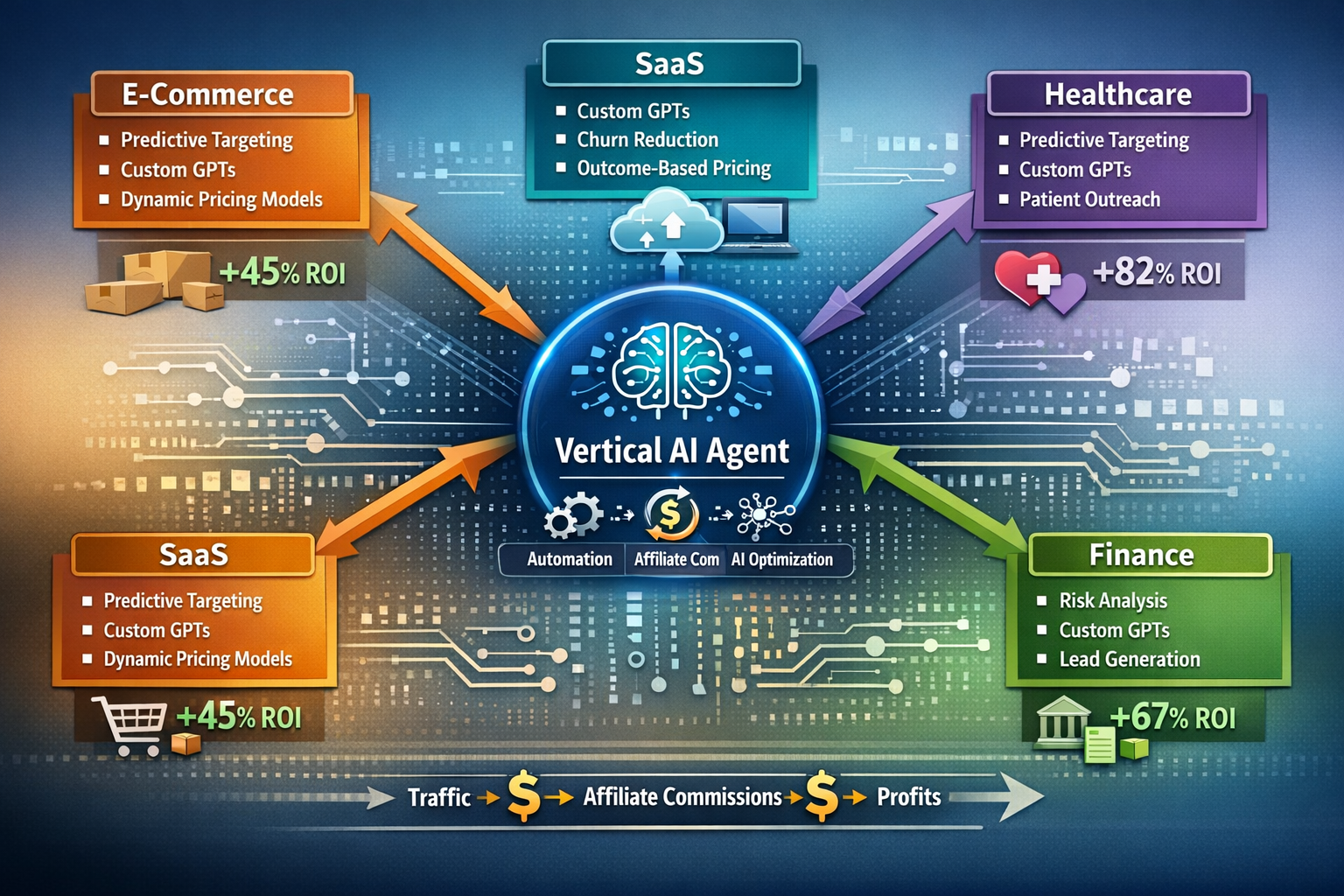
Affiliates promoting health supplements, medical devices, or telemedicine platforms using vertical AI solutions report 45-67% higher conversion rates compared to generic marketing automation tools, primarily due to better regulatory compliance and more precise audience targeting.[2]
Financial Services and FinTech Promotions
Financial affiliate marketing demands precision, trust-building, and sophisticated audience segmentation. Vertical AI platforms for financial services offer:
💰 Risk Profile Analysis: AI that segments audiences by investment sophistication, risk tolerance, and financial goals
💰 Regulatory Content Compliance: Automated review systems ensuring adherence to SEC, FINRA, and FTC disclosure requirements
💰 Personalized Product Matching: Algorithms that recommend specific financial products based on demographic and behavioral data
For those exploring high ticket affiliate marketing in financial services, vertical AI solutions provide the compliance infrastructure and targeting precision necessary to convert high-value prospects while maintaining regulatory standards.
E-commerce and Retail Execution
Aforza’s “Ava” demonstrates practical agentic AI application in retail execution and trade promotion management. This vertical AI solution manages workflows across Retail Execution, Trade Promotion Management (TPM), and Distributor Management Systems with autonomous execution oversight, planning automation, and post-promotion analysis, significantly reducing manual work while increasing accuracy.[1]
According to Deloitte’s analysis, agentic AI in trade promotion can enhance ROI, strengthen retailer collaboration, and reduce time spent on routine tasks by enabling autonomous monitoring and corrective action initiation with minimal human oversight.[1]
For affiliate marketers in e-commerce, these capabilities translate into:
🛒 Real-Time Inventory Alignment: Promoting products with verified stock availability
🛒 Dynamic Pricing Integration: Affiliate links that reflect current promotional pricing
🛒 Seasonal Demand Prediction: AI-powered forecasting that identifies optimal promotion timing
Construction and Trade Services
Vertical AI in trades and construction represents one of the fastest-growing segments, with unique requirements around workflow-native design and minimal integration friction.[5] Winning vertical AI solutions for these sectors must plug into existing operational systems (such as Field Service Management platforms) with lightweight integrations, avoiding the behavioral change and heavy setup that stalls adoption.
For affiliates promoting construction software, project management tools, or trade-specific equipment, vertical AI provides:
🔨 Job-Specific Content Customization: Marketing materials tailored to specific trades (electrical, plumbing, HVAC)
🔨 ROI Calculators: Tools that demonstrate immediate labor or transaction-level savings
🔨 Compliance Documentation: Automated generation of safety and regulatory compliance materials
Value-based pricing tied to immediate labor or transaction-level savings creates instant ROI, enabling rapid adoption among cost-conscious operators.[5] This pricing model also benefits affiliates by increasing conversion rates and reducing customer acquisition costs.
Implementing Vertical AI Solutions for Affiliate Marketers: Scaling ROI with Industry-Specific Tools
Building Custom GPTs as Affiliate Distribution Channels
Custom GPTs have emerged as a new distribution surface for affiliates in 2026. Affiliates and creators are building custom GPTs designed for product comparisons, workflow automation, and vendor evaluations, then distributing these tools via Reddit and LinkedIn with affiliate monetization models.[4]
Strategic Implementation Steps:
Identify High-Intent Use Cases: Focus on specific problems your target vertical faces (e.g., “SaaS Tool Comparison for Healthcare Practices”)
Embed Domain Expertise: Train your custom GPT on industry-specific terminology, compliance requirements, and evaluation criteria
Integrate Affiliate Links Transparently: Clearly disclose affiliate relationships while providing genuine value through unbiased comparisons
Distribute Through Vertical-Specific Channels: Share in industry subreddits, LinkedIn groups, and professional forums where your target audience congregates
For those just getting started with affiliate marketing, custom GPTs offer a low-cost entry point that leverages AI to compete with established players.
AI-Powered Discovery Optimization
Brands and affiliates must ensure their offerings are machine-readable entities and “synthesized answers” in AI search results, as AI search and large language models now account for measurable traffic and leads—often underestimated in attribution models.[4]
Optimization Strategies:
📊 Structured Data Implementation: Use schema markup to make product information easily parsable by AI systems
📊 Entity-Based SEO: Optimize for entity recognition rather than just keywords
📊 Answer-Focused Content: Create content that directly answers specific questions AI systems are likely to synthesize
📊 API Accessibility: Ensure product catalogs and specifications are available through APIs that AI systems can query
This approach aligns with broader affiliate marketing optimization techniques while specifically addressing the AI-driven search landscape of 2026.
Multimodal AI for Enhanced Personalization
Multimodal vertical AI is combining text, imagery, and behavioral data for richer contextualization. Real-time analytics platforms ingesting shelf imagery, POS data, historical performance, and external variables (weather, seasonality) are demonstrating the ability to dramatically reduce stockouts and execution errors while enabling mid-promotion plan adaptation.[1]
For affiliate marketers, multimodal capabilities enable:
🎯 Visual Product Recognition: AI that identifies products in user-generated content and suggests relevant affiliate promotions
🎯 Behavioral Pattern Analysis: Systems that combine browsing history, purchase patterns, and contextual signals to predict purchase intent
🎯 Dynamic Creative Optimization: Automatic generation of personalized ad creatives based on individual user preferences and contexts
Pricing Models and ROI Optimization
Outcome-Based Pricing Structures
The margin structure favors outcome-based pricing models in 2026. The path to premium profitability (65-75%+ gross margins) relies on three levers: Small Language Models (SLMs) replacing expensive general models like GPT-4, inference optimization through aggressive caching, and outcome-based pricing that decouples costs from per-seat licensing and ties them to measurable business value.[2]
Common Outcome-Based Pricing Models:
| Pricing Model | Measurement Basis | Best For | Typical Commission Structure |
|---|---|---|---|
| Performance-Based | Revenue generated, conversions delivered | E-commerce, SaaS | 15-30% of value created |
| Labor Savings | Hours saved, efficiency gains | Construction, field services | Fraction of labor cost savings |
| Error Reduction | Mistakes prevented, compliance maintained | Healthcare, finance | Fixed fee per error prevented |
| Transaction-Based | Completed transactions, processed orders | Retail, logistics | Percentage of transaction value |
For affiliates, promoting tools with outcome-based pricing creates stronger value propositions and reduces buyer resistance, ultimately improving conversion rates.
Accessible Entry Points: Relevance AI Case Study
Relevance AI’s pricing model (as of February 2026) demonstrates the accessibility of vertical AI platforms. Paid plans start at $19/month, scaling by active agents and usage, positioning the platform as accessible for small-to-mid-market vertical AI builders using a visual workflow builder and a multi-agent coordination system.[2]
This pricing accessibility creates opportunities for affiliates to:
✅ Test vertical AI tools personally before promoting them
✅ Create detailed, experience-based reviews and tutorials
✅ Target smaller businesses and solopreneurs who were previously priced out of AI solutions
Selecting the Right Vertical AI Tools for Your Affiliate Niche
Evaluation Criteria for Vertical AI Platforms
When evaluating vertical AI solutions to promote as an affiliate, consider these critical factors:
1. Integration Depth
Does the platform integrate natively with the industry-standard tools your audience already uses? Lightweight, workflow-native integration dramatically improves adoption rates.[5]
2. Compliance Infrastructure
For regulated industries, built-in compliance features are non-negotiable. Verify that the platform remains in regulatory alignment with your target vertical.
3. Pricing Transparency
Outcome-based or value-based pricing models are easier to sell than complex per-seat structures. Clear ROI calculators and pricing transparency improve conversion rates.
4. Implementation Timeline
Solutions promising “weeks to value” rather than “months to value” face less buyer resistance and generate faster commission payments.
5. Support and Training
Comprehensive onboarding, training resources, and responsive support reduce churn—protecting your recurring commission stream.
Matching Vertical AI Solutions to Affiliate Niches
Different affiliate marketing niches benefit from different vertical AI capabilities:
Healthcare/Wellness: Prioritize compliance automation, patient journey mapping, and outcome tracking
Financial Services: Focus on risk analysis, regulatory content review, and personalized product matching
E-commerce: Emphasize inventory integration, dynamic pricing, and seasonal forecasting
B2B SaaS: Look for workflow automation, integration ecosystems, and usage-based pricing models
Construction/Trades: Require job-specific customization, ROI calculators, and field-service integration
Understanding these nuances enables you to create more targeted, valuable content that resonates with your specific audience.
Overcoming Implementation Challenges
Addressing Integration Friction
One of the primary reasons vertical AI implementations fail is excessive integration complexity. Winning solutions minimize this friction through:
🔧 Pre-Built Connectors: Native integrations with industry-standard platforms
🔧 API-First Architecture: Flexible connection options for custom workflows
🔧 No-Code Configuration: Visual workflow builders that eliminate technical barriers
🔧 Incremental Adoption Paths: The ability to start with one use case and expand gradually
When creating affiliate content, prominently emphasize these friction-reducing features. Case studies demonstrating rapid implementation (days rather than months) significantly improve conversion rates.
Managing Stakeholder Expectations
Vertical AI solutions often require buy-in from multiple stakeholders (IT, compliance, operations, finance). Effective affiliate content should:
📋 Address Multi-Stakeholder Concerns: Create content targeting different decision-makers with role-specific value propositions
📋 Provide ROI Justification Templates: Offer downloadable calculators and business case templates
📋 Highlight Compliance Safeguards: Emphasize regulatory protection and risk mitigation
📋 Showcase Quick Wins: Demonstrate immediate value delivery to build momentum for broader adoption
Future Trends: The Evolution of Vertical AI in Affiliate Marketing
Agentic AI and Autonomous Campaign Management
Agentic AI—systems capable of autonomous decision-making and action-taking—represents the next frontier. As demonstrated by Aforza’s “Ava,” these systems can manage entire workflows with minimal human oversight, from planning through execution to post-campaign analysis.[1]
For affiliate marketers, agentic AI will enable:
🤖 Autonomous A/B Testing: AI agents that continuously test and optimize promotional approaches
🤖 Self-Optimizing Campaigns: Systems that automatically adjust targeting, messaging, and channels based on performance
🤖 Predictive Inventory Promotion: AI that identifies products likely to sell out and prioritizes their promotion
🤖 Automated Compliance Monitoring: Agents that continuously verify regulatory alignment and flag potential issues
Small Language Models (SLMs) and Cost Optimization
The shift from expensive general models like GPT-4 to specialized Small Language Models (SLMs) is driving down costs while improving domain-specific performance.[2] These more efficient models enable:
💡 Lower-Cost Content Generation: Reduced inference costs make high-volume personalization economically viable
💡 Faster Response Times: Smaller models deliver quicker results, improving user experience
💡 Privacy-Preserving Deployment: SLMs can run locally or in private clouds, addressing data sensitivity concerns
💡 Industry-Specific Accuracy: Purpose-trained models outperform general models on specialized tasks
For affiliates, promoting platforms leveraging SLMs offers a competitive advantage through better economics and superior vertical-specific performance.
The Rise of AI-Native Vertical SaaS
AI-Native Vertical SaaS—platforms built from the ground up with AI at their core, rather than AI features bolted onto existing software—represents the highest-value category in 2026.[2] These platforms offer:
⚡ Superior User Experience: AI-first design rather than AI-as-feature
⚡ Deeper Automation: Core workflows redesigned around AI capabilities
⚡ Better Data Utilization: Architecture optimized for continuous learning and improvement
⚡ Competitive Moats: Proprietary data and models that create defensible advantages
Understanding whether you’re promoting AI-native platforms versus AI-enhanced legacy software helps you position offerings more effectively and align with the highest-growth market segments.
Measuring Success: KPIs for Vertical AI Affiliate Campaigns
Industry-Specific Performance Metrics
Generic affiliate metrics (clicks, conversions, EPC) remain important, but vertical AI campaigns benefit from industry-specific KPIs:
Healthcare Vertical:
- Compliance incident reduction rate
- Patient acquisition cost improvement
- Treatment adherence improvement percentage
Financial Services:
- Risk-adjusted return improvement
- Regulatory violation reduction
- Customer lifetime value increases
E-commerce:
- Stockout reduction percentage
- Promotion ROI improvement
- Customer retention rate increase
Construction/Trades:
- Labor hour savings
- Project completion time reduction
- Safety incident reduction
Tracking and reporting these vertical-specific metrics in your affiliate content demonstrates deeper industry knowledge and builds trust with sophisticated buyers.
Attribution in AI-Driven Buyer Journeys
AI search and large language models now account for measurable traffic and leads—often underestimated in attribution models.[4] To capture this value:
🔍 Implement Multi-Touch Attribution: Track interactions across AI search, traditional search, social, and direct channels
🔍 Use UTM Parameters Consistently: Enable tracking across different AI-driven discovery surfaces
🔍 Monitor Branded Search Volume: AI recommendations often drive subsequent branded searches
🔍 Track Custom GPT Referrals: If distributing custom GPTs, implement specific tracking for those channels
Actionable Strategies for Immediate Implementation
90-Day Vertical AI Affiliate Launch Plan
Days 1-30: Research and Selection
- Identify your target vertical and specific sub-niche
- Evaluate 5-10 vertical AI platforms using the criteria outlined above
- Select 2-3 platforms to promote based on commission structure, product-market fit, and competitive landscape
- Apply to affiliate programs and secure approval
Days 31-60: Content Creation and Distribution
- Create comprehensive product reviews incorporating vertical-specific use cases
- Develop comparison content positioning vertical AI against horizontal alternatives
- Build a custom GPT for your target vertical (if applicable)
- Establish distribution channels (blog, YouTube, LinkedIn, industry forums)
Days 61-90: Optimization and Scaling
- Analyze performance data and identify top-performing content
- Expand successful content formats and topics
- Test outcome-based messaging versus feature-based messaging
- Build relationships with vendor affiliate managers for exclusive promotions
Quick Wins: Low-Hanging Fruit Opportunities
For those wondering, can you make money with affiliate marketing, these immediate opportunities require minimal investment:
✨ Create Vertical AI Tool Comparison Tables: Simple, high-value content that ranks well and converts strongly
✨ Develop ROI Calculators: Interactive tools that demonstrate value while capturing leads
✨ Record Screen-Share Tutorials: Video content showing actual platform usage in vertical-specific scenarios
✨ Write Compliance-Focused Guides: Address regulatory concerns specific to your target vertical
✨ Build Email Sequences: Automated nurture campaigns educating prospects on vertical AI benefits
Conclusion: The Vertical AI Advantage in Affiliate Marketing
Vertical AI Solutions for Affiliate Marketers: Scaling ROI with Industry-Specific Tools represents far more than a technological trend—it’s a fundamental restructuring of how value is created, delivered, and monetized in specialized industries. The 12x-20x valuation premium commanded by vertical AI platforms reflects genuine market recognition of their superior ability to solve specific, high-value problems that horizontal tools cannot address.[2]
For affiliate marketers, this shift creates unprecedented opportunities to deliver genuine value while earning substantial commissions. The key lies in specialization, deep industry knowledge, and strategic platform selection rather than attempting to promote every AI tool to every audience.
The most successful affiliate marketers in 2026 will be those who:
🎯 Choose a specific vertical and become genuine experts in its challenges, regulations, and workflows
🎯 Promote AI-native vertical solutions rather than horizontal platforms with limited industry customization
🎯 Create outcome-focused content that demonstrates measurable ROI rather than generic feature lists
🎯 Leverage emerging distribution channels like custom GPTs and AI-powered discovery optimization
🎯 Build trust through compliance expertise and regulatory knowledge in their chosen vertical
Your Next Steps
- Select Your Vertical: Choose an industry where you have existing knowledge, interest, or connections
- Research Platform Options: Evaluate vertical AI solutions using the criteria outlined in this guide
- Create Your First Piece of Content: Develop a comprehensive review or comparison addressing specific vertical challenges
- Implement Discovery Optimization: Ensure your content is structured for AI search and synthesis
- Track Vertical-Specific Metrics: Monitor industry-relevant KPIs alongside traditional affiliate metrics
The vertical AI revolution is accelerating, and early movers who establish authority in specific industries will capture disproportionate value. The question isn’t whether to embrace vertical AI affiliate marketing—it’s which vertical to dominate and how quickly you can establish your position.
Start today. Choose your vertical. Build your expertise. Scale your ROI with industry-specific tools that deliver measurable value to real businesses solving real problems.
References
[1] What To Expect From Vertical Ai In 2026 – https://aforza.com/what-to-expect-from-vertical-ai-in-2026/
[2] Vertical Ai Saas Passive Income – https://sliver-lane.com/vertical-ai-saas-passive-income/
[4] B2b Marketing Trends 2026 – https://www.rightsideup.com/blog/b2b-marketing-trends-2026
[5] Vertical Ai In Trades And Construction – https://www.signalfire.com/blog/vertical-ai-in-trades-and-construction
[6] 10 Affiliate Trends Reshaping Affiliate Marketing In 2026 – https://www.affiversemedia.com/10-affiliate-trends-reshaping-affiliate-marketing-in-2026/
