

{"cover":"Professional landscape format (1536x1024) hero image featuring bold text overlay 'Voice Search Optimization for Affiliates: Capturing Conversions in 2026' in extra large 72pt white sans-serif font with dark gradient shadow, centered in upper third. Background shows futuristic smart speaker device with glowing AI voice waves emanating outward, holographic product recommendations floating in air, smartphone displaying voice search interface, and subtle affiliate commission icons. Color scheme: deep purple, electric blue, white accents. High contrast, magazine cover quality, editorial style with modern tech aesthetic and conversion funnel visualization.", "content":["Detailed landscape format (1536x1024) image showing close-up of smartphone screen displaying conversational voice search query 'where can I buy the best wireless headphones under 100 dollars' with AI assistant interface responding with structured product recommendations. Screen shows featured snippet box with star ratings, price comparison table, and affiliate product cards. Background includes schema markup code snippets overlaid semi-transparently, FAQ accordion elements, and natural language processing visualization with keyword highlighting. Modern UI design, clean white and blue color palette, professional e-commerce aesthetic with conversion elements clearly visible.", "Comprehensive landscape format (1536x1024) infographic-style image displaying voice search conversion funnel for affiliate marketers. Left side shows traditional text search with generic keywords, right side shows conversational voice queries with long-tail phrases. Center features comparison chart of page load speeds (52% faster notation), position zero featured snippet example with affiliate product, mobile device showing local business schema markup implementation, and micro-moment conversion icons. Includes data visualization bars showing 300% growth trend, 65% local search statistic callout, and structured data JSON-LD code samples. Professional gradient background transitioning from teal to navy, white text overlays, clean modern business aesthetic."]}
The affiliate marketing landscape has transformed dramatically. Voice-activated devices now answer over 65% of local searches, and AI assistants are becoming the primary gateway between consumers and products. Voice Search Optimization for Affiliates: Capturing Conversions in Conversational AI Interfaces represents the critical evolution from traditional keyword targeting to conversational discovery models that capture high-intent traffic at the exact moment consumers need solutions.
For affiliate marketers, this shift creates both unprecedented challenges and remarkable opportunities. While traditional SEO focused on ranking for typed keywords, voice search demands content structured for natural conversation, instant answers, and AI-powered recommendation engines. The stakes are clear: adapt to conversational AI interfaces or watch competitors capture the growing wave of voice-driven conversions.
Key Takeaways
- 🎯 Voice search now dominates local queries, with over 65% of local searches performed via voice-activated interfaces in 2026, requiring affiliates to pivot toward conversational content strategies
- ⚡ Page speed is non-negotiable, as voice search results load 52% faster than traditional pages—even half-second delays cause AI assistants to bypass slower sites entirely
- 🏆 Position Zero is the only position that matters, since AI assistants read aloud only the top-most featured snippet, making snippet optimization essential for voice visibility
- 📱 Mobile optimization drives 60% of voice searches, with smartphone users relying on voice to discover brands and products while on the go
- 📊 Schema markup implementation is foundational, particularly FAQPage, HowTo, and Product schemas that help AI assistants understand and recommend affiliate content
Understanding Voice Search Optimization for Affiliates: Capturing Conversions in Conversational AI Interfaces
The Voice Search Revolution in Affiliate Marketing
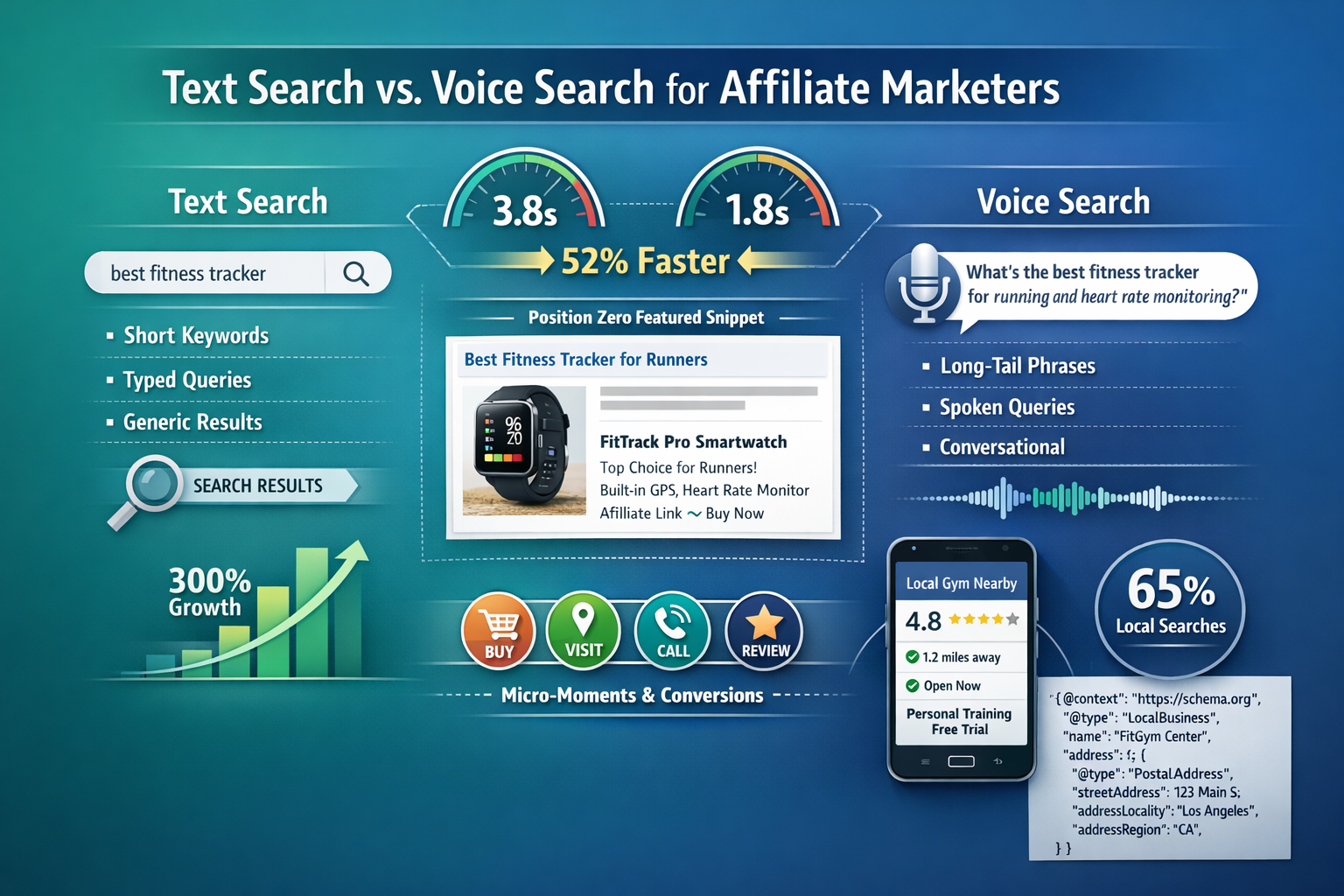
Voice search has experienced explosive 300% growth over the last three years[2], fundamentally changing how consumers discover and purchase products. Unlike traditional typed searches, voice queries are conversational, question-based, and intent-rich. When someone asks their smart speaker "What's the best budget laptop for college students?" they expect immediate, authoritative answers—not a list of blue links to explore.
For affiliates, this creates a unique conversion opportunity. Voice searchers demonstrate higher purchase intent because they're seeking specific solutions rather than browsing generally. The challenge lies in positioning affiliate content to be selected by AI assistants as the definitive answer.
Understanding affiliate marketing fundamentals remains essential, but voice optimization requires additional technical and content strategies that align with how AI processes and delivers information.
How AI Assistants Select Content for Voice Results
AI-powered assistants like Alexa, Siri, Google Assistant, and ChatGPT use sophisticated algorithms to evaluate content quality, relevance, and structure. They prioritize:
- Featured snippets (Position Zero) that directly answer questions
- Fast-loading pages that deliver information instantly
- Structured data that helps AI understand content context
- Natural language that matches conversational query patterns
- Authoritative sources with strong domain credibility
The critical insight: AI assistants don't present multiple options for voice results. They select one answer to read aloud. This winner-takes-all dynamic makes optimization strategy fundamentally different from traditional SEO where ranking on page one still generates traffic.
Structuring Affiliate Content for Voice Discovery
Writing for Conversational Queries vs. Traditional Keywords
Traditional keyword research focused on high-volume search terms like "wireless headphones" or "protein powder." Voice search demands long-tail conversational phrases that mirror natural speech patterns[3].
Traditional approach:
- Target: "best protein powder"
- Search volume: High
- Competition: Intense
Voice-optimized approach:
- Target: "what's the best protein powder for building muscle on a budget?"
- Search volume: Moderate
- Competition: Lower
- Conversion potential: Higher
These longer, more specific phrases often convert better because they capture precise user intent. Someone asking a detailed question is further along the buyer's journey than someone typing generic keywords.
To identify conversational keywords:
- Analyze customer support conversations and social media questions
- Review product reviews for natural language patterns
- Use tools like AnswerThePublic to find question-based queries
- Check "People Also Ask" boxes in Google search results
- Monitor voice search query reports in Google Search Console
Implementing strong search engine optimization techniques provides the foundation, but voice optimization requires specific conversational targeting.
Creating FAQ Sections That AI Assistants Love
Comprehensive FAQ sections have become essential infrastructure for voice search success[3]. AI assistants frequently pull answers directly from well-structured FAQ content because it matches the question-and-answer format of voice queries.
Effective FAQ structure for voice optimization:
| Element | Best Practice | Why It Matters |
|---|---|---|
| Question format | Use exact natural language questions | Matches voice query patterns |
| Answer length | 40-60 words for featured snippets | Optimal for voice reading |
| Schema markup | Implement FAQPage schema | Helps AI identify Q&A structure |
| Question variety | Address multiple query variations | Captures diverse voice searches |
| Depth | Provide comprehensive, accurate answers | Builds authority and trust |
Example FAQ optimized for voice:
Q: What's the best affiliate program for beginners with no money to invest?
A: Amazon Associates is the best affiliate program for beginners with zero investment because it requires no upfront costs, offers millions of products to promote, and provides a trusted brand that converts well. Beginners can start earning 1-10% commissions immediately without website hosting fees by using free platforms like social media or Medium.
This answer format works because it:
- ✅ Directly addresses the conversational question
- ✅ Provides a specific recommendation immediately
- ✅ Explains the reasoning concisely
- ✅ Includes relevant details (commission rates)
- ✅ Fits within optimal length for voice reading
For those exploring how to start affiliate marketing with no money, voice-optimized FAQs create multiple entry points for discovery.
Implementing Schema Markup for Voice Search
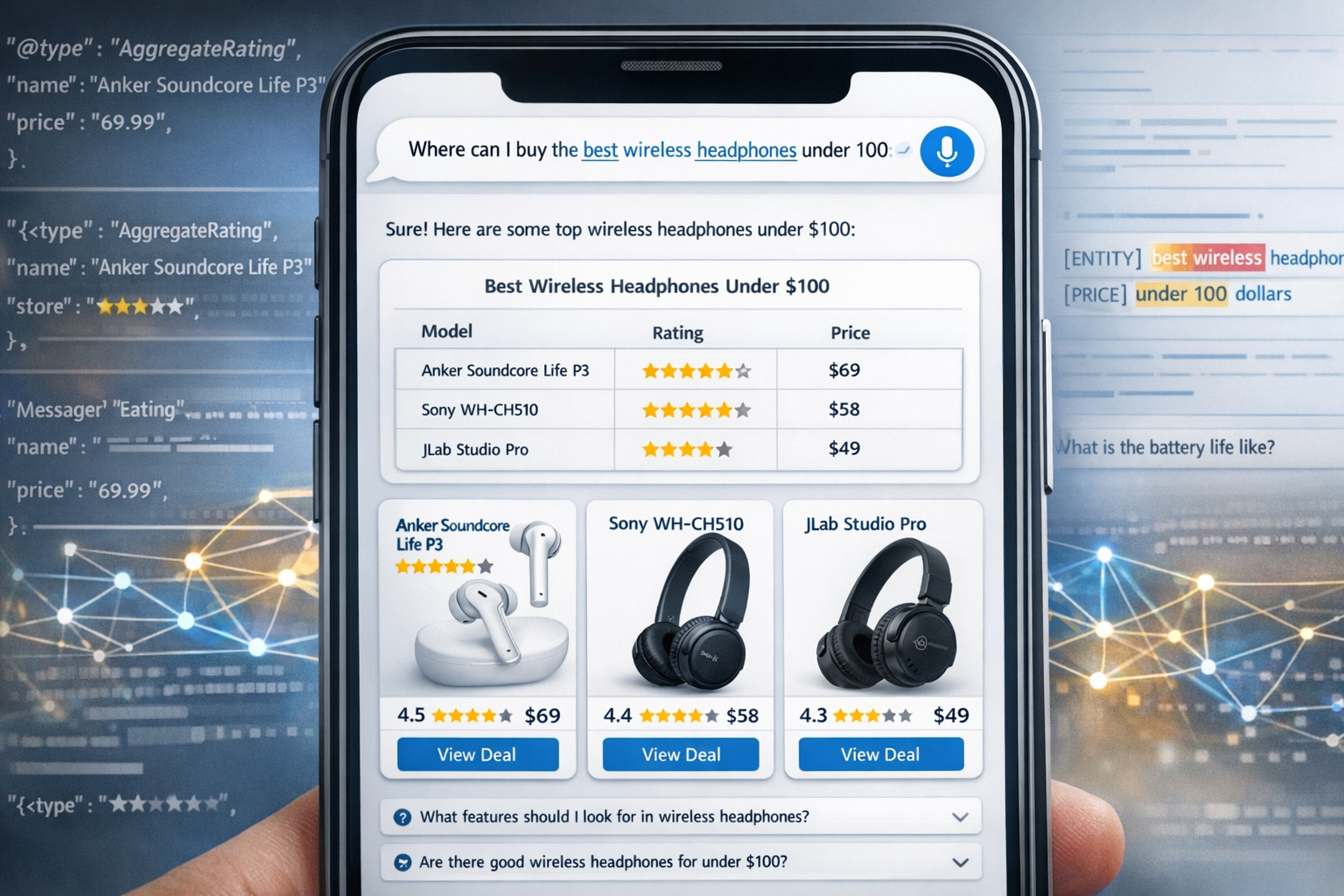
Schema markup is no longer optional—it's foundational infrastructure for voice search consideration[3]. Structured data helps AI assistants understand content context, relationships, and relevance.
Critical schema types for affiliates:
1. FAQPage Schema
Marks up question-and-answer content, making it easily identifiable for voice assistants seeking direct answers.
2. HowTo Schema
Perfect for tutorial content and product guides that answer "how to" voice queries.
3. Product Schema
Essential for e-commerce affiliates, including:
- Product name and description
- Price and availability
- Ratings and reviews
- Brand information
4. Review Schema
Highlights product reviews and ratings, building trust signals for AI recommendation engines.
5. LocalBusiness Schema
Critical for affiliates targeting local markets where 65% of searches now occur via voice[1].
Implementation doesn't require advanced coding skills. Tools like Google's Structured Data Markup Helper, Schema.org, and WordPress plugins (like Rank Math or Yoast SEO) simplify the process.
Verification is crucial: Always test schema implementation using Google's Rich Results Test to ensure proper formatting and avoid errors that could prevent AI recognition.
Building on foundations of SEO for affiliate marketing, schema markup creates the technical layer that makes content accessible to conversational AI.
Optimizing for Position Zero and Featured Snippets
Why Position Zero Dominates Voice Search Results
Position Zero—the featured snippet that appears above traditional search results—has become the only position that matters for voice search[1]. When AI assistants answer voice queries, they read aloud the featured snippet content, bypassing all other results entirely.
This creates a binary outcome: either your content is selected for Position Zero, or it receives zero voice traffic. There's no "ranking #3" in voice search.
Featured snippet formats that work for voice:
- Paragraph snippets (40-60 words answering specific questions)
- List snippets (numbered steps or bulleted points)
- Table snippets (comparison data or specifications)
- Video snippets (with transcripts for voice extraction)
Strategies to Capture Featured Snippets
Winning featured snippets requires strategic content structuring:
1. Identify snippet opportunities
Use tools like SEMrush, Ahrefs, or Moz to find keywords where competitors hold featured snippets. These represent immediate opportunities for displacement.
2. Answer questions directly and concisely
Place clear, definitive answers immediately after question-formatted headings. Don't bury the answer in lengthy paragraphs.
3. Use strategic heading hierarchy
Structure content with H2 questions and immediate H3 or paragraph answers that AI can easily extract.
4. Optimize answer length
Featured snippet paragraphs typically contain 40-60 words—concise enough for voice reading but comprehensive enough to be valuable.
5. Include supporting context
While the answer should be concise, surrounding content should provide depth and authority that signals expertise to AI algorithms.
6. Format for scannability
Use bold text, bullet points, and numbered lists that AI can easily parse and extract.
Affiliates who master how to succeed in affiliate marketing increasingly recognize featured snippet optimization as a core competitive advantage.
Technical Optimization for Voice Search Speed
The 52% Speed Advantage
Voice search results load approximately 52% faster than traditional web pages[1][3]. This isn't coincidental—it's a requirement. AI assistants prioritize fast-loading content because voice users expect instant answers, not loading delays.
Even a half-second delay can cause AI assistants to bypass your content entirely, selecting faster alternatives instead.
Critical speed optimizations for voice search:
🚀 Image optimization
- Compress images to 100KB or less
- Use next-gen formats (WebP, AVIF)
- Implement lazy loading
- Specify image dimensions in HTML
⚡ Code efficiency
- Minify CSS, JavaScript, and HTML
- Eliminate render-blocking resources
- Reduce server response time to under 200ms
- Use browser caching effectively
📱 Mobile performance
- Prioritize mobile-first design
- Eliminate intrusive interstitials
- Optimize for 3G and 4G networks
- Test with Google's Mobile-Friendly Test
🌐 Hosting and CDN
- Use fast, reliable hosting providers
- Implement Content Delivery Networks (CDN)
- Enable HTTP/2 or HTTP/3
- Optimize database queries
Measurement tools:
- Google PageSpeed Insights
- GTmetrix
- WebPageTest
- Chrome DevTools Lighthouse
For affiliates working on Google Sites search engine optimization, platform-specific speed limitations require careful workarounds and optimization strategies.
Natural Language Offer Phrasing for Conversions
Matching Voice Search Intent
Voice searches carry distinct intent patterns that require adapted affiliate messaging:
Informational intent:
"How does protein powder help build muscle?"
→ Content focus: Educational guides with soft product recommendations
Navigational intent:
"Where can I buy Optimum Nutrition Gold Standard whey?"
→ Content focus: Direct purchase links with price comparisons
Transactional intent:
"What's the best price for wireless noise-canceling headphones?"
→ Content focus: Price comparison tables with affiliate links
Commercial investigation:
"Which protein powder is better for beginners, whey or plant-based?"
→ Content focus: Comparison reviews with clear recommendations
Crafting Conversational Calls-to-Action
Traditional CTAs like "Click here" or "Buy now" don't align with voice search behavior. Voice-optimized CTAs use natural language that flows conversationally:
❌ Traditional: "Click the link below to purchase"
✅ Voice-optimized: "You can find this product at Amazon, where it currently has over 10,000 five-star reviews and qualifies for Prime shipping"
❌ Traditional: "Check out our top pick"
✅ Voice-optimized: "Based on extensive testing, the [Product Name] offers the best combination of performance and value for most users"
The voice-optimized versions work because they:
- Provide context and reasoning
- Sound natural when read aloud
- Include trust signals (reviews, testing)
- Guide action without aggressive sales language
E-Commerce Voice Search Strategy for Affiliates
Product Content Optimization
E-commerce affiliates must create detailed product descriptions that answer common voice queries[3]:
Essential product content elements:
- Comprehensive specifications (AI assistants pull technical details)
- Use case scenarios ("best for college students," "ideal for small apartments")
- Price context (budget, mid-range, premium positioning)
- Availability information (in stock, shipping timeframes)
- Comparison context (how it differs from alternatives)
Product schema implementation:
{
  "@context": "https://schema.org/",
  "@type": "Product",
  "name": "Wireless Noise-Canceling Headphones",
  "description": "Premium over-ear headphones with active noise cancellation",
  "brand": {
    "@type": "Brand",
    "name": "Brand Name"
  },
  "offers": {
    "@type": "Offer",
    "price": "299.99",
    "priceCurrency": "USD",
    "availability": "https://schema.org/InStock"
  },
  "aggregateRating": {
    "@type": "AggregateRating",
    "ratingValue": "4.7",
    "reviewCount": "12847"
  }
}
Optimizing for "Where Can I Buy" Queries
Voice searches frequently include location and availability queries:
- "Where can I buy [product] near me?"
- "What's the best price for [product]?"
- "Is [product] available at [retailer]?"
Optimization strategies:
📍 Include retailer information
Mention specific retailers where products are available, with affiliate links to each option.
💰 Provide price comparisons
Create tables comparing prices across multiple retailers (all with affiliate links).
⏱️ Address availability
Include current stock status and shipping timeframes when possible.
🏆 Highlight best value
Clearly state which option offers the best overall value and why.
Affiliates exploring high ticket affiliate marketing opportunities can leverage voice search to capture premium product queries where commissions are substantially higher.
Mobile Voice Search Optimization
The 60% Mobile Voice Search Reality
Nearly 60% of smartphone users rely on voice search to find information about brands and businesses while on the go[1]. This mobile dominance means voice optimization and mobile optimization are inseparable.
Mobile voice search characteristics:
- Performed in micro-moments (immediate need)
- Often location-based ("near me" queries)
- Expect instant, actionable answers
- Frequently lead to same-day conversions
- Require thumb-friendly navigation
Mobile optimization checklist:
✅ Responsive design that adapts to all screen sizes
✅ Touch-friendly buttons and links (minimum 48×48 pixels)
✅ Readable text without zooming (16px minimum)
✅ Fast loading on mobile networks (under 3 seconds)
✅ Simplified navigation with minimal clicks
✅ Click-to-call functionality for phone numbers
✅ Mobile-optimized forms (minimal fields)
Local Voice Search for Affiliates
The 65% of local searches now performed via voice[1] creates opportunities for affiliates targeting geographic markets:
Local optimization strategies:
- Create location-specific content ("Best [product] in [city]")
- Implement LocalBusiness schema with accurate NAP (Name, Address, Phone)
- Optimize Google Business Profile (if applicable)
- Include local landmarks and context in content
- Target "near me" query variations
Even online-only affiliates can leverage local intent by creating city-specific buying guides, local price comparisons, and regional product recommendations.
Measuring Voice Search Performance
Key Metrics to Track
Voice search requires adapted analytics approaches:
Primary metrics:
📊 Featured snippet ownership
Track which keywords you hold Position Zero for using SEMrush, Ahrefs, or Moz.
🎯 Question-based keyword rankings
Monitor rankings specifically for question-formatted queries (who, what, where, when, why, how).
⚡ Page speed scores
Track Core Web Vitals and overall page speed consistently.
📱 Mobile traffic percentage
Monitor mobile traffic growth as indicator of voice search adoption.
🔍 Zero-click search rate
Track queries where your content appears in featured snippets but doesn't generate clicks (voice result served directly).
Google Search Console insights:
Filter queries by question words to identify voice search traffic patterns. Look for:
- Query length (voice searches average 3-5 words longer)
- Question formats
- Conversational language patterns
- Mobile vs. desktop distribution
Advanced Voice Search Strategies
Leveraging AI-Powered Content Creation
AI tools can help identify and optimize for voice search opportunities:
Strategic AI applications:
- Query expansion: Generate conversational variations of target keywords
- FAQ development: Create comprehensive question sets based on topic analysis
- Answer optimization: Refine answers to fit optimal featured snippet length
- Schema generation: Automate structured data creation
- Content gap analysis: Identify missing voice search opportunities
Voice Search and Conversational AI Platforms
Beyond traditional voice assistants, conversational AI platforms like ChatGPT, Claude, and Perplexity are becoming product discovery channels:
Optimization for AI chatbots:
- Create authoritative, comprehensive content that AI can reference
- Include clear product recommendations with reasoning
- Provide up-to-date information (AI models value recency)
- Structure content logically for easy extraction
- Build domain authority through quality backlinks
These platforms increasingly cite sources when answering product questions, creating new affiliate traffic opportunities for well-optimized content.
Common Voice Search Optimization Mistakes
Pitfalls to Avoid
❌ Keyword stuffing with question phrases
Natural language is essential—awkward, over-optimized content gets rejected by AI.
❌ Ignoring page speed
Even great content won't rank for voice if it loads slowly.
❌ Skipping schema implementation
Structured data is foundational, not optional.
❌ Creating thin FAQ content
Brief, unhelpful answers won't win featured snippets.
❌ Neglecting mobile optimization
Voice search is predominantly mobile—desktop-only optimization fails.
❌ Focusing only on high-volume keywords
Long-tail conversational phrases often convert better despite lower volume.
❌ Not tracking position zero performance
You can't optimize what you don't measure.
Conclusion
Voice Search Optimization for Affiliates: Capturing Conversions in Conversational AI Interfaces represents the most significant evolution in affiliate marketing since mobile-first indexing. With over 65% of local searches now performed via voice and adoption growing 300% over three years, affiliates who master conversational optimization gain substantial competitive advantages.
The path forward requires:
🎯 Strategic content restructuring around natural language questions and conversational query patterns
⚡ Technical excellence with 52% faster page speeds and comprehensive schema markup implementation
🏆 Position Zero focus through featured snippet optimization that captures the only position AI assistants read aloud
📱 Mobile-first design that serves the 60% of voice searches performed on smartphones
💡 Continuous adaptation as AI assistants and conversational platforms evolve
Immediate action steps:
- Audit existing content for voice search readiness using the strategies outlined above
- Implement FAQPage schema on your highest-traffic affiliate content
- Optimize page speed to meet the 52% faster threshold required for voice consideration
- Create conversational FAQ sections targeting question-based keywords in your niche
- Monitor featured snippet opportunities and systematically capture Position Zero rankings
- Test mobile voice search for your target keywords to understand current user experience
The affiliates who thrive in 2026 and beyond will be those who recognize that voice search isn't a future trend—it's the current reality reshaping how consumers discover, evaluate, and purchase products. By implementing the voice optimization strategies detailed in this guide, you position yourself to capture high-intent conversions at the exact micro-moment when consumers need solutions.
Start with one high-value piece of content, apply these voice optimization principles, and measure the results. Then scale the approach across your entire affiliate portfolio. The conversational AI revolution is here—and it's time to ensure your affiliate content is ready to be heard.
References
[1] New 2026 Consumer Search Report Voice Ai Reshapes Local Search And Digital Marketing Intent – https://www.einpresswire.com/article/893712291/new-2026-consumer-search-report-voice-ai-reshapes-local-search-and-digital-marketing-intent
[2] Optimizing Voice Ai Search – https://www.affilorama.com/optimizing-voice-ai-search
[3] Voice Search Seo 2026 Complete Guide – https://almcorp.com/blog/voice-search-seo-2026-complete-guide/
[4] Voice Search Seo – https://improvado.io/blog/voice-search-seo