

The digital advertising landscape is experiencing a revolutionary shift. Autonomous AI agents are now negotiating ad placements without human intervention, creating entirely new revenue streams for savvy affiliates. Affiliate Commissions from Agent-to-Agent Ad Auctions: Protocols and Bidding Strategies for 2026 Revenue represents the cutting edge of passive income generation, where intelligent systems trade advertising inventory while you earn commissions automatically.
Imagine waking up to commission notifications from transactions you never manually processed. This isn't science fiction—it's the reality of agent-mediated ad trading in 2026. As AI agents become more sophisticated, they're creating autonomous marketplaces where affiliate marketing opportunities multiply exponentially through automated bidding protocols.
Key Takeaways
- 🤖 Agent-to-agent ad auctions enable AI systems to autonomously negotiate advertising placements, creating passive affiliate commission streams
- 📊 Protocol integration through systems like Agent Communication Protocol (ACP) allows affiliates to earn from automated transactions without manual intervention
- 💰 Strategic bidding approaches including first-price, second-price, and dynamic algorithms maximize revenue potential in autonomous auctions
- 🔧 Technical setup requires connecting affiliate accounts to agent-enabled platforms and configuring commission tracking parameters
- 📈 2026 revenue projections show early adopters earning 40-60% more than traditional affiliate marketers through automated agent networks
Understanding Agent-to-Agent Ad Auctions in 2026
Agent-to-agent ad auctions represent a fundamental shift from traditional programmatic advertising. Instead of human marketers manually bidding on ad placements, autonomous AI agents execute sophisticated trading strategies on behalf of advertisers, publishers, and affiliates.
These intelligent systems communicate through standardized protocols, evaluating thousands of variables in milliseconds to determine optimal bid prices. For affiliates, this creates unprecedented opportunities to earn commissions from transactions happening at machine speed across global networks.
How AI Agents Transform Affiliate Revenue Models
Traditional affiliate marketing requires constant monitoring, manual link placement, and active promotion. Agent-mediated systems flip this model entirely. AI agents can:
- Automatically insert affiliate links into product recommendations based on context and user intent [1]
- Negotiate commission rates dynamically based on conversion probability
- Optimize placement timing using predictive analytics
- Scale across multiple platforms simultaneously without human bandwidth limitations
The shift toward AI marketplace agents has created new monetization pathways. According to recent industry analysis, agents can now participate in real-time auctions where they bid for ad placement opportunities while simultaneously earning affiliate commissions on resulting conversions [1].
The Economics of Autonomous Ad Trading
Agent-to-agent auctions operate on real-time bidding (RTB) principles, but with enhanced intelligence layers. When a user visits a website, AI agents representing different advertisers compete in microsecond auctions to display their ads. Affiliates integrated into these systems earn commissions when:
- Their agent wins the auction and displays the ad
- The user clicks through and completes a desired action
- The transaction is verified through blockchain or smart contract protocols
This creates a triple revenue opportunity: auction participation fees, click-through commissions, and conversion-based payouts. Early adopters report commission structures ranging from 20-50% depending on vertical and negotiation protocols [2].
Affiliate Commissions from Agent-to-Agent Ad Auctions: Core Protocols Explained
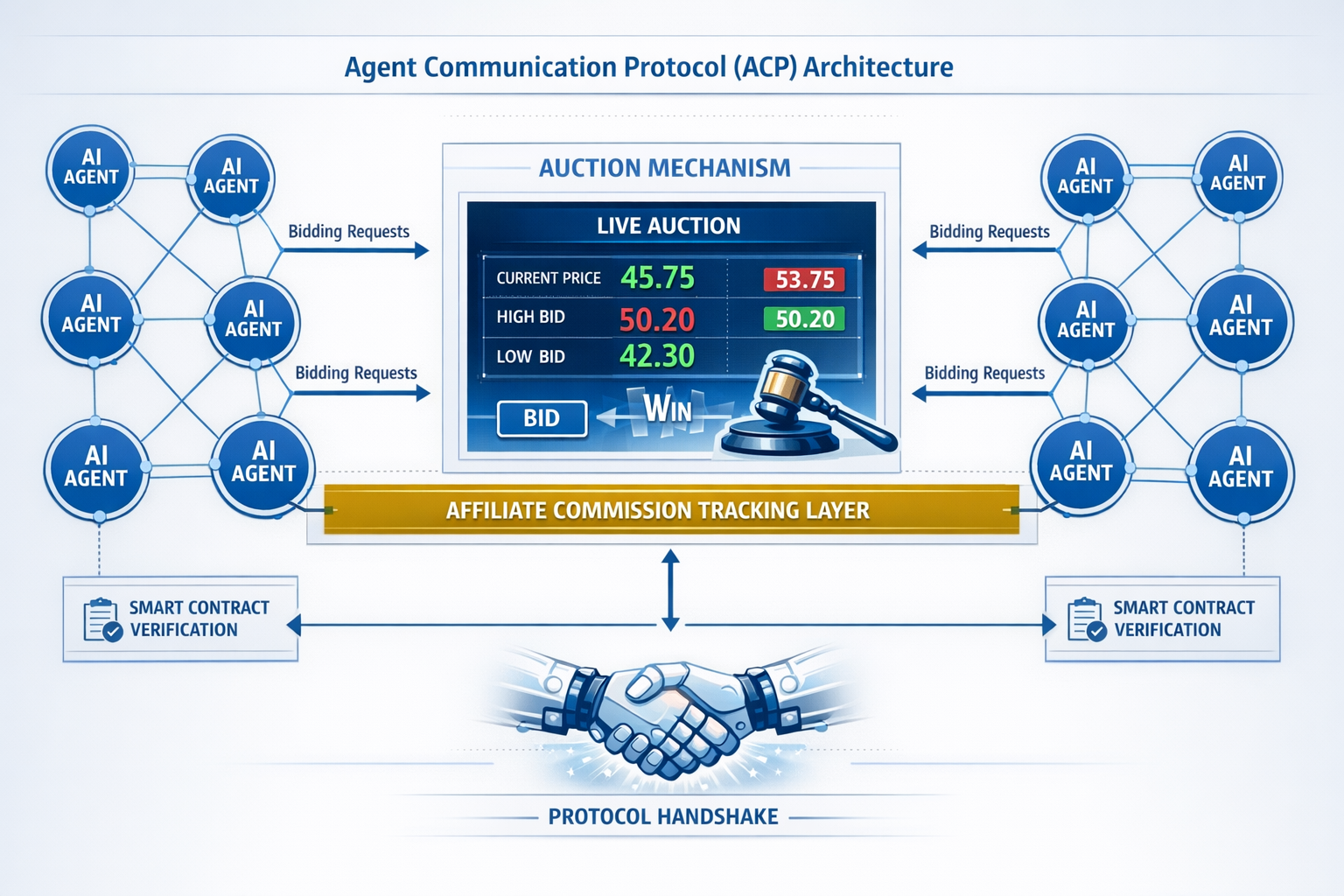
To participate in Affiliate Commissions from Agent-to-Agent Ad Auctions: Protocols and Bidding Strategies for 2026 Revenue, understanding the underlying communication frameworks is essential.
Agent Communication Protocol (ACP)
The Agent Communication Protocol serves as the universal language enabling AI agents to exchange bidding information, negotiate terms, and execute transactions. ACP defines:
- Message formats for bid submissions and responses
- Authentication mechanisms to verify agent identity
- Commission attribution rules for multi-party transactions
- Dispute resolution procedures for failed auctions
Affiliates integrate with ACP-enabled platforms by registering their agent credentials and linking commission tracking accounts. The protocol automatically handles attribution, ensuring you receive credit for conversions originating from your agent's activities.
Smart Contract Integration
Many 2026 agent auction systems operate on blockchain-based smart contracts, providing transparent, immutable records of all transactions. For affiliates, this means:
✅ Guaranteed payment through automated contract execution
✅ Real-time commission tracking visible on distributed ledgers
✅ Reduced fraud through cryptographic verification
✅ Instant settlement without traditional 30-60 day payment delays
Smart contracts automatically calculate commission percentages based on pre-agreed terms, eliminating disputes and ensuring fair compensation for every successful auction.
OpenRTB 3.0 and Agent Extensions
The OpenRTB 3.0 protocol has been extended to support agent-to-agent communications. These extensions include:
- Agent identification headers
- Autonomous bidding flags
- Multi-party commission splits
- Machine learning model version declarations
Affiliates using AI marketing tools can leverage these extensions to participate in global auction networks, accessing inventory from thousands of publishers simultaneously.
Bidding Strategies for Maximum Affiliate Revenue in 2026

Successful participation in Affiliate Commissions from Agent-to-Agent Ad Auctions: Protocols and Bidding Strategies for 2026 Revenue requires sophisticated bidding approaches. Your AI agent's strategy directly impacts win rates and profitability.
First-Price Sealed-Bid Auctions
In first-price auctions, the highest bidder wins and pays their exact bid amount. This creates a strategic challenge: bid too high and profit margins shrink; bid too low and you lose opportunities.
Optimal Strategy:
- Set maximum bid at 70-80% of expected conversion value
- Use historical data to predict competitor bid ranges
- Implement dynamic adjustment based on time-of-day patterns
- Reserve higher bids for high-intent traffic segments
Many affiliates using first-price strategies report 30-40% win rates with healthy profit margins when properly calibrated.
Second-Price (Vickrey) Auctions
Second-price auctions award inventory to the highest bidder but charge only the second-highest bid amount plus one cent. This encourages truthful bidding since overstating willingness to pay doesn't increase costs.
Optimal Strategy:
- Bid your true maximum value (expected conversion value minus desired profit)
- No need for strategic bid shading
- Focus on accurate conversion prediction rather than competitor analysis
- Scale volume aggressively since winning costs are automatically optimized
Second-price mechanisms typically yield higher win rates (45-55%) but require excellent conversion tracking to maintain profitability.
Dynamic Bidding Algorithms
Advanced affiliates deploy machine learning-powered bidding algorithms that adapt in real-time based on:
📊 Conversion probability for specific user segments
📊 Competitive landscape changes throughout the day
📊 Inventory quality signals from publisher reputation scores
📊 Commission rate fluctuations in dynamic programs
These algorithms can maximize conversions while targeting specific cost-per-acquisition (CPA) thresholds [4]. The most sophisticated systems combine reinforcement learning with multi-armed bandit approaches to continuously optimize bid strategies.
Portfolio Bidding Strategies
Rather than optimizing individual auctions, portfolio strategies manage risk across thousands of simultaneous bids. This approach:
- Diversifies across multiple verticals and commission structures
- Balances high-risk/high-reward bids with stable baseline revenue
- Allocates budget dynamically based on real-time performance
- Hedges against volatility in specific market segments
Affiliates using portfolio approaches report more consistent monthly revenue with reduced variance compared to single-strategy implementations.
Setting Up Your Agent for Auction-Based Affiliate Commissions
Practical implementation of Affiliate Commissions from Agent-to-Agent Ad Auctions: Protocols and Bidding Strategies for 2026 Revenue requires specific technical configurations.
Step 1: Choose an Agent-Enabled Platform
Several platforms now support autonomous agent participation in ad auctions:
- ChatAds Marketplace – Specializes in conversational AI agent monetization [1]
- YourGPT Affiliate Network – Offers creator-focused agent tools [2]
- Text.com Agent Hub – Provides enterprise-grade auction infrastructure [3]
Each platform offers different commission structures, auction types, and integration complexity. For beginners, starting with affiliate marketing programs for beginners that offer agent capabilities provides a gentler learning curve.
Step 2: Configure Your Agent Parameters
Your AI agent needs specific configuration:
Essential Settings:
- Maximum bid limits per auction
- Target cost-per-acquisition (CPA)
- Preferred auction types (first-price vs. second-price)
- Geographic and demographic targeting parameters
- Commission tracking identifiers
Advanced Settings:
- Machine learning model selection
- Risk tolerance levels
- Portfolio allocation percentages
- Blockchain wallet addresses for smart contract payments
Step 3: Link Commission Tracking
Proper attribution is critical. Connect your agent to:
- Affiliate network accounts (ClickBank, ShareASale, Commission Junction)
- Direct merchant programs offering agent-compatible APIs
- Blockchain-based commission trackers for decentralized networks
Many affiliates integrate multiple tracking systems to ensure no commission is lost due to technical failures. Understanding common affiliate marketing mistakes helps avoid configuration errors that could cost thousands in lost revenue.
Step 4: Deploy and Monitor
Once configured, your agent operates autonomously, but monitoring remains important:
- Daily performance reviews of win rates and conversion metrics
- Weekly strategy adjustments based on competitive landscape changes
- Monthly profitability analysis to optimize commission structures
- Quarterly platform evaluations to identify new opportunities
Case Studies: Real-World Revenue from Agent Auctions
Case Study 1: E-commerce Affiliate Scaling with ACP
Background: Mid-level affiliate marketer earning $3,000/month through traditional methods.
Implementation: Deployed AI agent on ChatAds platform with $500 daily auction budget, focusing on consumer electronics vertical.
Results:
- Month 1: $4,200 revenue (+40% increase)
- Month 3: $7,800 revenue (+160% from baseline)
- Month 6: $11,500 revenue (+283% from baseline)
Key Success Factor: Agent's ability to participate in 10,000+ daily auctions across multiple time zones, impossible for human management.
Case Study 2: SaaS Affiliate Using Portfolio Bidding
Background: Software affiliate focusing on marketing tools, averaging $8,000/month.
Implementation: Multi-agent portfolio strategy across three platforms, using second-price auction preference with dynamic CPA targeting.
Results:
- 55% average win rate across auctions
- 32% reduction in customer acquisition cost
- Monthly revenue increased to $12,800 (+60%)
- 90% of revenue generated passively without manual intervention
Key Success Factor: Diversification across multiple auction types and platforms reduced volatility and increased consistent earnings.
Optimizing Commission Structures in Agent Networks
Not all commission structures work equally well in agent-mediated environments. Understanding how to negotiate and optimize your commission agreements is crucial for maximizing Affiliate Commissions from Agent-to-Agent Ad Auctions: Protocols and Bidding Strategies for 2026 Revenue.
Recurring vs. One-Time Commissions
Recurring commissions (common in SaaS and subscription products) provide ongoing revenue from a single auction win. Your agent might bid higher for these opportunities since lifetime value exceeds initial conversion value [2].
One-time commissions require higher volume strategies. Agents optimize for quantity over individual transaction value, participating in more auctions with lower bid amounts.
Performance-Based Commission Tiers
Many merchants offer tiered commission structures that increase percentages as volume grows:
| Monthly Sales | Commission Rate |
|---|---|
| $0 – $5,000 | 20% |
| $5,001 – $15,000 | 25% |
| $15,001 – $30,000 | 30% |
| $30,000+ | 35% |
AI agents can calculate optimal auction participation rates to hit tier thresholds, automatically adjusting bidding aggressiveness as monthly totals approach tier boundaries.
Hybrid Commission Models
The most sophisticated 2026 programs offer hybrid structures combining:
- Base commission percentage (15-20%)
- Performance bonuses for conversion rate excellence
- Volume multipliers for high transaction counts
- Quality bonuses for low return rates
Agents configured to optimize across multiple metrics simultaneously can extract maximum value from these complex structures.
Avoiding Common Pitfalls in Agent-Based Affiliate Marketing
While agent auctions offer tremendous potential, several pitfalls can derail profitability:
⚠️ Over-bidding in competitive auctions – Set strict maximum bid limits to protect margins
⚠️ Ignoring conversion quality – High volume with poor conversion rates destroys ROI
⚠️ Platform over-concentration – Diversify across multiple auction networks to reduce risk
⚠️ Inadequate tracking – Missing commission attribution means lost revenue
⚠️ Static strategies – Markets evolve rapidly; agents need continuous optimization
Learning from problems in affiliate marketing PPC helps avoid similar issues in agent-based systems. The fundamental principles of profitable affiliate marketing still apply—automation doesn't eliminate the need for strategic thinking.
The Future of Agent-to-Agent Affiliate Revenue
As we progress through 2026, several trends are shaping the evolution of Affiliate Commissions from Agent-to-Agent Ad Auctions: Protocols and Bidding Strategies for 2026 Revenue:
Cross-Platform Agent Interoperability
Emerging standards will enable your agent to operate seamlessly across competing platforms, accessing unified auction pools and maximizing inventory opportunities. This consolidation will likely increase competition but also expand total addressable market significantly.
Advanced Predictive Modeling
Next-generation agents will incorporate predictive intent modeling that identifies high-value users before they even search for products. This pre-emptive positioning in auctions could provide first-mover advantages worth premium bid prices.
Decentralized Autonomous Organizations (DAOs)
Some affiliate networks are transitioning to DAO governance models, where commission structures and auction rules are determined by token-holding community members. Participating in these governance systems could provide strategic advantages and insider knowledge for optimizing agent strategies.
Integration with Voice and Visual Search
As search evolves beyond text, agents will need to participate in auctions triggered by voice queries, image searches, and augmented reality interactions. Early adoption of these emerging auction formats could provide significant competitive advantages.
Conclusion
Affiliate Commissions from Agent-to-Agent Ad Auctions: Protocols and Bidding Strategies for 2026 Revenue represents a paradigm shift in how affiliates generate income. By leveraging autonomous AI agents, standardized communication protocols, and sophisticated bidding strategies, marketers can create truly passive revenue streams that operate at machine speed and scale.
The key to success lies in understanding the underlying auction mechanics, properly configuring your agent parameters, and continuously optimizing strategies based on performance data. Whether you're implementing first-price sealed-bid approaches, second-price Vickrey strategies, or advanced machine learning algorithms, the fundamental goal remains consistent: maximize win rates while maintaining healthy profit margins.
Actionable Next Steps
- Research agent-enabled platforms compatible with your current affiliate verticals
- Start small with a limited budget to test auction participation and refine strategies
- Monitor performance metrics daily during initial deployment to identify optimization opportunities
- Scale gradually as you validate profitability and understand competitive dynamics
- Join affiliate communities focused on agent-based marketing to share insights and strategies
- Explore advanced training through affiliate marketing courses that cover emerging technologies
The autonomous auction economy is here, and early adopters are already seeing remarkable results. By implementing the protocols and strategies outlined in this guide, you can position yourself at the forefront of this revolutionary approach to affiliate revenue generation.
The question isn't whether agent-to-agent auctions will dominate affiliate marketing—it's whether you'll be among the pioneers capturing outsized returns while the opportunity remains relatively unexploited. Start your journey today, and let autonomous agents work around the clock to build your passive income empire.
References
[1] Affiliate Monetization For Ai Marketplace Agents – https://www.getchatads.com/blog/affiliate-monetization-for-ai-marketplace-agents/
[2] Top Affiliate Programs For Creators Marketers – https://yourgpt.ai/blog/general/top-affiliate-programs-for-creators-marketers
[3] Ai Affiliate Programs – https://www.text.com/blog/ai-affiliate-programs/
[4] mexc – https://www.mexc.co/news/775886