

The affiliate marketing landscape is experiencing a seismic shift in 2026. While marketers once spent hours toggling between analytics dashboards, campaign managers, and segmentation tools, a new generation of agentic AI systems is taking control of entire campaign lifecycles—from initial strategy to final media buys. These autonomous orchestrators, led by platforms like Zeta Athena, are transforming how affiliates optimize commissions without constant manual oversight.
Agentic AI Campaign Orchestrators: How Affiliates Can Leverage Autonomous Systems Like Zeta Athena for End-to-End Commission Optimization in 2026 represents more than just another marketing automation tool. These systems employ multiple specialized AI agents working in concert to analyze data, recommend actions, and execute optimizations autonomously—delivering results that were previously impossible without dedicated teams.
Key Takeaways
- 🤖 Agentic AI systems like Zeta Athena use multiple specialized agents working together to handle complete campaign lifecycles autonomously
- 📊 Real-world results show 50% reduction in cost-per-customer acquisition through AI-driven optimization capabilities
- 🚀 General availability launches end of Q1 2026, with beta access already demonstrating 25-fold increase in AI-agent activity
- 💡 Natural language interfaces replace traditional dashboard workflows, allowing affiliates to manage campaigns conversationally
- 🎯 Three-agent architecture (Insights, Advisor, Attribution) creates continuous optimization feedback loops for commission maximization
Understanding Agentic AI Campaign Orchestrators in 2026
What Makes Systems "Agentic"?
Traditional marketing automation follows pre-programmed rules. Agentic AI systems fundamentally differ by employing autonomous agents capable of independent decision-making, goal pursuit, and adaptive learning. According to recent industry data, 72% of companies now adopt AI in at least one business function—up dramatically from 55% in 2023[1].
These orchestrators don't simply execute commands. They:
- Analyze campaign performance across multiple channels simultaneously
- Identify optimization opportunities humans might miss
- Execute changes autonomously based on real-time data
- Learn from outcomes to improve future decisions
- Communicate findings through natural language interfaces
For affiliate marketers looking to scale their operations, this represents a paradigm shift from manual campaign management to strategic oversight.
The Zeta Athena Architecture
Announced at CES Las Vegas on January 5, 2026, Zeta Global's partnership with OpenAI positions Athena as the leading example of agentic campaign orchestration[1]. The system sits atop the Zeta Marketing Cloud as a "superintelligent" agent layer that collapses traditional workflows into conversational interactions[2].
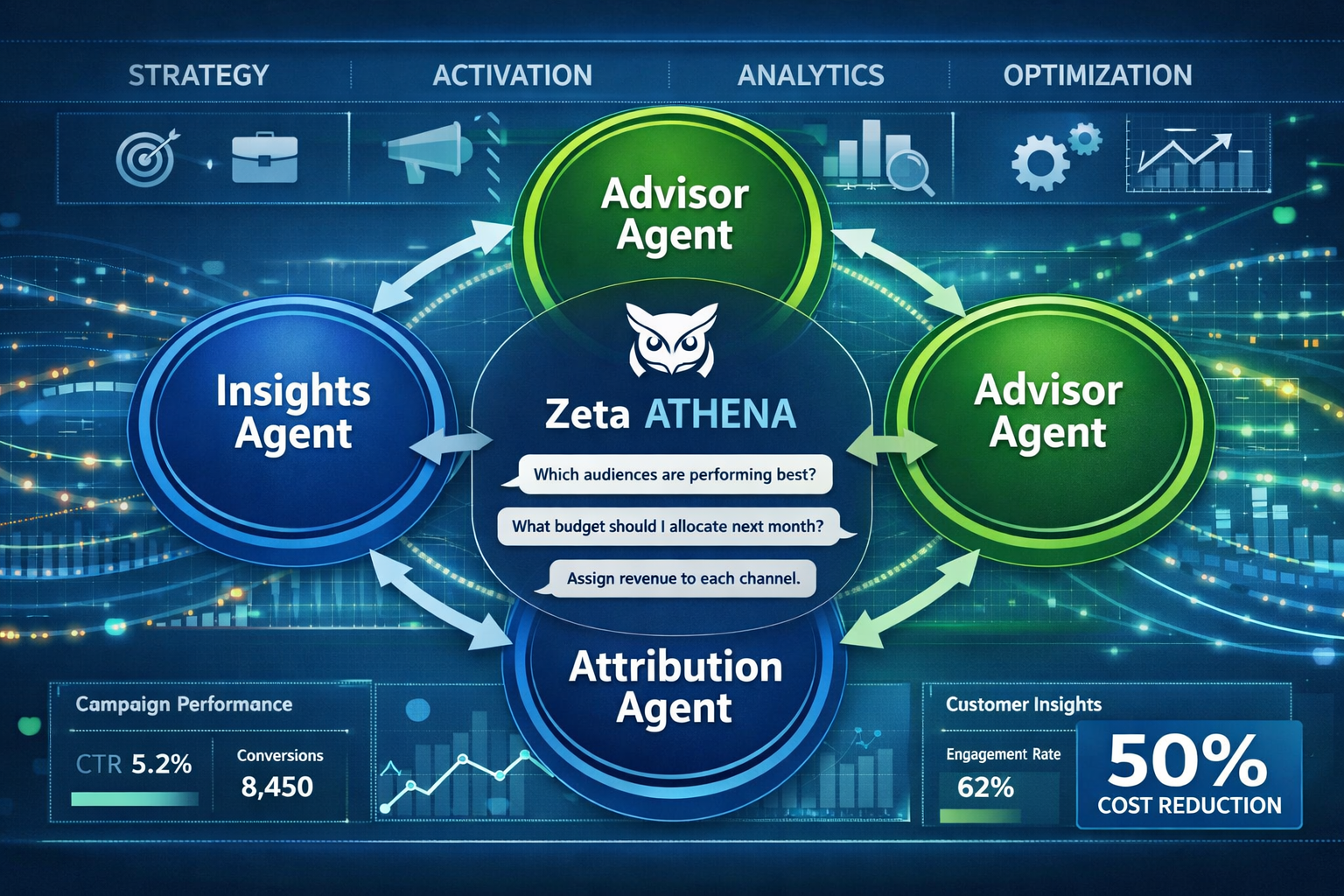
Athena employs three specialized AI agents working in real-time coordination:
| Agent Type | Primary Function | Affiliate Application |
|---|---|---|
| Insights Agent | Conversational analytics with trend identification | Discover which products/offers resonate with specific audience segments |
| Advisor Agent | Goal-driven optimization with action recommendations | Receive automated suggestions for bid adjustments and creative variations |
| Attribution Agent | Real-time performance tracking and feedback loops | Understand exactly which touchpoints drive commissions |
This three-agent system creates continuous optimization feedback loops[3]. The Attribution Agent informs the other two agents what worked, enabling them to refine strategies automatically—a critical capability for affiliates managing multiple programs simultaneously.
How Affiliates Can Leverage Autonomous Systems for Commission Optimization
Replacing Manual Campaign Management
Traditional affiliate workflows require constant monitoring: checking conversion rates, adjusting bids, testing creative variations, and analyzing traffic sources. Agentic AI Campaign Orchestrators eliminate this manual burden through autonomous operation.
During the Black Friday/Cyber Monday 2025 period, Zeta reported a 153% year-over-year increase in platform usage and a 25-fold climb in AI-agent activity[1]. This surge demonstrates how affiliates increasingly rely on autonomous systems during high-stakes promotional periods when manual management becomes overwhelming.
For those exploring best affiliate marketing programs for beginners, agentic systems lower the expertise barrier by handling complex optimization tasks automatically.
Conversational Interface Benefits
Rather than navigating multiple dashboards, affiliates can now interact with campaigns using natural language queries:
- "Which traffic sources generated the highest ROI last week?"
- "Optimize my budget allocation across all active campaigns"
- "Show me audience segments most likely to convert on high-ticket offers"
- "What creative variations should I test next?"
The system processes these requests, analyzes relevant data, and either provides insights or executes actions autonomously[2]. This conversational approach dramatically reduces the time between identifying opportunities and capitalizing on them.
Real-World Performance Metrics
Zeta has demonstrated clients achieving 50% reduction in cost-per-customer acquisition through Athena's optimization capabilities[3]. For affiliate marketers operating on commission-based models, this translates directly to:
✅ Higher profit margins on existing traffic
✅ Ability to compete in more expensive traffic channels
✅ Faster scaling without proportional increases in management time
✅ Better attribution of commissions to specific marketing activities
These improvements stem from the system's ability to process vastly more data points and execute optimizations faster than human operators—a key advantage when succeeding in affiliate marketing requires constant adaptation.
Practical Integration Tactics for Affiliates in 2026
Starting with Beta Access and Early Adoption
With general availability targeted for end of Q1 2026 (by March 31, 2026), affiliates should position themselves for early access[1][4]. Zeta has already expanded beta access for Athena's Insights and Advisor applications, allowing select users to test capabilities before widespread release.
Action steps for early adoption:
- Evaluate current MarTech stack compatibility with agentic systems
- Identify highest-value campaigns where autonomous optimization would deliver maximum impact
- Request beta access through Zeta or similar platform providers
- Establish baseline metrics before implementation for accurate ROI measurement
- Start with limited deployment on 1-2 campaigns to validate results
For affiliates leveraging AI marketing tools, integration with existing systems becomes crucial for seamless operation.
Overcoming Common Deployment Obstacles
Despite surging adoption, primary deployment obstacles persist[1]:
- Siloed proofs of concept that don't integrate with broader workflows
- Fragmented functions across different marketing channels
- Choice overload from dozens of AI tool entry points
- Insufficient data quality undermining AI performance
"The key differentiator isn't just AI power—it's enterprise-grade governance, trust, and transparency. Large brands need explainability and data governance compliance before they'll fully commit to autonomous systems." — Industry Analysis[2]
Affiliates can address these challenges by:
🔧 Consolidating data sources into unified customer profiles
🔧 Establishing clear governance policies for AI decision-making boundaries
🔧 Starting with high-quality data from proven traffic sources
🔧 Implementing gradual automation rather than immediate full autonomy
Maximizing ROI Without Constant Oversight
The ultimate value proposition of Agentic AI Campaign Orchestrators lies in achieving superior results with minimal ongoing intervention. This requires proper initial setup:
Configuration priorities:
- Define clear commission goals and acceptable cost thresholds
- Set guardrails for maximum daily spend and bid limits
- Establish approval workflows for major strategic shifts
- Configure reporting cadence for performance monitoring
- Integrate attribution tracking across all affiliate networks
Once configured, the system operates autonomously while you focus on strategic activities: identifying new partnership opportunities, negotiating better commission structures, or expanding into new niches. This aligns perfectly with strategies outlined in top affiliate marketing approaches for 2024 that emphasize working smarter rather than harder.
Leveraging the OpenAI Partnership Advantage
The OpenAI partnership announced January 5, 2026 provides Athena users with early access to cutting-edge language models and AI capabilities[1][4]. This partnership ensures the system benefits from:
- Advanced natural language understanding for more intuitive conversational interfaces
- Improved reasoning capabilities for complex optimization decisions
- Faster model iterations as OpenAI releases new features
- Enhanced multimodal processing for creative asset analysis
Affiliates using Athena gain competitive advantages through these capabilities, particularly when managing campaigns across diverse channels requiring different creative approaches.
The Broader Agentic AI Ecosystem for Affiliates
Beyond Zeta Athena: Alternative Platforms
While Zeta Athena leads the enterprise space, several other agentic AI platforms serve affiliate marketers:
- AI Agent Studio (launched March 2025 by Zeta) offers pre-built agentic workflows for specific use cases[1]
- Specialized attribution platforms using multi-agent systems for commission tracking
- Conversational analytics tools providing natural language data exploration
- Autonomous bid management systems for paid traffic optimization
The key is selecting platforms that integrate with your existing affiliate marketing infrastructure and offer APIs for custom workflow development.
Data Quality as the Foundation
Insufficient data quality remains the primary obstacle undermining AI performance[1]. Agentic systems make decisions based on available data—garbage in, garbage out.
Data quality checklist:
✔️ Accurate conversion tracking across all devices and touchpoints
✔️ Clean customer identifiers for proper attribution
✔️ Consistent taxonomy for products, categories, and segments
✔️ Historical performance data spanning multiple seasonal cycles
✔️ Real-time data pipelines enabling immediate optimization
Investing in data infrastructure pays dividends when autonomous systems leverage that foundation for decision-making.
Governance and Transparency Requirements
Enterprise adoption of agentic AI hinges on trust and transparency[2]. Affiliates managing significant budgets need similar assurances:
- Explainability: Understanding why the system made specific decisions
- Audit trails: Complete records of autonomous actions taken
- Override capabilities: Manual intervention options when needed
- Performance guarantees: Clear accountability for results
- Data privacy compliance: Adherence to regulations like GDPR and CCPA
Platforms emphasizing these governance features will dominate the affiliate space as budgets scale and regulatory scrutiny increases.
Future Outlook: The Evolution of Autonomous Affiliate Marketing
Market Growth Projections
With ChatGPT users sending 5 billion weekly messages in 2025 versus 1 billion in 2024[1], the trajectory toward AI-first workflows is unmistakable. Zeta's $325 million acquisition of Marigold's enterprise software assets in late November 2025 and FY-26 revenue guidance above $1.73 billion[1] signal massive market confidence in agentic AI platforms.
For affiliates, this means:
📈 Increased platform competition driving better features and pricing
📈 More specialized tools for niche affiliate strategies
📈 Higher performance expectations as autonomous optimization becomes standard
📈 Greater emphasis on strategic thinking over tactical execution
Skills Shift for Affiliate Marketers
As Agentic AI Campaign Orchestrators handle tactical optimization, successful affiliates will need to develop:
- Strategic partnership development skills for securing exclusive deals
- Data analysis capabilities for interpreting AI-generated insights
- Creative direction for guiding autonomous content generation
- Technical integration knowledge for connecting systems
- Governance expertise for setting appropriate AI guardrails
This shift mirrors broader trends in AI marketing and data analytics, where human expertise focuses on strategy while AI handles execution.
Preparing for Full Campaign Autonomy
The ultimate vision for Agentic AI Campaign Orchestrators in 2026 involves complete end-to-end automation:
- AI identifies emerging product trends and affiliate opportunities
- System negotiates commission structures with merchants
- Autonomous agents create and test marketing creative
- Platform executes multi-channel campaigns across paid and organic channels
- Real-time optimization maximizes commissions continuously
- Automated reporting provides strategic insights for human decision-makers
While full autonomy remains aspirational, each component already exists in various platforms. The next 12-24 months will see rapid integration of these capabilities into unified orchestration systems.
Conclusion
Agentic AI Campaign Orchestrators: How Affiliates Can Leverage Autonomous Systems Like Zeta Athena for End-to-End Commission Optimization in 2026 represents the most significant evolution in affiliate marketing since the advent of programmatic advertising. By employing multiple specialized AI agents working in concert, these systems deliver autonomous optimization that was previously impossible without dedicated teams.
The evidence is compelling: 50% reductions in customer acquisition costs, 25-fold increases in AI-agent activity, and 153% year-over-year platform usage growth during peak periods[1][3]. With general availability launching by the end of Q1 2026, now is the time for affiliates to prepare for this transformation.
Next Steps for Implementation
🎯 Immediate actions:
- Audit current campaign performance to establish baseline metrics
- Request beta access to Zeta Athena or similar platforms
- Consolidate data sources to ensure quality foundations
- Identify 1-2 high-value campaigns for initial autonomous optimization testing
🎯 30-day goals:
- Complete platform integration and configuration
- Set appropriate guardrails and approval workflows
- Launch limited autonomous optimization on test campaigns
- Monitor results and refine system parameters
🎯 90-day objectives:
- Expand autonomous optimization to majority of campaigns
- Develop conversational workflows for routine campaign management
- Measure ROI improvements and time savings
- Scale successful strategies across entire affiliate portfolio
The future of affiliate marketing belongs to those who embrace autonomous systems while maintaining strategic oversight. Agentic AI Campaign Orchestrators don't replace affiliate marketers—they amplify their capabilities, enabling management of larger portfolios with better results and less manual effort. The question isn't whether to adopt these systems, but how quickly you can integrate them into your commission optimization strategy.
References
[1] Zeta Global Partners With Openai To Power Athena Marketing Agent – https://www.cmswire.com/digital-marketing/zeta-global-partners-with-openai-to-power-athena-marketing-agent/
[2] Zeta Brings Athena To Ces 2026 Positioning Ai Agents As The New Marketing Interface – https://martechedge.com/news/zeta-brings-athena-to-ces-2026-positioning-ai-agents-as-the-new-marketing-interface
[3] Watch – https://www.youtube.com/watch?v=7PdtO4Mh7eg