

Last updated: March 23, 2026
Quick Answer
Agentic AI for B2B Environmental SaaS enables fully autonomous systems that track emissions in real-time, execute carbon credit trades through machine-to-machine protocols, and generate compliance-ready ESG reports without human intervention. These AI agents integrate with IoT sensors, emissions databases, financial platforms, and regulatory frameworks to deliver continuous sustainability management. By 2026, these systems are operational in production environments, addressing the gap between corporate net-zero commitments and execution capabilities.
Key Takeaways
- Autonomous ESG reporting systems now connect to multiple data sources (emissions databases, HR systems, financial platforms) and generate publication-ready reports aligned to EU CSRD, SASB, and GRI frameworks without manual compilation
- Real-time carbon credit trading agents execute buy-sell decisions based on emissions data, market conditions, and sustainability targets through automated M2M protocols
- Salesforce Agentforce for Net Zero Cloud represents a live production deployment tracking Scope 1, 2, and 3 emissions with automated report generation
- Gartner predicts 40% of enterprise applications will feature task-specific AI agents by end of 2026, up from less than 5% in 2025, indicating rapid adoption across environmental workflows
- Over 40% of agentic AI projects will fail by 2027 due to legacy system incompatibilities, presenting significant integration risks for enterprises
- Continuous compliance monitoring replaces periodic audits, with agents mapping controls across multiple frameworks simultaneously
- Supplier ESG risk agents automatically validate certifications, score suppliers, and flag non-compliant vendors before contract execution
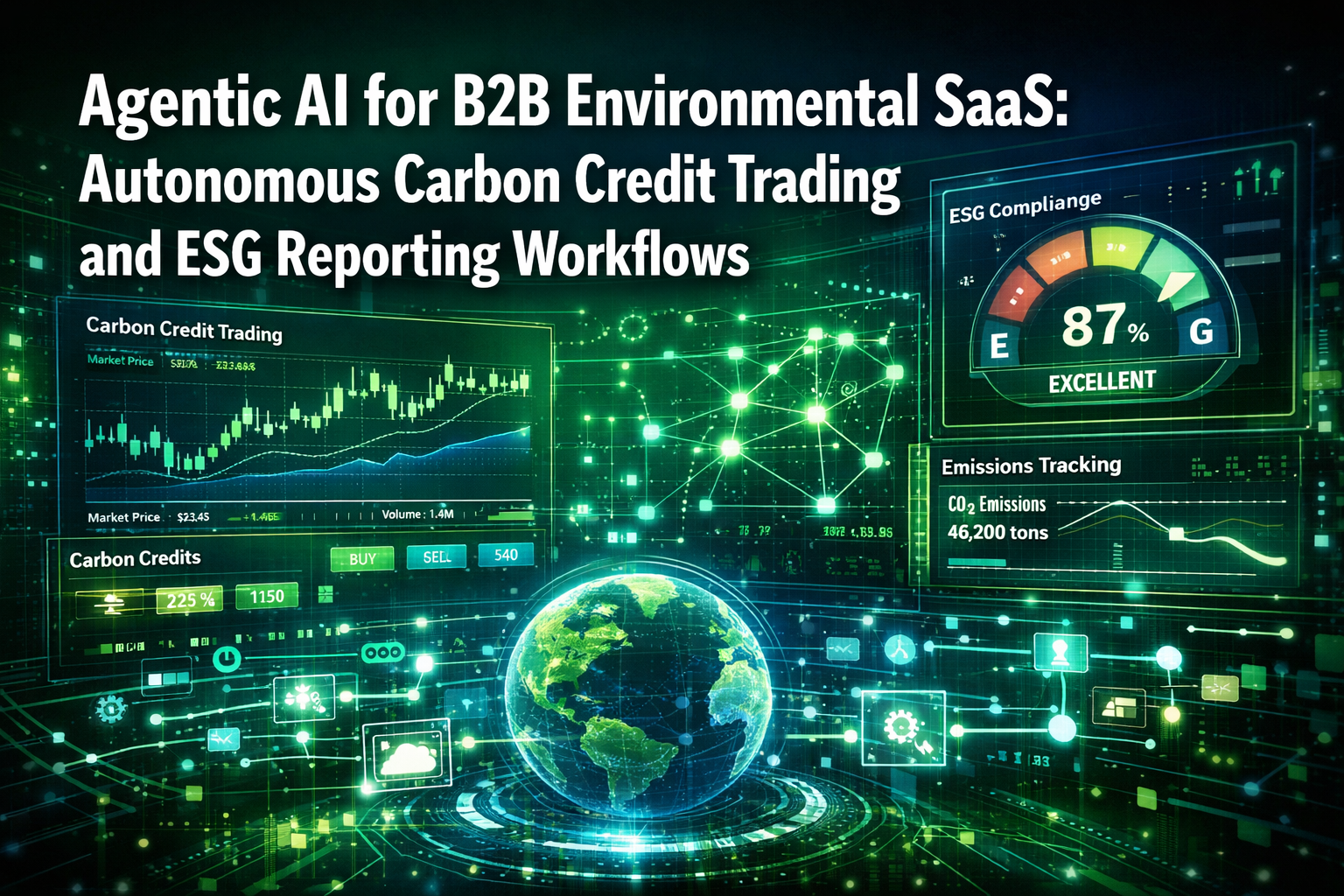
What Is Agentic AI for B2B Environmental SaaS?
Agentic AI for B2B Environmental SaaS refers to autonomous software systems that independently manage sustainability workflows without requiring human oversight for routine decisions. These agents connect to emissions tracking infrastructure, carbon markets, compliance databases, and operational systems to execute tasks like emissions monitoring, carbon credit trading, and regulatory reporting.
Unlike traditional automation that follows rigid if-then rules, agentic AI systems make contextual decisions based on multiple data inputs, changing market conditions, and regulatory requirements. For environmental SaaS platforms, this means agents can:
- Integrate data from disparate sources including IoT sensors, facility management systems, energy usage records, and supply chain databases
- Make autonomous trading decisions for carbon credits based on real-time emissions data, market pricing, and corporate sustainability targets
- Generate compliant reports that align with multiple frameworks (EU CSRD, SASB, GRI) simultaneously
- Identify and flag compliance gaps before regulatory deadlines
- Optimize emissions reduction strategies through continuous facility-level adjustments
The shift to agentic systems addresses a critical infrastructure gap: most organizations have net-zero commitments but lack the operational capacity to track, report, and optimize emissions at the speed required by 2026 regulatory standards.
Choose agentic AI if: Your organization manages complex multi-site emissions data, trades carbon credits regularly, or reports to multiple ESG frameworks. Stick with traditional tools if: Your sustainability reporting is annual-only with simple data sources and no trading requirements.
How Do Autonomous Carbon Credit Trading Workflows Operate?
Autonomous carbon credit trading workflows use AI agents that monitor emissions in real-time, compare current performance against sustainability targets, and execute buy or sell orders on carbon exchanges without human approval for routine transactions.
These systems integrate three core components:
1. Real-Time Emissions Intelligence
- Agents connect to IoT sensors, energy management systems, and facility operations platforms
- Continuous data aggregation calculates current emissions across Scope 1, 2, and 3 categories
- Natural language query interfaces let sustainability managers ask questions like "What caused the emissions spike in Building 3 last Tuesday?" and receive root cause analysis with remediation suggestions
2. Market Integration and Trading Logic
- Agents connect to carbon credit exchanges via API integrations and M2M protocols
- Trading algorithms evaluate current credit prices, forward market trends, and corporate offset requirements
- Autonomous execution for trades within predefined parameters (price thresholds, volume limits, vendor preferences)
- Escalation to human oversight for trades exceeding risk parameters or involving new counterparties
3. Compliance and Audit Trail
- Every trade is logged with emissions justification, market conditions, and decision rationale
- Automated documentation generation for regulatory audits
- Integration with financial systems for accounting treatment of carbon assets
According to research on agentic AI implementations, carbon footprint optimization agents are now operational, making continuous adjustments to work toward defined emissions targets and addressing the infrastructure gap between net-zero commitments and execution.[1]
Common mistake: Organizations often deploy trading agents without establishing clear escalation rules, resulting in agents executing trades that require board approval or violate internal sustainability policies.
What Makes Automated ESG Reporting Different in 2026?
Automated ESG reporting in 2026 operates through fully autonomous systems that aggregate data from multiple sources, write narrative explanations, and generate publication-ready reports aligned to specific regulatory frameworks without manual data entry or document assembly.
Modern agentic ESG reporting systems like Salesforce Agentforce for Net Zero Cloud demonstrate this capability in production environments. These systems integrate with CRM platforms, external emissions databases, and operational data sources to track Scope 1, 2, and 3 emissions and automatically generate compliant reports.[1]
Key Capabilities of Autonomous ESG Reporting
| Capability | Traditional Approach | Agentic AI Approach |
|---|---|---|
| Data Collection | Manual extraction from multiple systems | Autonomous integration with 10+ data sources |
| Framework Alignment | Consultant-led mapping to standards | Simultaneous mapping to EU CSRD, SASB, GRI, TCFD |
| Narrative Generation | Writer creates explanations | AI generates context-aware narratives |
| Compliance Checking | Periodic legal review | Continuous gap identification and flagging |
| Update Frequency | Annual or quarterly | Real-time with on-demand report generation |
| Audit Trail | Manual documentation | Automated provenance tracking for every metric |
Vanta's Agentic Trust Platform exemplifies multi-framework compliance automation, mapping controls across EU AI Act, CSRD, DORA, NIS 2, GDPR, and ISO 42001 simultaneously, enabling continuous compliance monitoring rather than periodic audits.[1]
The shift from periodic to continuous reporting addresses a critical executive need: sustainability leaders require rapid decision-making capabilities but traditional reporting cycles operate on quarterly timelines. Agentic systems enable natural language queries against live sustainability data, identify anomalies as they occur, and surface root causes with suggested remediation actions.[1]
Edge case: Organizations operating in multiple jurisdictions may need agents that can generate different report versions optimized for regional regulatory requirements (EU CSRD vs. SEC climate disclosure rules) from the same underlying data.
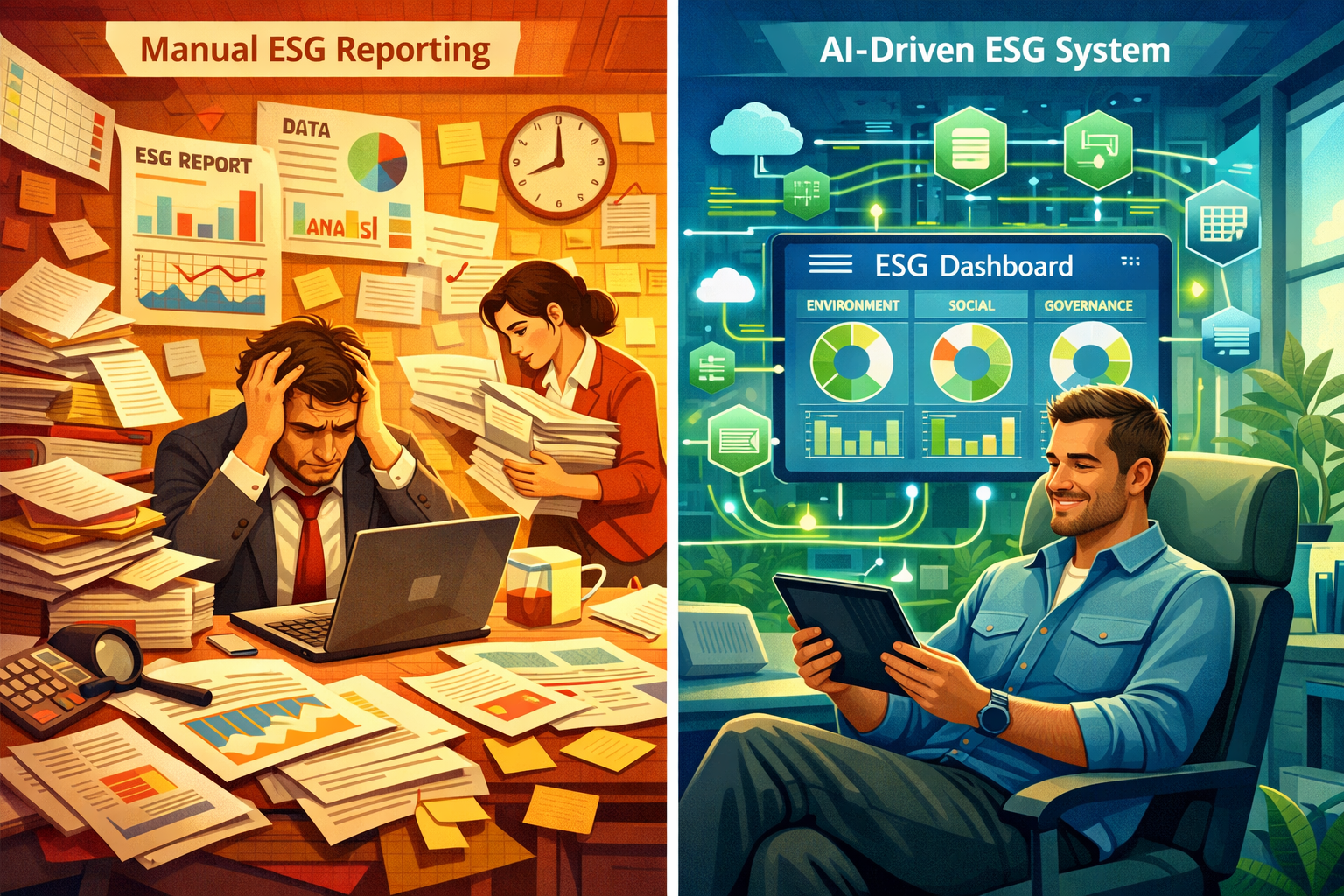
How Do These Systems Integrate with Existing Environmental SaaS Platforms?
Integration between agentic AI systems and existing environmental SaaS platforms occurs through three primary methods: API connections to data sources, embedded agent modules within SaaS applications, and orchestration layers that coordinate multiple specialized agents.
API-Based Integration
Most environmental SaaS platforms expose APIs that allow agentic systems to:
- Pull emissions data, energy usage metrics, and facility operations information
- Push compliance reports, audit documentation, and risk assessments back into the platform
- Trigger workflows when specific conditions are met (emissions thresholds exceeded, compliance deadlines approaching)
Embedded Agent Modules
Leading environmental SaaS vendors now build agentic capabilities directly into their platforms. Salesforce's Agentforce for Net Zero Cloud represents this approach, where the agent operates as a native feature rather than an external integration.[1]
Orchestration Layers
Complex sustainability workflows often require multiple specialized agents working together. An orchestration layer coordinates:
- An emissions tracking agent monitoring real-time facility data
- A trading agent executing carbon credit transactions
- A reporting agent generating compliance documentation
- A supplier risk agent validating vendor sustainability credentials
According to Gartner predictions from January 2026, 40% of enterprise applications will feature task-specific AI agents by the end of 2026, up from less than 5% in 2025, indicating that embedded agent capabilities will become standard features rather than custom integrations.[5]
Critical integration challenge: Legacy compliance and financial systems often lack the API infrastructure required for real-time agent access. Organizations must evaluate whether to upgrade legacy systems, build middleware integration layers, or accept limited agent functionality. Research indicates over 40% of agentic AI projects will fail by 2027 due to legacy systems being unable to support modern AI execution demands.[7]
For organizations exploring AI-driven workflows, understanding how automation transforms digital processes provides valuable context for implementation planning.
What Are the Core Components of Agentic Environmental SaaS Systems?
Agentic environmental SaaS systems consist of five core components that work together to deliver autonomous sustainability management: data integration engines, decision-making agents, execution interfaces, compliance validators, and audit trail systems.
1. Data Integration Engines
These components connect to diverse data sources and normalize information for agent consumption:
- IoT sensor networks providing real-time emissions and energy usage data
- Facility management systems tracking operational parameters
- Financial platforms for carbon credit accounting and sustainability investment tracking
- HR systems for workforce-related ESG metrics
- Supply chain databases for Scope 3 emissions calculations
2. Decision-Making Agents
Specialized AI agents that make autonomous decisions within defined parameters:
- Emissions optimization agents that adjust facility operations to reduce carbon output
- Trading agents that execute carbon credit buy-sell decisions
- Reporting agents that select appropriate frameworks and generate compliant documentation
- Risk assessment agents that identify compliance gaps and supplier sustainability issues
3. Execution Interfaces
Connections to external systems where agents take action:
- Carbon credit exchanges for automated trading
- Regulatory portals for compliance submission
- Operational control systems for emissions reduction adjustments
- Procurement platforms for supplier sustainability scoring
4. Compliance Validators
Systems that ensure agent actions meet regulatory and policy requirements:
- Multi-framework mapping to EU CSRD, SASB, GRI, TCFD, and regional standards
- Policy enforcement checking agent decisions against corporate sustainability policies
- Regulatory change monitoring to update compliance rules as regulations evolve
5. Audit Trail Systems
Comprehensive logging that documents every agent decision and action:
- Decision rationale capture explaining why agents took specific actions
- Data provenance tracking showing the source of every metric in reports
- Change history documenting how sustainability performance evolved over time
Agentic procurement systems demonstrate the power of integrated components by processing supplier questionnaires, validating certifications, scoring suppliers against ESG criteria, scanning news and regulatory databases for risk events, and flagging or substituting non-compliant suppliers before contracts execute.[1]
Implementation tip: Start with a single agent focused on one workflow (ESG reporting or carbon trading) before deploying multiple agents. This approach reduces integration complexity and allows teams to develop agent oversight capabilities before expanding scope.
How Does Autonomous Carbon Credit Trading Work in Practice?
Autonomous carbon credit trading operates through AI agents that continuously monitor an organization's emissions performance, evaluate carbon credit market conditions, and execute trades when predefined criteria are met, all without requiring human approval for routine transactions.
Step-by-Step Trading Workflow
Step 1: Emissions Baseline Establishment
The agent establishes current emissions levels by integrating data from facility sensors, energy usage records, and operational systems. It calculates the gap between actual emissions and corporate sustainability targets.
Step 2: Market Monitoring
The trading agent connects to carbon credit exchanges and monitors:
- Current spot prices for carbon credits
- Forward market pricing trends
- Credit quality ratings and verification standards
- Counterparty reliability scores
Step 3: Trading Decision Logic
The agent evaluates whether to buy, sell, or hold based on:
- Emissions gap (if actual emissions exceed targets, buy credits)
- Price thresholds (only execute if prices fall within acceptable ranges)
- Portfolio optimization (balance credit types and expiration dates)
- Regulatory deadlines (ensure sufficient credits before compliance reporting dates)
Step 4: Autonomous Execution
For trades meeting predefined parameters, the agent:
- Executes the transaction via M2M protocols with the exchange
- Confirms trade settlement and credit transfer
- Updates internal carbon asset accounting systems
- Logs the transaction with full decision rationale
Step 5: Escalation for Exception Cases
The agent escalates to human oversight when:
- Trade size exceeds predefined volume limits
- Prices fall outside acceptable ranges
- New counterparties require vendor approval
- Regulatory changes impact trading strategy
Real-world constraint: Most organizations limit autonomous trading to a percentage of their total carbon credit portfolio (typically 20-40%) and require human approval for larger strategic trades or long-term forward contracts.
Gartner's 2026 prediction that 90% of B2B buying will be AI agent intermediated by 2028, with over $15 trillion of B2B spend flowing through AI agent exchanges, suggests carbon credit trading will increasingly occur through agent-to-agent transactions rather than human-intermediated deals.[5]
What Compliance Frameworks Do Agentic ESG Systems Support?
Agentic ESG reporting systems support multiple regulatory frameworks simultaneously, with the most advanced platforms mapping controls and metrics across EU CSRD, SASB, GRI, TCFD, SEC climate disclosure rules, and emerging AI-specific regulations like the EU AI Act.
Major Framework Coverage
EU Corporate Sustainability Reporting Directive (CSRD)
- Mandatory for large EU companies and EU subsidiaries of non-EU companies
- Requires detailed disclosure across environmental, social, and governance metrics
- Agents automate the collection of double materiality assessments and sustainability statements
Sustainability Accounting Standards Board (SASB)
- Industry-specific materiality standards
- Agents map company operations to relevant SASB industry categories
- Automated metric collection for financially material sustainability factors
Global Reporting Initiative (GRI)
- Comprehensive sustainability reporting framework
- Agents generate reports covering economic, environmental, and social impacts
- Stakeholder engagement documentation and impact assessments
Task Force on Climate-related Financial Disclosures (TCFD)
- Climate risk and opportunity disclosure framework
- Agents model climate scenarios and assess financial impacts
- Governance, strategy, risk management, and metrics reporting
SEC Climate Disclosure Rules
- U.S. public company climate risk reporting requirements
- Agents track Scope 1 and 2 emissions with limited Scope 3 requirements
- Integration with financial reporting systems for material risk assessment
Vanta's platform demonstrates multi-framework capability by simultaneously mapping controls across EU AI Act, CSRD, DORA, NIS 2, GDPR, and ISO 42001, enabling continuous compliance monitoring rather than periodic audits.[1]
Critical consideration: Different frameworks have conflicting materiality definitions and metric calculation methodologies. Advanced agentic systems maintain separate calculation engines for each framework rather than attempting to use a single unified approach.
Organizations seeking to optimize their digital marketing and reporting workflows can apply similar automation principles to sustainability compliance.
What Are the Benefits and Limitations of Agentic Environmental SaaS?
Agentic AI for B2B Environmental SaaS delivers significant benefits in reporting speed, compliance accuracy, and operational efficiency, but faces limitations around legacy system integration, regulatory uncertainty, and the need for human oversight of high-stakes decisions.
Key Benefits
✅ Continuous Real-Time Monitoring
Traditional ESG reporting operates on quarterly or annual cycles. Agentic systems provide continuous monitoring, enabling immediate identification of emissions spikes, compliance gaps, and optimization opportunities.
✅ Multi-Framework Compliance Automation
Organizations reporting to multiple regulatory frameworks (EU CSRD, SASB, GRI) can generate compliant reports for all frameworks simultaneously from a single data source, eliminating duplicate data entry and reducing consultant costs.
✅ Reduced Manual Labor
Autonomous data collection, metric calculation, and report generation eliminate hundreds of hours of manual work per reporting cycle, allowing sustainability teams to focus on strategic initiatives rather than data compilation.
✅ Improved Accuracy and Audit Trails
Automated data provenance tracking and decision logging reduce human error and provide comprehensive audit trails that satisfy regulatory scrutiny.
✅ Faster Response to Regulatory Changes
When new regulations or framework updates are released, agents can be updated to incorporate new requirements faster than training human teams on new compliance procedures.
Significant Limitations
❌ Legacy System Integration Challenges
Over 40% of agentic AI projects will fail by 2027 due to legacy systems being unable to support modern AI execution demands.[7] Organizations with older compliance, financial, or operational systems may face significant integration costs or limited functionality.
❌ High Initial Implementation Costs
AI agent pricing is trending upward as agents become more sophisticated and handle higher-value tasks.[6] Enterprise-grade agentic environmental SaaS platforms command premium pricing, with implementation costs often exceeding $100,000 for mid-sized organizations.
❌ Regulatory Uncertainty Around AI Decision-Making
Regulatory bodies are still developing guidance on the acceptable use of AI for compliance reporting and financial transactions like carbon credit trading. Organizations may face auditor skepticism or require additional human review layers.
❌ Data Quality Dependencies
Agentic systems are only as good as their data sources. Poor quality IoT sensor data, incomplete supply chain information, or inconsistent facility reporting will produce unreliable agent outputs.
❌ Need for Human Oversight Infrastructure
Fully autonomous systems still require human oversight for exception handling, strategic decisions, and verification of high-stakes outputs. Organizations must build oversight processes and train teams to manage agent performance.
Decision framework: Deploy agentic systems if you have clean data infrastructure, report to multiple frameworks, and need real-time sustainability intelligence. Stick with traditional tools if you have limited data sources, simple reporting requirements, or significant legacy system constraints.
How Should Organizations Implement Agentic AI for Environmental Workflows?
Organizations should implement agentic AI for environmental workflows through a phased approach that starts with a single high-value use case, establishes data infrastructure and oversight processes, and gradually expands agent capabilities as teams develop management expertise.
Implementation Roadmap
Phase 1: Foundation (Months 1-3)
- Assess data infrastructure readiness: Audit existing emissions tracking, facility management, and compliance systems for API availability and data quality
- Select initial use case: Choose either autonomous ESG reporting or carbon credit trading as the first agent deployment based on business priority
- Establish governance framework: Define agent decision parameters, escalation rules, and human oversight requirements
- Pilot with limited scope: Deploy agent for a single facility, business unit, or framework before organization-wide rollout
Phase 2: Integration (Months 4-6)
- Connect data sources: Integrate agent with IoT sensors, operational systems, and external databases
- Configure compliance rules: Map agent outputs to relevant regulatory frameworks (EU CSRD, SASB, GRI)
- Train oversight teams: Develop internal expertise in monitoring agent performance and handling escalations
- Validate outputs: Run parallel processes with traditional methods to verify agent accuracy
Phase 3: Expansion (Months 7-12)
- Scale to additional use cases: Add second agent type (if started with reporting, add trading capability)
- Expand organizational coverage: Roll out to additional facilities, business units, or regions
- Optimize agent parameters: Refine decision rules based on performance data
- Integrate with financial systems: Connect carbon credit trading to accounting platforms and sustainability investment tracking
Phase 4: Advanced Capabilities (Months 13+)
- Deploy multi-agent orchestration: Coordinate multiple specialized agents for end-to-end sustainability management
- Enable predictive optimization: Use agents for forward-looking emissions reduction planning
- Implement supplier risk management: Add agentic procurement systems for supply chain ESG monitoring
- Participate in agent-to-agent exchanges: Connect to emerging B2B agent marketplaces for carbon credit trading
Critical Success Factors
Data Quality First
Agentic systems require clean, consistent, real-time data. Organizations should invest in data infrastructure improvements before deploying agents. This includes upgrading IoT sensor networks, standardizing facility reporting protocols, and establishing data governance policies.
Clear Escalation Rules
Define specific criteria for when agents should escalate decisions to humans. Examples include: trades exceeding $50,000, emissions variances greater than 20% from baseline, or compliance gaps requiring legal interpretation.
Regulatory Monitoring
Assign responsibility for tracking regulatory changes and updating agent compliance rules. As frameworks like EU CSRD evolve, agents must be updated to reflect new requirements.
Vendor Selection Criteria
Evaluate agentic environmental SaaS vendors based on:
- Framework coverage (number of supported compliance standards)
- Integration capabilities (pre-built connectors to common enterprise systems)
- Audit trail completeness (decision logging and data provenance)
- Escalation flexibility (customizable rules for human oversight)
- Vendor financial stability (agentic AI is a rapidly evolving market with consolidation risk)
Organizations exploring AI-driven marketing automation will find similar implementation principles apply to environmental workflow automation.
Common mistake: Organizations often underestimate the change management required for teams to trust and effectively oversee agentic systems. Plan for extensive training and gradual responsibility transfer rather than immediate full automation.
What Does the Future Hold for Agentic AI in Environmental SaaS?
The future of agentic AI in environmental SaaS points toward fully autonomous sustainability management by 2028, with AI agents handling end-to-end workflows from emissions monitoring through compliance reporting and carbon market participation, all while operating within agent-to-agent marketplaces that bypass traditional human intermediation.
Near-Term Trends (2026-2027)
Rapid Enterprise Adoption
Gartner's prediction that 40% of enterprise applications will feature task-specific AI agents by end of 2026 (up from less than 5% in 2025) indicates environmental SaaS platforms will quickly integrate agentic capabilities as standard features rather than premium add-ons.[5]
Consolidation of Point Solutions
The current landscape features specialized agents for emissions tracking, carbon trading, ESG reporting, and supplier risk management. Expect consolidation into unified platforms that coordinate multiple agent types through orchestration layers.
Regulatory Standardization
As more organizations deploy agentic systems for compliance reporting, regulatory bodies will develop specific guidance on acceptable use of AI for sustainability disclosure, audit requirements for agent-generated reports, and liability frameworks for autonomous trading decisions.
Medium-Term Evolution (2028-2030)
Agent-to-Agent Carbon Markets
Gartner predicts 90% of B2B buying will be AI agent intermediated by 2028, with over $15 trillion of B2B spend flowing through AI agent exchanges.[5] Carbon credit trading will likely shift to agent-to-agent marketplaces where corporate sustainability agents negotiate directly with credit issuer agents, optimizing for price, quality, and delivery timing without human involvement.
Predictive Sustainability Management
Current agentic systems are reactive (monitoring current emissions and responding to compliance requirements). Future systems will be predictive, modeling the emissions impact of business decisions before they're made. For example, an agent might evaluate the carbon footprint of opening a new facility in different locations and recommend the lowest-emissions option.
Supply Chain Transparency Enforcement
Agentic procurement systems will evolve from validating supplier certifications to actively monitoring supplier operations through connected IoT networks, providing real-time visibility into Scope 3 emissions and automatically triggering supplier substitution when sustainability performance degrades.
Integration with Financial Systems
Carbon accounting will become fully integrated with financial accounting, with agents automatically calculating the financial impact of emissions performance, carbon credit portfolio valuation, and sustainability-linked financing compliance.
Long-Term Implications (2030+)
Autonomous Net-Zero Operations
Organizations will deploy agentic systems with full authority to make operational decisions that optimize for emissions reduction, including energy procurement, facility operations scheduling, and supply chain routing, all within parameters that balance sustainability targets with business objectives.
Standardized Agent Protocols
Industry-wide standards will emerge for agent-to-agent communication in sustainability workflows, similar to how EDI standardized B2B transactions in the 1990s. These protocols will enable seamless data exchange between corporate sustainability agents, regulatory reporting systems, and carbon market platforms.
Liability and Insurance Markets
As agents take on higher-stakes decisions, new insurance products will emerge to cover agent errors, regulatory non-compliance from agent-generated reports, and financial losses from autonomous trading decisions.
For organizations exploring emerging AI applications, understanding broader AI marketing trends provides context for how agentic systems are transforming multiple business functions simultaneously.
Strategic consideration: Organizations that establish agentic capabilities early will have a competitive advantage as regulatory requirements intensify and agent-to-agent marketplaces become dominant. However, early adopters also face higher implementation risks and costs. Balance first-mover advantages against the risk of deploying immature technology.
Comparing Agentic AI Solutions for Environmental SaaS
Organizations evaluating agentic AI for environmental workflows should compare solutions across framework coverage, integration capabilities, autonomous decision scope, and pricing models to select platforms aligned with their compliance requirements and technical infrastructure.
Solution Comparison Framework
| Evaluation Criteria | What to Look For | Red Flags |
|---|---|---|
| Framework Coverage | Support for EU CSRD, SASB, GRI, TCFD, and regional standards relevant to your operations | Limited to single framework or requires custom development for additional standards |
| Data Integration | Pre-built connectors to major IoT platforms, facility management systems, and financial software | Requires extensive custom API development for each data source |
| Autonomous Scope | Clear definition of which decisions agents make independently vs. escalate to humans | Vague descriptions of agent capabilities or unlimited autonomous authority |
| Audit Trail Completeness | Comprehensive logging of decision rationale, data provenance, and change history | Limited documentation or inability to export audit trails for regulatory review |
| Compliance Updates | Vendor commitment to updating agents as regulations evolve, with clear SLA for implementation | Manual configuration required for each regulatory change |
| Pricing Transparency | Clear pricing based on users, facilities, or transaction volume | Opaque pricing requiring extensive negotiation |
| Legacy System Support | Demonstrated integration with older compliance and financial systems | Only supports modern cloud-native platforms |
| Vendor Stability | Established company with enterprise customers or well-funded startup with clear roadmap | Early-stage startup with limited customer base and uncertain funding |
Key Vendor Capabilities
Salesforce Agentforce for Net Zero Cloud
Live production deployment with CRM integration, Scope 1-2-3 emissions tracking, and automated report generation. Best for organizations already using Salesforce ecosystem.[1]
Vanta Agentic Trust Platform
Multi-framework compliance automation (EU AI Act, CSRD, DORA, NIS 2, GDPR, ISO 42001) with continuous monitoring. Best for organizations needing comprehensive compliance coverage beyond environmental reporting.[1]
Specialized Carbon Trading Platforms
Emerging vendors focused specifically on autonomous carbon credit trading with M2M exchange protocols. Best for organizations with high trading volumes and sophisticated carbon market strategies.
Enterprise Sustainability Suites
Traditional environmental SaaS vendors adding agentic capabilities to existing platforms. Best for organizations wanting to enhance current systems rather than replace them.
Decision rule: Choose established vendors with proven enterprise deployments if regulatory compliance is critical and risk tolerance is low. Consider specialized or emerging vendors if you need cutting-edge capabilities and have technical resources to manage integration challenges.
Organizations evaluating different marketing automation platforms will recognize similar evaluation criteria apply to environmental SaaS selection.
Frequently Asked Questions
What is agentic AI for environmental SaaS?
Agentic AI for environmental SaaS refers to autonomous software systems that independently manage sustainability workflows including emissions tracking, carbon credit trading, and ESG compliance reporting without requiring human oversight for routine decisions. These agents integrate with operational systems, regulatory frameworks, and carbon markets to deliver continuous sustainability management.
How much does agentic environmental SaaS cost?
Enterprise-grade agentic environmental SaaS platforms typically cost $100,000-$500,000+ for initial implementation, with ongoing subscription fees ranging from $50,000-$200,000 annually depending on organization size, number of facilities, and feature scope. AI agent pricing is trending upward as systems become more sophisticated.[6]
Can agentic AI systems generate compliant ESG reports?
Yes, modern agentic systems like Salesforce Agentforce for Net Zero Cloud generate publication-ready ESG reports aligned to multiple frameworks (EU CSRD, SASB, GRI) by autonomously integrating data from emissions databases, operational systems, and financial platforms.[1] However, most organizations still require human review before submission.
Is autonomous carbon credit trading legal?
Autonomous carbon credit trading is legal in most jurisdictions, but organizations typically limit agent authority to routine trades within predefined parameters and require human approval for larger strategic transactions. Regulatory guidance on AI-executed trades is still evolving, so consult legal counsel before deploying autonomous trading agents.
What data sources do agentic environmental systems need?
Agentic environmental systems require connections to IoT sensors for real-time emissions monitoring, facility management systems for operational data, energy usage records, financial platforms for carbon accounting, HR systems for workforce metrics, and supply chain databases for Scope 3 emissions calculations.
How long does it take to implement agentic AI for ESG reporting?
Implementation typically takes 6-12 months for initial deployment covering a single use case (either ESG reporting or carbon trading), including data infrastructure assessment, system integration, governance framework establishment, and pilot validation. Full organization-wide deployment with multiple agent types may take 18-24 months.
What are the biggest risks of agentic environmental SaaS?
The biggest risks include legacy system integration failures (over 40% of projects fail by 2027 due to this issue[7]), poor data quality producing unreliable agent outputs, regulatory uncertainty around AI-generated compliance reports, and insufficient human oversight leading to inappropriate autonomous decisions.
Can small businesses use agentic AI for sustainability?
Most current agentic environmental SaaS platforms target mid-market and enterprise organizations due to high implementation costs and complex integration requirements. Small businesses with simple reporting needs and limited data sources are better served by traditional sustainability software until more affordable agentic solutions emerge.
How do agentic systems handle regulatory changes?
Advanced agentic platforms like Vanta automatically update compliance rules when regulations change, mapping new requirements to existing data sources and flagging gaps that require additional data collection.[1] However, organizations should verify vendor SLAs for regulatory update timelines.
What's the difference between agentic AI and traditional automation?
Traditional automation follows rigid if-then rules and requires human intervention when conditions change. Agentic AI makes contextual decisions based on multiple data inputs, adapts to changing conditions, and operates autonomously within defined parameters without requiring pre-programmed rules for every scenario.
Do agentic systems replace sustainability teams?
No, agentic systems augment rather than replace sustainability teams by automating data collection, routine reporting, and compliance monitoring. This allows human teams to focus on strategic initiatives like setting sustainability targets, stakeholder engagement, and interpreting complex regulatory requirements that require judgment.
How accurate are AI-generated ESG reports?
Accuracy depends on data quality and proper system configuration. Organizations running parallel processes with traditional methods during pilot phases report 95%+ accuracy for metric calculations and framework alignment when data sources are clean and complete. Narrative quality varies and typically requires human editing for tone and stakeholder communication.
Conclusion
Agentic AI for B2B Environmental SaaS represents a fundamental shift from manual sustainability management to autonomous, continuous optimization of emissions tracking, carbon credit trading, and ESG compliance reporting. Organizations deploying these systems gain real-time visibility into sustainability performance, automated compliance across multiple regulatory frameworks, and the operational capacity to execute net-zero commitments at scale.
The technology is operational in production environments as of 2026, with platforms like Salesforce Agentforce for Net Zero Cloud and Vanta's Agentic Trust Platform demonstrating enterprise-grade capabilities. However, successful implementation requires clean data infrastructure, clear governance frameworks, and realistic expectations about the need for human oversight of high-stakes decisions.
Actionable Next Steps
For organizations beginning their agentic AI journey:
- Audit your data infrastructure to assess readiness for agent integration, focusing on API availability, data quality, and real-time access to emissions and operational data
- Select a single high-value use case (ESG reporting or carbon trading) as your initial deployment rather than attempting comprehensive automation
- Establish governance frameworks defining agent decision parameters, escalation rules, and human oversight requirements before deployment
- Evaluate vendors based on framework coverage, integration capabilities, audit trail completeness, and demonstrated enterprise deployments
For organizations already using traditional environmental SaaS:
- Engage your current vendor to understand their agentic AI roadmap and timeline for adding autonomous capabilities to existing platforms
- Assess integration requirements for connecting agentic systems to your current sustainability infrastructure
- Develop internal expertise in AI oversight through training programs and pilot projects with limited scope
- Monitor regulatory developments affecting AI use in compliance reporting and carbon trading in your jurisdictions
For sustainability leaders planning 2026-2027 strategy:
- Factor agentic capabilities into sustainability technology roadmaps, recognizing that 40% of enterprise applications will feature AI agents by end of 2026[5]
- Budget for higher implementation costs as AI agent pricing trends upward for sophisticated environmental workflows[6]
- Prepare for agent-to-agent marketplaces that will transform carbon credit trading and supplier sustainability management by 2028[5]
- Build change management plans that address team concerns about AI decision-making and establish trust in autonomous systems
The shift to agentic AI for environmental workflows is accelerating rapidly. Organizations that establish capabilities now will have significant advantages as regulatory requirements intensify and agent-to-agent marketplaces become dominant. However, success requires balancing first-mover advantages against implementation risks, legacy system constraints, and the need to build internal expertise in managing autonomous sustainability systems.
For organizations exploring broader AI applications across business functions, understanding AI-driven automation strategies provides valuable context for how agentic systems are transforming multiple workflows simultaneously.
References
[1] Top 50 Agentic Ai Implementations Use Cases To Learn From – https://8allocate.com/blog/top-50-agentic-ai-implementations-use-cases-to-learn-from/
[5] How Agentic Ai Will Disrupt Saas Industry 2026 2030 31 January 2026 – https://business20channel.tv/how-agentic-ai-will-disrupt-saas-industry-2026-2030-31-january-2026
[6] B2b Saas And Agentic Ai Pricing Predictions For 2026 – https://www.ibbaka.com/ibbaka-market-blog/b2b-saas-and-agentic-ai-pricing-predictions-for-2026
[7] Agentic Ai Strategy – https://www.deloitte.com/us/en/insights/topics/technology-management/tech-trends/2026/agentic-ai-strategy.html