

The clock is ticking. As 2026 unfolds, artificial intelligence is no longer a futuristic concept—it's the operational backbone reshaping how affiliate marketing teams work, communicate, and compete. Organizations that haven't prepared their teams for AI-driven workflows face a harsh reality: obsolescence isn't coming; it's already here. Building AI change fitness for affiliate teams before 2026 disruptions hit is the difference between thriving in the new landscape and scrambling to catch up.
Harvard Business School research emphasizes the urgency of developing "change fitness" as AI transforms business operations[2]. For affiliate marketers, this means more than adopting new tools—it requires fundamentally rethinking team capabilities, workflows, and strategic planning. The fitness industry offers a compelling parallel: AI has become "the backbone of programming, member communication, scheduling, personalization and staffing"[1], demonstrating how deeply automation will penetrate every operational layer.
Key Takeaways
- 🎯 AI change fitness requires proactive skill development in agentic workflows, automation management, and AI-human collaboration before disruptions accelerate
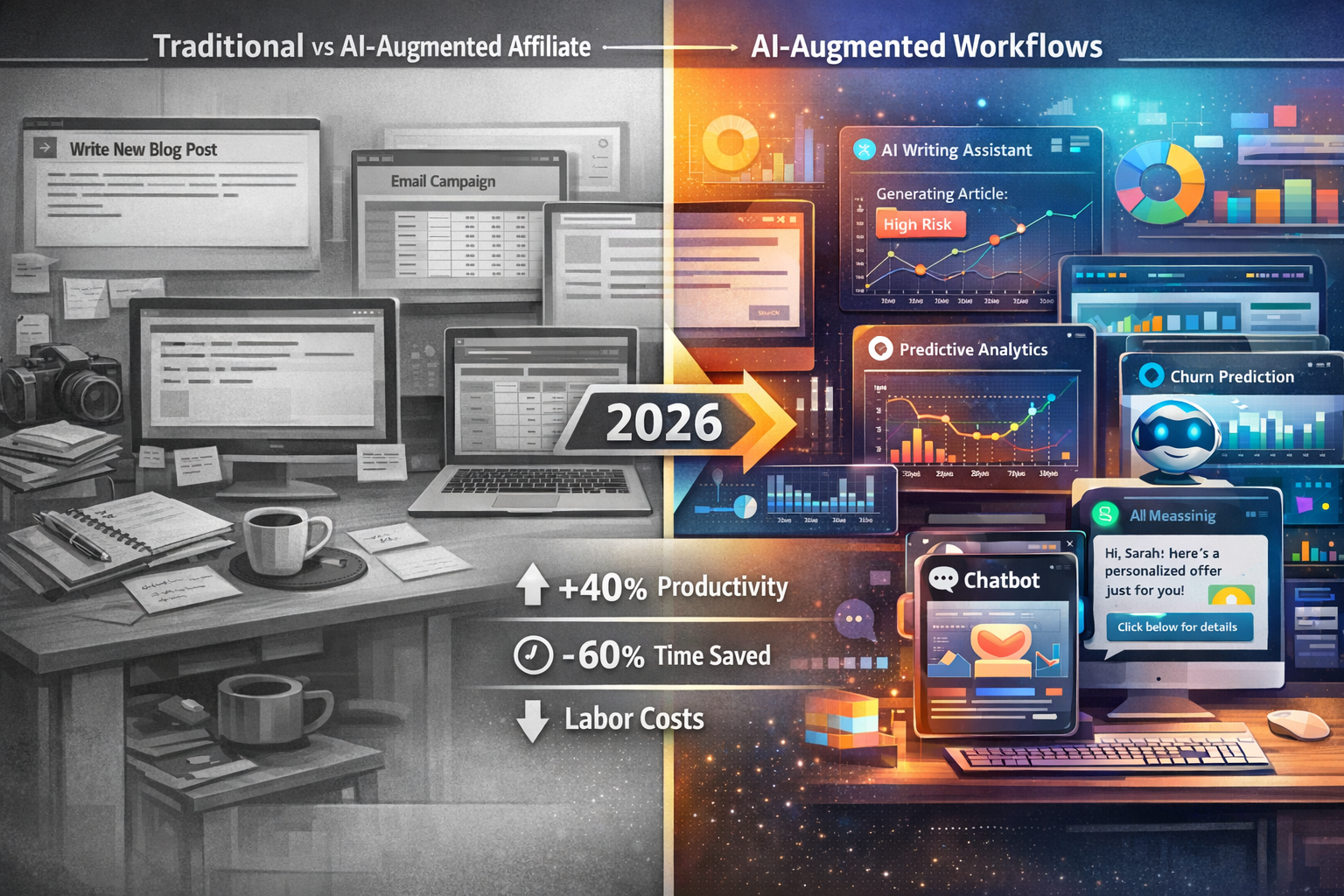
- 📊 Organizations using AI report 40% productivity gains and significant labor cost reductions through automated operations and predictive analytics[1]
- 🚀 Training roadmaps must prioritize prompt engineering, data literacy, and strategic AI integration over basic tool familiarity
- ⏰ The 2026 timeline demands immediate action—teams that wait risk falling permanently behind competitors already leveraging AI advantages
- 💡 Success depends on balancing human creativity with AI automation, not replacing marketers but amplifying their strategic capabilities
Understanding AI Change Fitness for Affiliate Teams
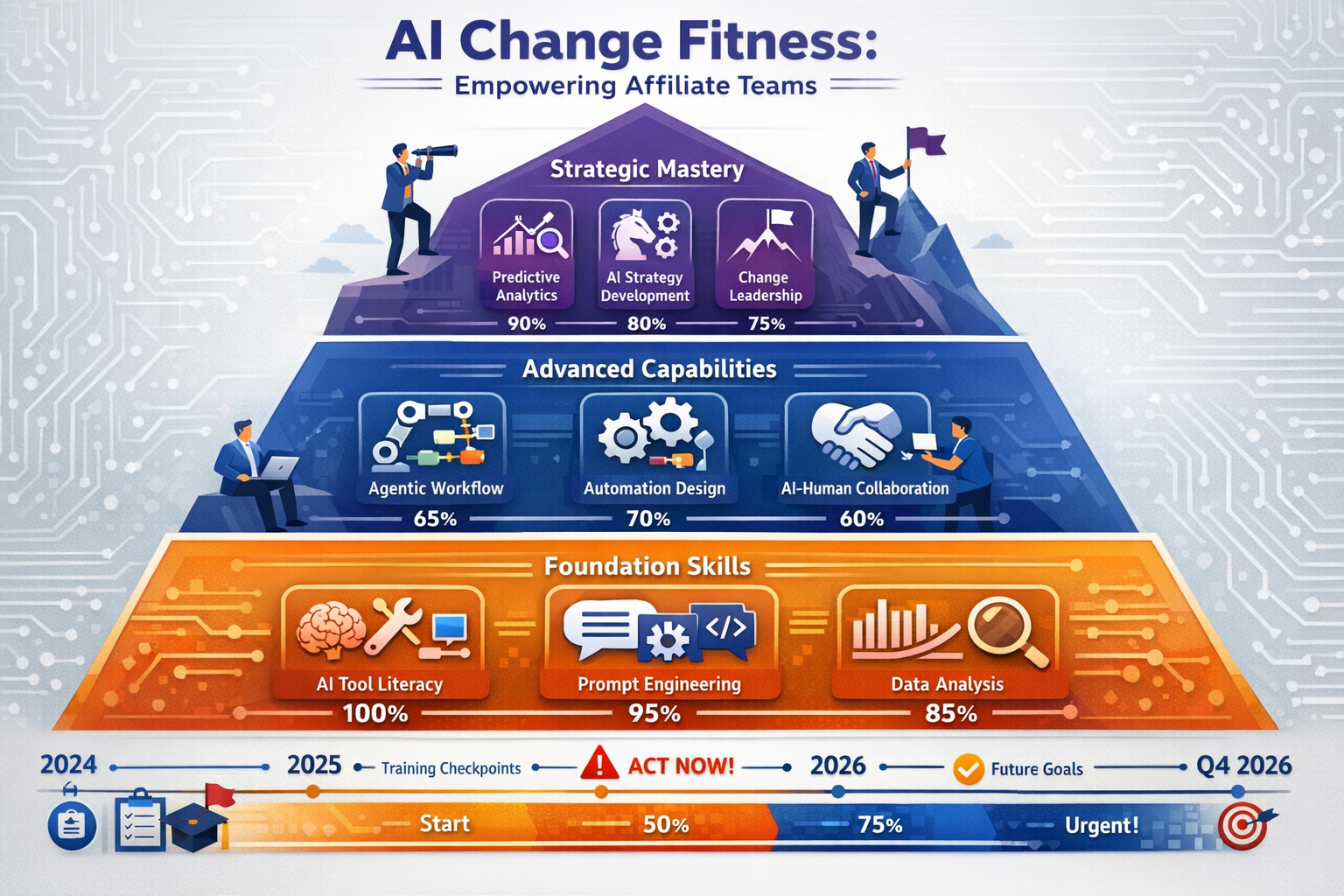
Change fitness represents an organization's capacity to adapt rapidly to technological disruption while maintaining performance and morale. For affiliate teams, this concept takes on special urgency as AI tools fundamentally alter content creation, audience analysis, campaign optimization, and revenue tracking.
Traditional affiliate marketing relied heavily on manual processes: writing product reviews, analyzing traffic patterns, testing promotional strategies, and managing partner relationships. AI disrupts every single element. Teams without change fitness struggle to integrate these tools effectively, creating a dangerous gap between potential and performance.
The Three Pillars of AI Change Fitness
| Pillar | Description | Key Skills Required |
|---|---|---|
| Technical Literacy | Understanding AI capabilities and limitations | Prompt engineering, tool selection, API integration |
| Strategic Adaptation | Redesigning workflows around AI augmentation | Process mapping, automation design, efficiency analysis |
| Cultural Readiness | Embracing continuous learning and experimentation | Growth mindset, failure tolerance, collaborative learning |
Building these pillars requires intentional effort. Affiliate marketing programs that incorporate AI training from the start position teams for long-term success, while those treating AI as an optional add-on face mounting disadvantages.
Why 2026 Marks a Critical Inflection Point
The convergence of several trends makes 2026 particularly significant for AI adoption in affiliate marketing:
Automation Maturity: AI tools have evolved from experimental to production-ready. Platforms now offer reliable automation for content generation, SEO optimization, email personalization, and performance forecasting. The question isn't whether to adopt but how quickly teams can master these capabilities.
Competitive Pressure: Early adopters are already seeing measurable advantages. Businesses using AI to reduce labor costs, predict member churn, and automate daily operations[1] create efficiency gaps that traditional teams cannot match through effort alone. This competitive pressure accelerates throughout 2026.
Skill Obsolescence: Manual tasks that once required hours—keyword research, competitor analysis, content outlining—now take minutes with AI assistance. Teams that haven't developed AI-augmented workflows find their traditional skills increasingly devalued in the marketplace.
"AI has transitioned from being a trend to becoming the backbone of programming, member communication, scheduling, personalization and staffing in fitness organizations."[1]
This transformation extends directly to affiliate marketing, where personalization, communication, and scheduling determine campaign success. For those exploring affiliate marketing for beginners, understanding AI integration is no longer advanced training—it's foundational knowledge.
Building Essential AI Skills: A Roadmap for Affiliate Teams
Developing AI change fitness requires structured skill development across three progressive stages:
Stage 1: Foundation Skills (Months 1-3)
AI Tool Literacy 🔧
- Master 3-5 core AI platforms relevant to affiliate marketing
- Understand when to use AI versus traditional methods
- Learn basic prompt engineering techniques
- Practice quality control for AI-generated content
Data Analysis Basics 📊
- Interpret AI-generated insights and recommendations
- Understand predictive analytics fundamentals
- Learn to validate AI outputs against business goals
- Develop critical evaluation skills for automated suggestions
Teams should dedicate 5-10 hours weekly to hands-on experimentation. The AI marketing tools landscape offers numerous platforms for practice, from content generation to audience segmentation.
Stage 2: Advanced Capabilities (Months 4-6)
Agentic Workflow Design ⚙️
- Map current processes and identify automation opportunities
- Design AI-human collaboration workflows
- Implement automated content pipelines
- Create quality assurance protocols for AI outputs
Strategic Integration 🎯
- Align AI capabilities with business objectives
- Develop hybrid strategies combining AI efficiency with human creativity
- Build measurement frameworks for AI impact
- Optimize resource allocation between automated and manual tasks
This stage requires rethinking fundamental assumptions about how work gets done. Successful teams discover that AI doesn't replace marketers—it eliminates repetitive tasks and amplifies strategic thinking. Understanding digital marketing fundamentals helps contextualize where AI adds maximum value.
Stage 3: Strategic Mastery (Months 7-12)
Predictive Planning 🔮
- Use AI for trend forecasting and opportunity identification
- Implement predictive models for campaign performance
- Develop scenario planning with AI assistance
- Create adaptive strategies that respond to real-time data
Change Leadership 👥
- Train and mentor team members on AI adoption
- Build organizational processes supporting continuous AI evolution
- Navigate ethical considerations and quality standards
- Foster innovation culture embracing experimentation
Teams reaching this level transform from AI users to AI strategists. They don't just execute with AI tools—they shape how AI capabilities align with business vision.
Practical Training Approaches for 2026 Readiness
The 90-Day Sprint Method
Rather than lengthy training programs, implement focused 90-day sprints targeting specific capabilities:
Sprint 1: Content Automation
- Week 1-2: Tool evaluation and selection
- Week 3-6: Prompt engineering mastery
- Week 7-10: Workflow integration
- Week 11-12: Performance measurement and optimization
Sprint 2: Audience Intelligence
- Weeks 1-4: AI-powered analytics platforms
- Weeks 5-8: Predictive modeling for audience behavior
- Weeks 9-12: Personalization strategy development
Sprint 3: Campaign Optimization
- Weeks 1-4: Automated A/B testing frameworks
- Weeks 5-8: Real-time performance adjustment
- Weeks 9-12: Multi-channel integration
This approach maintains momentum while delivering tangible results quickly. Teams see immediate value, reinforcing commitment to continued learning.
Learning Resources and Skill Development
Hands-On Practice 💪
- Dedicate 20% of work time to AI experimentation
- Create "AI sandbox" projects with low risk
- Document learnings and share across teams
- Celebrate failures as learning opportunities
Structured Education 📚
- Enroll in AI marketing certification programs
- Attend industry conferences focused on AI integration
- Join peer learning communities and mastermind groups
- Subscribe to AI trend newsletters and research publications
Mentorship and Collaboration 🤝
- Pair AI-savvy team members with those developing skills
- Create cross-functional learning groups
- Invite external experts for workshops and training
- Build relationships with AI tool vendors for advanced training
For teams working in specific affiliate niches, tailoring AI training to niche-specific applications accelerates relevance and adoption.
Overcoming Common Barriers to AI Adoption
Resistance to Change
Challenge: Team members fear AI will replace their roles or devalue their expertise.
Solution: Frame AI as augmentation, not replacement. Demonstrate how AI eliminates tedious tasks, freeing marketers for strategic work that requires human judgment, creativity, and relationship skills. Share success stories showing career advancement through AI mastery.
Skill Gaps and Learning Curves
Challenge: AI tools seem complex and overwhelming, especially for non-technical team members.
Solution: Start with user-friendly platforms requiring minimal technical knowledge. Build confidence through small wins before advancing to complex implementations. Provide dedicated learning time and remove pressure for immediate perfection.
Resource Constraints
Challenge: Limited budget and time for training programs.
Solution: Leverage free AI tools and educational resources. Implement peer-to-peer learning reducing external training costs. Start with high-impact, low-complexity applications delivering quick ROI to justify further investment.
Quality Control Concerns
Challenge: Worry about AI-generated content quality and brand alignment.
Solution: Establish clear quality standards and review processes. Develop brand voice guidelines for AI tools. Train teams to edit and enhance AI outputs rather than using them verbatim. Implement gradual rollout with close monitoring.
Understanding what makes affiliate marketing legitimate includes maintaining quality standards even as automation increases—a balance AI-ready teams must master.
Measuring AI Change Fitness Progress
Tracking development ensures teams stay on course toward 2026 readiness:
Key Performance Indicators
Skill Metrics 📈
- Percentage of team members proficient in core AI tools
- Average time from task assignment to AI-assisted completion
- Quality scores for AI-augmented content versus manual creation
- Number of automated workflows successfully implemented
Business Impact Metrics 💰
- Productivity improvement (tasks completed per hour)
- Cost reduction from automation
- Revenue increase from AI-optimized campaigns
- Time savings reallocated to strategic initiatives
Adoption Metrics ✅
- Frequency of AI tool usage across team
- Diversity of AI applications in daily workflows
- Team satisfaction scores with AI integration
- Innovation rate (new AI use cases identified monthly)
Regular assessment identifies gaps requiring additional training and celebrates progress maintaining momentum.
The Strategic Imperative: Leadership's Role in Building AI Change Fitness
Leadership commitment determines whether AI change fitness becomes organizational reality or remains aspirational. Harvard research on AI trends emphasizes balancing trade-offs and building adaptive capacity[2]—responsibilities that fall squarely on leadership shoulders.
Executive Actions Required 🎯
- Allocate Resources: Budget for tools, training, and experimentation time
- Model Behavior: Leaders must visibly use and champion AI adoption
- Remove Barriers: Eliminate policies and processes hindering AI integration
- Celebrate Learning: Reward skill development and innovative AI applications
- Maintain Standards: Ensure AI adoption doesn't compromise quality or ethics
Teams mirror leadership priorities. When executives treat AI change fitness as strategic imperative rather than optional initiative, adoption accelerates and resistance diminishes.
For those considering affiliate marketing jobs, demonstrating AI proficiency increasingly separates competitive candidates from the rest.
Preparing for Continuous Disruption Beyond 2026
AI change fitness isn't a destination—it's an ongoing capability. The tools and techniques mastered in 2026 will evolve by 2027, requiring teams to maintain learning agility indefinitely.
Building Sustainable Learning Culture 🌱
- Institutionalize Experimentation: Make trying new AI tools part of regular workflow
- Share Knowledge Systematically: Create internal wikis, training libraries, and best practice repositories
- Monitor Emerging Trends: Assign team members to track AI developments in affiliate marketing
- Refresh Skills Quarterly: Schedule regular training updates as tools evolve
- Connect with Community: Participate in industry forums, conferences, and peer networks
The most successful affiliate teams in 2026 and beyond won't be those with the most sophisticated AI tools—they'll be teams with the strongest learning cultures and adaptation capabilities.
Conclusion
AI change fitness for affiliate teams isn't optional preparation for potential future disruptions—it's urgent necessity for surviving and thriving in 2026's competitive landscape. The transformation is already underway, with AI becoming the operational backbone of successful marketing organizations.
Building essential skills before disruptions accelerate requires structured training roadmaps, leadership commitment, and cultural embrace of continuous learning. Teams that invest now in prompt engineering, agentic workflow design, and strategic AI integration position themselves for sustainable competitive advantage. Those that delay face mounting disadvantages as AI-proficient competitors capture market share through superior efficiency and personalization.
Your Next Steps 🚀
- Assess Current State: Evaluate your team's AI proficiency honestly across technical, strategic, and cultural dimensions
- Define Target Capabilities: Identify specific AI skills most valuable for your affiliate niche and business model
- Launch 90-Day Sprint: Implement focused training on highest-impact AI applications starting this week
- Measure and Adjust: Track skill development and business impact monthly, refining approach based on results
- Build Learning Culture: Institutionalize experimentation, knowledge sharing, and continuous improvement
The 2026 disruptions are here. The question isn't whether AI will transform affiliate marketing—it's whether your team will lead that transformation or struggle to keep pace. Start building AI change fitness today, because tomorrow's competitive landscape rewards only those prepared to leverage AI's full potential.
For comprehensive guidance on building AI-ready affiliate marketing strategies, explore resources that combine traditional marketing wisdom with cutting-edge AI integration techniques.
References
[1] 10 Fitness Trends In 2026 And Beyond – https://www.acefitness.org/resources/pros/expert-articles/9043/10-fitness-trends-in-2026-and-beyond/
[2] Ai Trends For 2026 Building Change Fitness And Balancing Trade Offs – https://www.hbs.edu/recruiting/insights-and-advice/blog/post/ai-trends-for-2026-building-change-fitness-and-balancing-trade-offs/