

The internet is drowning in content. In 2026, generative AI has made "good ideas" nearly worthless—anyone can produce polished blog posts, social media graphics, and video scripts in seconds. For affiliate marketers, this presents an existential challenge: how do you stand out when AI has commoditized creativity itself?
The answer lies not in abandoning AI, but in mastering AI-Native Creative Differentiation: 7 Tactics for Affiliates to Combat the 2026 Content Flood. This approach blends human taste, cultural resonance, and strategic restraint with AI's production capabilities to create content that evades detection as generated while building genuine audience trust.
Key Takeaways
- 🎯 AI won't eliminate affiliates—it will accelerate the decline of undifferentiated content models while rewarding publishers with genuine influence and editorial authority[2]
- 📊 Conversion rates from AI-driven recommendations remain low, creating opportunities for human-led affiliate channels that maintain consumer confidence[2]
- 🔄 The 2026 measurement gap: AI reshapes discovery and consideration, but affiliate attribution still pays primarily for last-touch outcomes[2]
- 🎨 Creative differentiation requires hybrid workflows that combine AI production speed with human curation for cultural context and brand voice
- 💡 Success in 2026 demands diversification beyond Google, building niche authority, and exploring new commercial models tied to influence rather than just CPA[2]
Understanding the 2026 Content Crisis
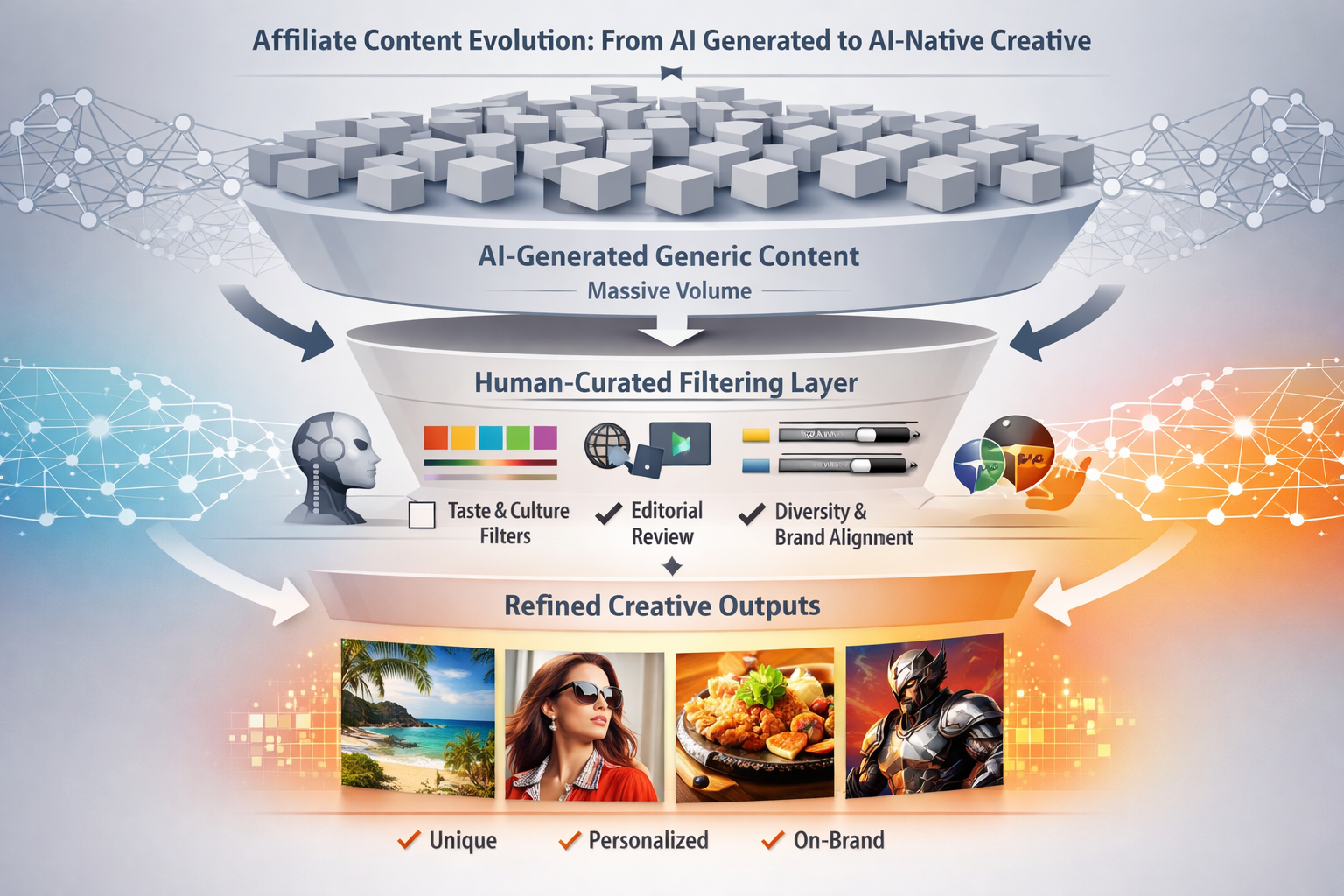
The AI Content Flood
By 2026, approximately 40% of video ads are created or enhanced using AI[3], and text generation has become virtually free. This democratization of content creation means affiliate marketers face unprecedented competition—not just from other humans, but from automated systems producing thousands of variations daily.
The core tension? AI-driven discovery is reshaping how consumers find products, while affiliate attribution still primarily pays for last-touch outcomes[2]. This creates a measurement gap that traditional ROAS optimization can't solve.
Why Generic Content Fails
AI systems excel at pattern recognition and replication. They produce content that looks professional but lacks:
- Cultural context and timing
- Authentic brand voice
- Genuine audience understanding
- Trust-building elements
Industry consensus from brands, publishers, and networks confirms that high-quality human content remains essential, as trust, credibility, and cultural context remain weak points for AI systems[2]. For those learning what is affiliate marketing, this distinction becomes critical for long-term success.
The 7 Tactics for AI-Native Creative Differentiation
Tactic 1: Build Recognizable Editorial Authority in Specific Niches
Rather than becoming a generic content distributor, position yourself as a trusted voice in a specific domain. Brands are specifically increasing spend with partners that demonstrate clear editorial authority[2].
How to implement:
- Choose narrow affiliate marketing niches where you have genuine expertise
- Develop a consistent editorial voice that AI can't easily replicate
- Create content series that build on previous work, showing depth over time
- Establish editorial standards that prioritize accuracy over volume
"Brands are specifically increasing spend with partners that demonstrate clear editorial authority, not just traffic volume."[2]
Tactic 2: Create Content Designed to Be Referenced, Not Just Clicked
In zero-click environments where AI summaries replace traditional search results, content value shifts from clicks to citations. This positions your work for reference within AI systems themselves[2].
Practical approaches:
- Structure content with clear, quotable insights
- Include original data, research, or perspectives
- Create comprehensive resource guides that AI systems will reference
- Use schema markup to help AI understand your content structure
This tactic directly addresses the challenge of how to succeed in affiliate marketing when traditional traffic sources are disrupted.
Tactic 3: Generate Unlimited Visual Creative Variations Using AI Tools
Combat creative fatigue by leveraging AI to produce optimized variations from core assets. Tools like CTR Guard automatically refresh fatigued creatives, while AI video generation creates variations from static assets[3][5].
Implementation strategy:
| Creative Type | AI Tool Application | Differentiation Element |
|---|---|---|
| Static Images | Generate 10-20 variations with different backgrounds, colors, layouts | Human curator selects culturally appropriate versions |
| Video Ads | Create multiple edits from single footage | Add human-written hooks and CTAs |
| Product Shots | Automate background removal and scene placement | Apply brand-specific styling guidelines |
| Social Posts | Generate caption variations | Inject brand voice and current trends |
Tactic 4: Use AI-Generated Models and Virtual Personas Strategically
AI-generated models increase CTR on social platforms (Instagram, X, Telegram) while avoiding licensing issues tied to stock photos or traditional influencers[5]. However, this works best when integrated into existing affiliate funnels rather than as standalone business models.
Best practices:
- ✅ Use AI models for product demonstrations and lifestyle contexts
- ✅ Maintain consistency in virtual persona appearance across campaigns
- ✅ Disclose AI-generated imagery where required by platform policies
- ❌ Avoid creating deceptive or misleading representations
- ❌ Don't rely solely on AI personas without editorial oversight
Tactic 5: Diversify Distribution Aggressively Beyond Google
AI overviews are disrupting search-based discovery. Move away from Google reliance and build presence across multiple platforms[2].
Distribution channels for 2026:
- 📱 Social platforms: TikTok, Instagram Reels, YouTube Shorts
- 📧 Email lists: Direct audience relationships
- 🎙️ Podcasts: Audio content with affiliate integration
- 💬 Community platforms: Discord, Reddit, niche forums
- 📺 Connected TV: Emerging affiliate opportunities
Understanding top strategies for affiliate marketers helps identify which channels align with your niche and audience.
Tactic 6: Implement AI-Driven Automation in Workflows
Operational efficiency becomes a competitive advantage as teams are asked to do more with fewer resources[2]. Focus AI automation on:
- Reporting and analytics: Automated performance dashboards
- Data strengthening: Audience segmentation and insights
- Creative testing: A/B test management and winner identification
- Decision-making: Predictive models for campaign optimization
Wrap AI initiatives in strong data and compliance guardrails[1], aligning with legal, privacy, and brand teams on approved use cases before scaling. Use affiliate programs as budget-safe testing grounds where pay-for-performance models limit risks.
Tactic 7: Explore New Commercial Models Beyond CPA
The future of affiliate measurement extends beyond last-click attribution. Explore commercial models tied to influence and brand lift[2]:
Emerging models:
- 🎯 Brand uplift studies combined with affiliate data
- 📊 "How did you hear about us?" survey responses as measurement tools
- 💰 Hybrid CPM + CPA arrangements for awareness-stage content
- 🤝 Influence-based partnerships with guaranteed content distribution
- 📈 Multi-touch attribution that credits discovery and consideration
This approach aligns with broader affiliate marketing optimization techniques that recognize the full customer journey.
Implementing Hybrid AI-Human Workflows
The Restraint Principle
Not every piece of content needs AI generation. Strategic restraint differentiates your work:
- Use AI for scale (product descriptions, routine updates)
- Reserve human creation for high-value content (pillar articles, video scripts)
- Apply human curation to all AI-generated outputs
- Maintain editorial standards regardless of production method
Niche Storytelling Frameworks
Develop storytelling frameworks that AI can't easily replicate:
- Personal experience narratives: Share genuine product testing stories
- Cultural commentary: Connect products to current trends and movements
- Community insights: Aggregate and analyze audience feedback
- Comparative analysis: Provide nuanced product comparisons based on specific use cases
Quality Control Checkpoints
Before publishing AI-assisted content, verify:
- ✅ Factual accuracy (AI hallucinates)
- ✅ Brand voice consistency
- ✅ Cultural appropriateness
- ✅ Unique value proposition
- ✅ Compliance with disclosure requirements
Measuring Success in the AI-Native Era

Beyond Traditional Metrics
While conversion rates and ROAS remain important, expand your measurement framework:
| Traditional Metric | AI-Native Addition | Why It Matters |
|---|---|---|
| Click-through rate | Content citation rate | Measures reference value |
| Conversion rate | Brand lift score | Captures awareness impact |
| Revenue per click | Audience trust index | Predicts long-term value |
| Traffic volume | Editorial authority score | Indicates differentiation |
Attribution in Multi-Touch Journeys
Recognize that AI assistants introduce new touchpoints. Work with affiliate networks to:
- Track assisted conversions, not just last-click
- Measure content influence across the customer journey
- Document "How did you hear about us?" responses
- Build relationships with brands willing to test new attribution models
Conclusion: Thriving in the 2026 Content Landscape
AI-Native Creative Differentiation: 7 Tactics for Affiliates to Combat the 2026 Content Flood isn't about fighting AI—it's about strategically combining AI's production capabilities with uniquely human elements that build trust, cultural resonance, and genuine influence.
The affiliates who thrive in 2026 will be those who:
- Embrace AI as a production tool while maintaining human editorial control
- Build recognizable authority in specific niches rather than chasing broad traffic
- Create content designed for citation in AI-driven discovery systems
- Diversify distribution beyond search-dependent channels
- Explore new commercial models that recognize the full customer journey
Your Next Steps
- Audit your current content: Identify which pieces could be AI-enhanced and which require human creation
- Choose one niche: Commit to building editorial authority in a specific domain
- Test AI creative tools: Experiment with visual variation generation on a small campaign
- Diversify one channel: Add a new distribution platform beyond your current primary source
- Propose hybrid attribution: Approach one brand partner about testing influence-based measurement
The content flood is real, but it creates opportunity for those who differentiate strategically. By blending AI efficiency with human taste, cultural awareness, and genuine audience relationships, affiliate marketers can not only survive the 2026 landscape—they can dominate it.
For those ready to implement these tactics, exploring AI marketing tools and understanding the introduction to AI in marketing provides essential technical foundations for success.
References
[1] Five Trends Redefining Affiliate Creator Retail Media 2026 – https://ovative.com/impact/expert-insights/five-trends-redefining-affiliate-creator-retail-media-2026/
[2] Ai Affiliate Marketing Fight Discovery 2026 – https://www.affilifest.com/blog/ai-affiliate-marketing-fight-discovery-2026
[3] Future Native Ads Affiliate Marketing Trends Watch – https://www.mgid.com/blog/future-native-ads-affiliate-marketing-trends-watch
[5] Ai Generated Models Make Money – https://affdays.com/post_articles/ai-generated-models-make-money/