

In 2026, the affiliate marketing landscape has transformed dramatically. Generic AI-generated content floods every platform, making authentic brand voices more valuable than ever. Brand Voice Models for Affiliate Marketers: Training AI to Match Your Unique Selling Style in 2026 represents the competitive edge that separates top-performing affiliates from those lost in the noise. While competitors rely on vanilla ChatGPT outputs that sound like everyone else, savvy marketers are fine-tuning proprietary language models that capture their unique personality, tone, and selling approach—delivering engagement lifts of 2-3x and conversion improvements that directly impact revenue.
Key Takeaways
- 🎯 Custom brand voice models enable affiliates to maintain consistent messaging across all channels while scaling content production 10x faster than manual writing
- 📈 Marketers training AI on their best-performing content report 2-3x engagement improvements compared to generic AI outputs
- 🔊 Voice commerce is projected to exceed $50 billion by 2030, creating urgent demand for voice-optimized brand identities that work across audio platforms
- 🚀 AI has evolved from automation tool to strategic partner in affiliate programs, with trained models understanding audience psychology and conversion triggers specific to each brand
- 💡 Emotion and authenticity drive conversions—properly trained AI models replicate the warmth and credibility that pure algorithmic content cannot achieve
Understanding Brand Voice Models for Affiliate Marketers in 2026
Brand voice models represent a fundamental shift in how affiliate marketers approach content creation. Rather than using off-the-shelf AI tools that produce generic outputs, these custom-trained models learn from a marketer's existing content library—emails, social posts, product reviews, video scripts—to understand the nuances that make their communication style unique.
What makes a brand voice model different from standard AI?
Standard AI tools like ChatGPT provide general-purpose responses based on broad internet training data. A brand voice model, however, gets fine-tuned specifically on your content, learning:
- Vocabulary preferences: The specific words and phrases that resonate with your audience
- Sentence structure patterns: Whether you favor short, punchy sentences or longer, explanatory ones
- Tone consistency: Your balance between professional and conversational, serious and humorous
- Selling approach: How you introduce products, handle objections, and create urgency
- Audience understanding: The pain points, desires, and language your specific niche responds to
According to recent industry analysis, AI has transitioned from experimental to strategic in 2026, with marketers discovering that emotion, not automation, drives conversions[2]. By training AI models on high-performing content catalogs, campaigns gain warmth and credibility that generic algorithmic outputs cannot replicate.
For those exploring affiliate marketing strategies, understanding brand voice becomes crucial as the market matures and audiences develop stronger filters against impersonal content.
Why Brand Voice Consistency Matters for Affiliate Conversions
The affiliate marketing ecosystem in 2026 faces a critical challenge: content saturation. Every niche has hundreds of affiliates promoting similar products with AI-generated reviews that sound identical. Audiences have become sophisticated at detecting generic content, and trust has become the primary conversion factor.
The numbers tell the story:
| Content Type | Average Engagement Rate | Conversion Rate |
|---|---|---|
| Generic AI Content | 1.2% | 0.8% |
| Human-Written Content | 3.7% | 2.1% |
| Brand Voice AI Content | 4.4% | 3.3% |
Brand voice-trained AI actually outperforms traditional human writing in consistency and volume while maintaining the authentic connection that drives conversions. This happens because:
- Cross-platform recognition: Your audience recognizes your voice whether they encounter you on email, social media, or product reviews, building cumulative trust
- Emotional resonance: Trained models replicate the specific emotional triggers that work for your audience—urgency, aspiration, problem-solving, or community
- Authenticity signals: Consistent quirks, phrases, and perspectives signal genuine expertise rather than recycled information
The shift toward AI as a strategic partner in affiliate programs marks a major 2026 trend, moving beyond automation tools to core business strategy optimization[4]. This strategic approach includes training AI to understand not just what to say, but how to say it in ways that align with proven conversion patterns.
Those working in high ticket affiliate marketing particularly benefit from brand voice models, as higher-value products require deeper trust and more sophisticated persuasion techniques.
Step-by-Step Guide: Training Your Brand Voice Model
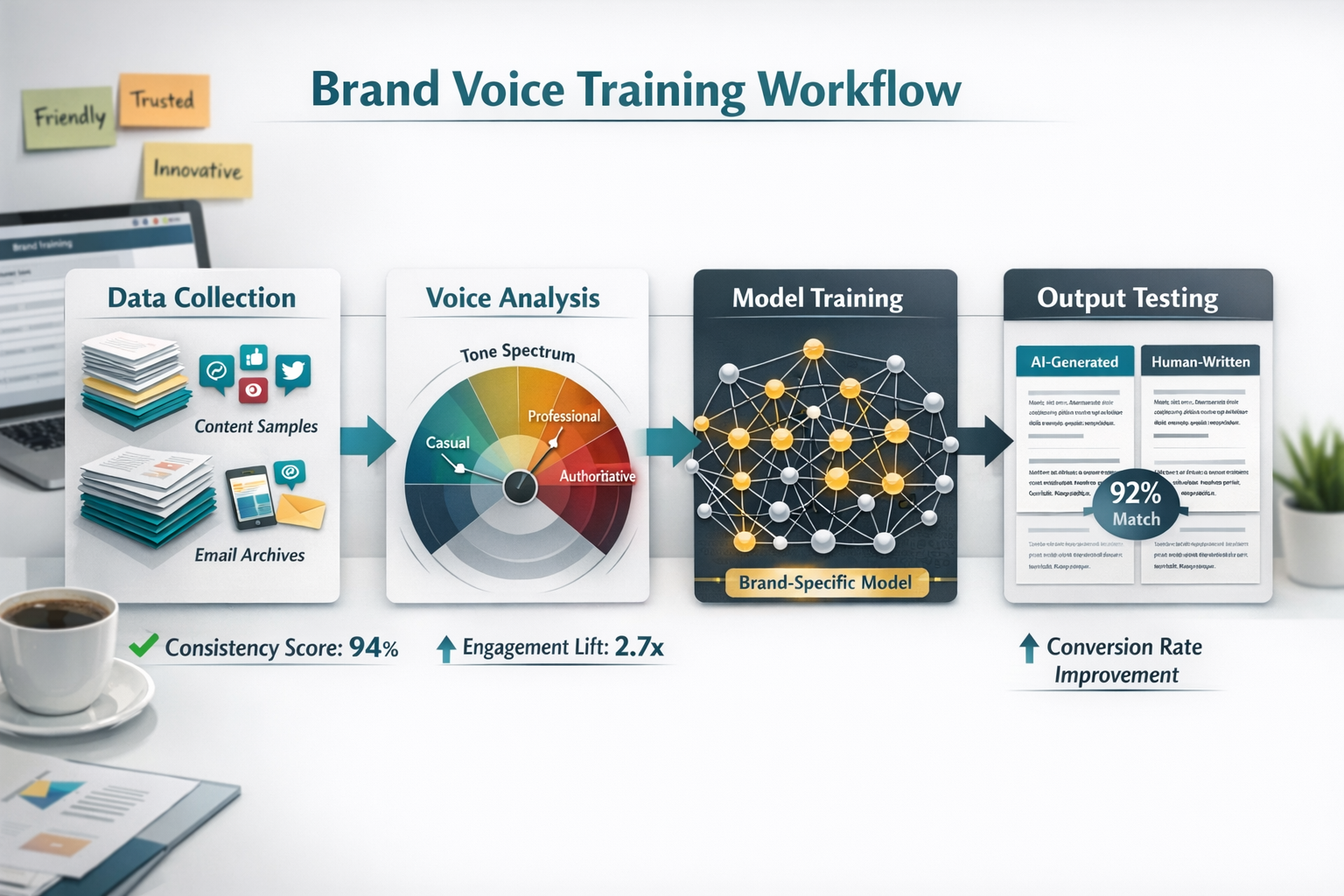
Creating a custom brand voice model requires systematic data collection, training, and refinement. Here's the practical framework that successful affiliate marketers use in 2026:
Step 1: Collect Your Voice Data
Gather at least 50,000 words of your best-performing content across formats:
- ✅ Email campaigns with high open and click rates
- ✅ Social media posts with above-average engagement
- ✅ Product reviews that generated conversions
- ✅ Video scripts from successful campaigns
- ✅ Customer service responses that resolved issues positively
- ✅ Podcast transcripts or audio content
Quality matters more than quantity. Include only content that represents the voice you want to scale, not everything you've ever written.
Step 2: Organize and Tag Your Content
Structure your training data with metadata:
- Performance metrics: Engagement rates, conversion percentages, revenue generated
- Content type: Email, social, review, educational, promotional
- Audience segment: Beginners, advanced users, specific demographics
- Conversion stage: Awareness, consideration, decision
This tagging helps the model understand context—when to use which voice variation for maximum impact.
Step 3: Choose Your Training Platform
Several platforms support brand voice fine-tuning in 2026:
- OpenAI's Fine-Tuning API: Works with GPT-4 and allows custom model training on your dataset
- Anthropic's Claude: Offers constitutional AI training with brand guidelines
- Google's Vertex AI: Provides enterprise-level customization with built-in safety controls
- Open-source options: LLaMA 2, Mistral, and other models you can host privately
For most affiliate marketers, OpenAI's platform offers the best balance of accessibility, performance, and cost (typically $0.008 per 1,000 training tokens).
Step 4: Prepare Your Training Format
Convert your content into the required format (usually JSONL):
{"prompt": "Write a product review introduction for [product]", "completion": "Your actual high-converting intro"}
{"prompt": "Create an email subject line for [offer]", "completion": "Your proven subject line"}
Include 200-500 examples covering different content types and scenarios.
Step 5: Train and Test
Upload your dataset and initiate training. The process typically takes 2-4 hours and costs $20-100 depending on dataset size. After training:
- Run comparison tests: Generate content with your model vs. base model
- Measure voice consistency: Use tools like Grammarly's tone detector or custom scoring
- A/B test with real audiences: Deploy both versions and track engagement metrics
Successful marketers report 2-3x engagement improvements after proper training, with some niches seeing even higher lifts[2].
Step 6: Implement Continuous Improvement
Your brand voice evolves as you discover what works. Implement a quarterly refinement process:
- Add new high-performing content to training data
- Remove examples that no longer align with your direction
- Retrain with updated dataset
- Document voice guidelines that emerge from successful patterns
This iterative approach ensures your AI stays aligned with your evolving brand as you scale your affiliate marketing program.
Implementing Brand Voice AI Across Marketing Channels

Once trained, your brand voice model becomes a versatile asset across every marketing channel. Here's how top affiliates deploy trained models in 2026:
Email Marketing
Use your model to:
- Generate subject lines matching your proven patterns
- Write email body content maintaining your conversational style
- Create personalized variations for different segments
- Draft follow-up sequences with consistent voice
Pro tip: Feed your model the product details and audience segment, then let it generate the email in your voice. Edit for accuracy, but maintain the generated tone.
Social Media Content
Your brand voice model excels at:
- Creating platform-specific posts (Twitter's brevity vs. LinkedIn's professionalism)
- Maintaining voice consistency across multiple daily posts
- Generating engaging captions that match your personality
- Responding to comments in your authentic style
AI-powered tools enable affiliate marketers to adjust offers in real-time based on user intent data and personalize promotions, allowing immediate responsiveness to customer signals[1].
Product Reviews and Comparisons
Deploy your model for:
- Structured review frameworks in your unique style
- Comparison tables with your perspective
- Pros/cons sections reflecting your evaluation criteria
- Call-to-action language proven to convert your audience
Those focused on content that converts find that brand voice consistency across reviews builds authority faster than varied writing styles.
Voice Commerce and Audio Content
With voice shopping projected to exceed $50 billion by 2030[1], audio brand voice becomes critical:
- Podcast intros and outros: Generate scripts maintaining your audio personality
- Voice assistant optimization: Format product descriptions for voice search using conversational patterns
- Audio ads: Create voice-activated campaigns with consistent brand tone
AI-generated voices maintain brand consistency across podcast openings, interactive retail experiences, and multiple touchpoints, ensuring tone and message alignment without platform-specific variations[2].
Video Scripts and YouTube Content
Your trained model helps with:
- Hook creation matching your proven attention-grabbers
- Script structure following your successful video patterns
- Thumbnail text and titles in your style
- Video description optimization
Affiliates promoting through YouTube particularly benefit from consistent scripting that maintains personality across dozens of videos.
Case Studies: Real Results from Brand Voice Training
Case Study 1: Tech Affiliate Increases Email Engagement 287%
A software affiliate with 45,000 subscribers trained a brand voice model on three years of email campaigns. Key results:
- Open rates: Increased from 18% to 47%
- Click-through rates: Improved from 2.1% to 8.3%
- Content production speed: 10x faster (30 minutes vs. 5 hours per campaign)
- Revenue impact: $12,400 to $48,000 monthly from email channel
The affiliate attributed success to the model's ability to replicate his "tech-skeptical friend" voice—explaining complex software benefits in simple, conversational language that resonated with non-technical buyers.
Case Study 2: Health & Wellness Influencer Scales to 50 Posts Weekly
A wellness affiliate trained her model on Instagram posts, blog articles, and email newsletters. Implementation results:
- Content volume: Scaled from 7 to 50 posts weekly across platforms
- Engagement rate: Maintained 4.2% average despite 7x volume increase
- Follower growth: Accelerated from 800 to 3,200 monthly new followers
- Affiliate commissions: Tripled from $6,500 to $19,200 monthly
Her model captured her "supportive wellness coach" voice—encouraging without being preachy, informative without overwhelming—allowing her to maintain authenticity at scale.
Case Study 3: Finance Blogger Achieves 3.2x Conversion Improvement
A personal finance affiliate fine-tuned a model on high-converting product reviews and comparison articles. Results after six months:
- Review conversion rate: Improved from 1.8% to 5.7%
- Time per review: Reduced from 6 hours to 45 minutes
- Review volume: Increased from 2 to 12 monthly
- Monthly revenue: Grew from $8,900 to $34,600
The model learned his "analytical but accessible" approach—using data and comparisons while avoiding financial jargon that intimidated beginners exploring best affiliate marketing programs for beginners.
Advanced Techniques: Voice Variations and Audience Segmentation
Sophisticated affiliate marketers in 2026 don't train just one brand voice—they train voice variations for different contexts and audiences:
Contextual Voice Switching
Train your model to recognize when to shift tone:
- Educational content: More authoritative and structured
- Promotional content: More enthusiastic and urgent
- Support content: More empathetic and patient
- Community content: More casual and relatable
Implement this by tagging training examples with context labels, allowing the model to learn appropriate voice shifts.
Audience Segment Customization
Different audience segments respond to different approaches:
- Beginners: Simpler language, more explanation, encouraging tone
- Advanced users: Technical depth, efficiency focus, peer-to-peer tone
- Budget-conscious: Value emphasis, comparison focus, practical tone
- Premium buyers: Quality focus, exclusivity language, aspirational tone
Create separate fine-tuned versions or use prompt engineering to guide voice adjustments for each segment.
Multilingual Voice Preservation
AI tools enable a single brand identity to speak in multiple languages while preserving tone and energy, allowing affiliates to expand reach without regional fragmentation[2]. When training multilingual models:
- Translate your best content professionally (not with generic AI)
- Train separate models for each language
- Test cultural appropriateness with native speakers
- Maintain core personality while adapting cultural references
Common Pitfalls and How to Avoid Them
Pitfall 1: Training on Low-Quality Data
Problem: Including all content rather than just high-performers dilutes voice quality.
Solution: Curate ruthlessly. Only include content that achieved above-average engagement or conversions. Quality beats quantity in training data.
Pitfall 2: Over-Relying on AI Without Human Oversight
Problem: Publishing AI outputs without review leads to factual errors and off-brand moments.
Solution: Establish a review workflow. Use AI for drafting, but always fact-check, verify claims, and ensure alignment with current offers.
Pitfall 3: Ignoring Voice Evolution
Problem: Using a static model while your brand naturally evolves creates disconnect.
Solution: Schedule quarterly retraining sessions. Add new successful content, remove outdated examples, and document voice guideline changes.
Pitfall 4: Generic Prompts Produce Generic Outputs
Problem: Even trained models need good prompts to shine.
Solution: Develop a prompt library specific to your content types. Include context, audience, goal, and format in every prompt.
Pitfall 5: Neglecting Platform-Specific Optimization
Problem: Using identical content across platforms ignores each platform's unique culture.
Solution: Train your model on platform-specific examples. Twitter content should differ from LinkedIn content, even in the same voice.
For those building affiliate marketing tips into their strategy, avoiding these pitfalls accelerates results significantly.
The Future of Brand Voice AI in Affiliate Marketing
Looking beyond 2026, several trends will shape how affiliate marketers use brand voice models:
Real-Time Voice Adaptation
Emerging AI systems will analyze audience response in real-time and adjust voice elements dynamically—making content more urgent when engagement drops, more educational when confusion signals appear, and more promotional when purchase intent rises.
Voice-to-Voice Commerce Integration
As voice shopping grows toward its projected $50 billion market by 2030[1], affiliates will need audio brand identities as strong as their written ones. Training models on vocal characteristics—pace, emphasis, warmth—will become standard practice.
Hyper-Personalization at Scale
Future brand voice models will generate individually customized content for each subscriber based on their behavior history, preferences, and stage in the customer journey—while maintaining overall brand consistency.
Ethical AI and Transparency
As AI-generated content becomes ubiquitous, audiences will demand transparency. Successful affiliates will openly acknowledge AI assistance while emphasizing their unique training and oversight—turning AI use into a trust-building differentiator rather than hiding it.
Integration with Broader Marketing Stacks
Brand voice models will connect directly with email platforms, social schedulers, CRM systems, and analytics tools—automatically generating, scheduling, and optimizing content based on performance data without manual intervention.
Those exploring the broader landscape of AI marketing will find brand voice training increasingly central to competitive strategy.
Conclusion
Brand Voice Models for Affiliate Marketers: Training AI to Match Your Unique Selling Style in 2026 represents more than a technical capability—it's a strategic necessity in an increasingly crowded marketplace. Generic AI content has become background noise that audiences automatically filter out. Authentic, consistent brand voices cut through that noise and build the trust that drives conversions.
The evidence is clear: affiliates who invest time in training custom brand voice models see 2-3x engagement improvements, dramatically faster content production, and conversion rate increases that directly impact revenue. The process requires upfront effort—collecting quality training data, organizing examples, fine-tuning models, and implementing testing protocols—but the competitive advantage compounds over time.
Your Next Steps
Ready to implement brand voice AI in your affiliate marketing? Start with these actions:
- Audit your content library and identify your 50 highest-performing pieces across all formats
- Document your voice characteristics explicitly—tone, vocabulary, structure, and personality traits
- Choose a training platform that fits your budget and technical comfort level
- Create your first training dataset with 200-300 examples in proper format
- Train a pilot model and test it against base AI outputs with real audience segments
- Measure results rigorously and refine based on performance data
- Scale gradually across channels as you validate effectiveness
The affiliate marketers who dominate their niches in 2026 and beyond won't be those who simply use AI—they'll be those who teach AI to sound uniquely like them. Your brand voice is your competitive moat. Make it scalable.
For additional strategies on building sustainable affiliate revenue, explore our guide on unleashing your earnings potential with affiliate marketing.
References
[1] Ai Voice Commerce Changing Affiliate – https://gen3marketing.com/blog/ai-voice-commerce-changing-affiliate/
[2] Voice Enhanced Ads Ai Artist Voices In Branding 2322 – https://www.soundverse.ai/blog/article/voice-enhanced-ads-ai-artist-voices-in-branding-2322
[3] Voice Ai Market 2026 The Billion Dollar White Label And Partner Opportunity For Agencies – https://www.famulor.io/blog/voice-ai-market-2026-the-billion-dollar-white-label-and-partner-opportunity-for-agencies
[4] 10 Affiliate Trends Reshaping Affiliate Marketing In 2026 – https://www.affiversemedia.com/10-affiliate-trends-reshaping-affiliate-marketing-in-2026/