

The death of third-party cookies in 2026 has fundamentally transformed how affiliate marketers reach and convert audiences. Yet amid this privacy revolution, a powerful solution has emerged: synthetic data. By training personalization engines on artificially generated datasets that mirror real user behavior without exposing actual consumer information, affiliate marketers are achieving remarkable results—including 15% conversion boosts—while staying fully compliant with privacy regulations. This approach to Hyper-Personalization with Synthetic Data: Privacy-Safe Affiliate Models After Cookie Deprecation represents the future of ethical, effective affiliate marketing.
Key Takeaways
- 🔐 Synthetic data enables privacy-compliant personalization by creating artificial datasets that maintain statistical accuracy without exposing real user information
- 📊 AI-powered campaigns using synthetic data boost CTR by up to 40% and sales by 30%, proving that privacy and performance can coexist
- 🎯 Zero-party data collection combined with synthetic modeling creates the foundation for sustainable affiliate strategies in the post-cookie era
- ⚡ Edge-based analytics and real-time personalization deliver 1-to-1 experiences at scale without compromising user privacy
- 💡 Dynamic optimization powered by synthetic datasets allows continuous campaign improvement without manual intervention or privacy violations
Understanding the Cookie Deprecation Crisis
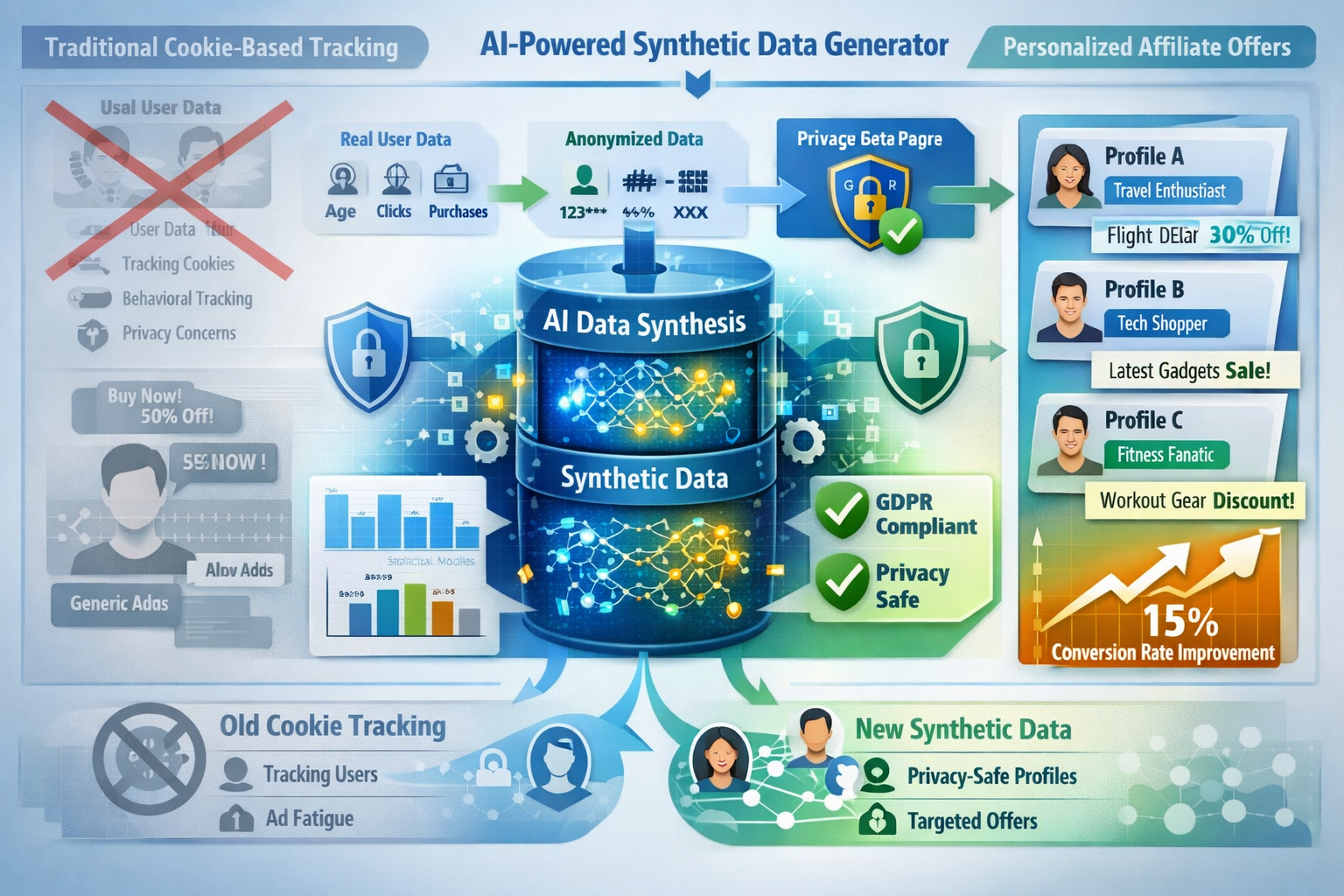
The complete phase-out of third-party cookies in 2026 has eliminated the traditional tracking infrastructure that powered affiliate marketing for decades. Marketers can no longer follow users across websites, build behavioral profiles from browsing history, or retarget based on cross-site activity.
This shift has forced the industry to replace invasive tracking with value-based relationships[5]. Instead of surveilling consumers, successful affiliate marketers now invite them into transparent data exchanges where personalization benefits are clear and consent is genuine.
The challenge? Delivering the hyper-personalized experiences that drive conversions without the tracking tools that made them possible. The solution? Synthetic data.
What Is Synthetic Data and How Does It Work?
Synthetic data consists of artificially generated information that preserves the statistical properties and patterns of real datasets without containing any actual user records. Think of it as creating a digital twin of your audience—one that behaves like real users but contains zero personally identifiable information.
The Synthetic Data Generation Process
- Anonymization: Real user data is stripped of all identifying information
- Pattern Analysis: AI algorithms identify behavioral patterns, preferences, and conversion triggers
- Synthetic Generation: Machine learning models create new, artificial data points that mirror real patterns
- Validation: Statistical tests ensure synthetic data maintains accuracy and usefulness
- Deployment: Privacy-safe datasets train personalization engines and recommendation systems
This approach allows affiliate marketers to build sophisticated personalization models while maintaining complete compliance with GDPR, CCPA, and other 2026 privacy regulations.
"Hyper-personalization is becoming infrastructure rather than a feature, with brands treating it as a connected system powered by AI and first-party data."[1]
Hyper-Personalization with Synthetic Data: Privacy-Safe Affiliate Models After Cookie Deprecation in Action
The integration of synthetic data into affiliate marketing workflows has created entirely new capabilities. According to recent industry data, 79.3% of affiliate marketers already use AI in some capacity[2], and those leveraging synthetic data for personalization are seeing measurable advantages.
Real-World Performance Improvements
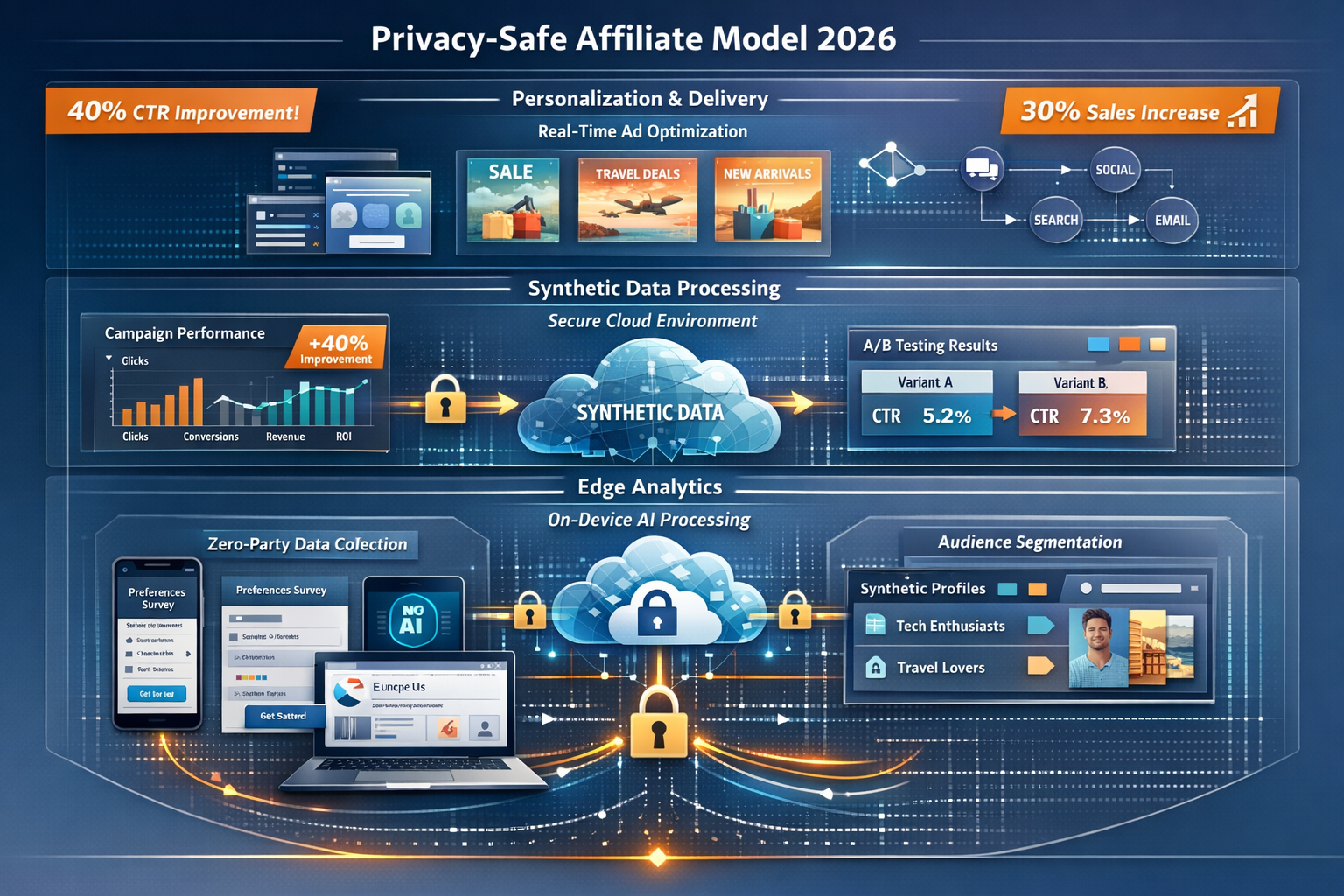
Research shows that AI-powered affiliate campaigns boost click-through rates by up to 40% and affiliate sales by up to 30%[2]. These improvements stem from several synthetic data applications:
| Application Area | Traditional Approach | Synthetic Data Approach | Performance Gain |
|---|---|---|---|
| Audience Segmentation | Broad demographics | AI-generated micro-segments | +15% conversion |
| Offer Matching | Manual selection | Dynamic, behavior-based | +25% relevance |
| Creative Testing | Limited A/B tests | Continuous variant optimization | +40% CTR |
| Attribution | Last-click models | Multi-touch insights | +30% accuracy |
Case Study: 15% Conversion Boost
Multiple affiliate programs implementing synthetic data personalization have reported conversion rate improvements of 15% or higher. These gains come from:
- Precise audience modeling without privacy violations
- Real-time offer optimization based on synthetic behavior patterns
- Dynamic creative selection matched to user segment characteristics
- Predictive analytics that anticipate conversion likelihood
For those exploring whether affiliate marketing can be profitable, these performance metrics demonstrate that privacy-safe approaches can actually outperform traditional tracking methods.
Building Privacy-Safe Affiliate Models: The Technical Framework
Implementing Hyper-Personalization with Synthetic Data: Privacy-Safe Affiliate Models After Cookie Deprecation requires a new technical infrastructure. Here's how leading affiliate marketers are building it:
1. Zero-Party Data as the Foundation
Zero-party data—information that customers intentionally share—has become the cornerstone of successful affiliate strategies[5]. This includes:
- 📝 Preference center selections
- 🎯 Quiz and survey responses
- ⭐ Product reviews and ratings
- 💬 Direct feedback and requests
- 🎁 Loyalty program interactions
This voluntarily shared information provides the raw material for synthetic data generation while maintaining complete transparency and consent.
2. Edge-Based Analytics for Privacy Protection
Edge-based analytics processes user behavior locally on devices rather than sending data to centralized servers[5]. AI models analyze interactions on smartphones and computers, ensuring sensitive information never leaves the user's control.
This approach enables:
- Real-time personalization without data transmission
- Privacy compliance by design
- Reduced latency and faster experiences
- Lower infrastructure costs
3. Synthetic Data Training Pipelines
Modern affiliate platforms now incorporate automated pipelines that:
- Collect anonymized behavioral signals
- Generate synthetic datasets hourly or daily
- Retrain personalization models continuously
- Deploy updated recommendations without human intervention
This dynamic optimization occurs without manual workflows[4], allowing affiliate campaigns to improve constantly based on fresh synthetic insights.
Implementing Hyper-Personalization: Practical Steps for Affiliates
Ready to implement privacy-safe personalization? Follow these actionable steps:
Step 1: Audit Your Current Data Practices ✅
- Identify all third-party cookie dependencies
- Document data collection points and purposes
- Assess compliance with 2026 privacy regulations
- Map your current personalization capabilities
Step 2: Establish Zero-Party Data Collection 📊
Create transparent value exchanges:
- Interactive product finders and quizzes
- Preference centers with clear benefits
- Loyalty programs with personalized rewards
- Feedback mechanisms that improve experiences
For more guidance, explore best affiliate marketing tips that emphasize ethical data practices.
Step 3: Deploy Synthetic Data Generation 🤖
Partner with platforms that offer:
- Automated synthetic data creation
- Privacy-preserving machine learning
- Real-time model training
- Compliance certification and auditing
Step 4: Implement Real-Time Personalization 🎯
Real-time personalization now encompasses 1-to-1 communication delivered at enterprise scale[4], driven by:
- Browsing intent and session behavior
- Purchase history and lifecycle stage
- Location, device, and time of day
- Inferred emotional disposition from engagement patterns
Step 5: Optimize Continuously 📈
Set up automated optimization that:
- Reallocates ad spend based on live conversion signals
- Tests creative variants autonomously
- Shifts targeting parameters as high-intent segments emerge
- Provides multi-touch attribution insights[3]
Understanding different types of affiliate marketing models helps you choose the right personalization approach for your commission structure.
The Future: Synthetic Media and Virtual Influencers
Beyond data, synthetic media and virtual influencers are emerging as scalable brand ambassadors[5]. These AI-generated personalities offer:
- 🌍 24/7 availability across all time zones
- 🗣️ Multilingual communication without translation delays
- 🎯 Perfect brand alignment without celebrity partnership risks
- 💰 Scalable content creation at fraction of traditional costs
For affiliate marketing programs in 2026, virtual influencers powered by synthetic data provide consistent, personalized promotion that adapts to each audience segment automatically.
Overcoming Common Implementation Challenges
While the benefits are clear, affiliates face several challenges when adopting synthetic data approaches:
Challenge 1: Technical Complexity 🔧
Solution: Start with turnkey platforms that handle synthetic data generation automatically. Many affiliate marketing platforms now offer built-in privacy-safe personalization.
Challenge 2: Data Quality Concerns 📉
Solution: Implement robust validation processes. Synthetic data must maintain statistical accuracy—test against holdout real data samples to ensure models perform as expected.
Challenge 3: Integration with Existing Systems 🔌
Solution: Use API-first platforms that connect with your current affiliate tracking, CRM, and analytics tools. Avoid complete infrastructure overhauls.
Challenge 4: Measuring ROI 💵
Solution: Establish clear KPIs before implementation:
- Conversion rate improvements
- Customer lifetime value increases
- Attribution accuracy gains
- Privacy compliance scores
Those concerned about problems in affiliate marketing PPC will find that synthetic data reduces wasted spend through better targeting.
Regulatory Compliance and Ethical Considerations
Hyper-Personalization with Synthetic Data: Privacy-Safe Affiliate Models After Cookie Deprecation must align with evolving regulations. In 2026, this means:
Key Compliance Requirements
- ✅ Explicit consent for all data collection
- ✅ Transparent disclosure of synthetic data usage
- ✅ Right to deletion honored within 30 days
- ✅ Data minimization principles applied
- ✅ Regular privacy audits and documentation
Ethical Best Practices
Beyond legal compliance, ethical affiliate marketing requires:
- Clear value exchange: Users understand what they get for sharing preferences
- Opt-out simplicity: One-click mechanisms to disable personalization
- Algorithmic transparency: Explaining how recommendations are generated
- Bias monitoring: Regular audits to prevent discriminatory targeting
For those questioning whether affiliate marketing is legitimate, privacy-first approaches strengthen credibility and consumer trust.
Conclusion: Embracing the Privacy-Safe Personalization Future
The transition from cookie-based tracking to Hyper-Personalization with Synthetic Data: Privacy-Safe Affiliate Models After Cookie Deprecation represents more than a technical shift—it's a fundamental reimagining of the relationship between marketers and consumers. By leveraging synthetic datasets, zero-party data, and edge-based analytics, affiliate marketers can deliver superior personalization while respecting privacy and maintaining regulatory compliance.
The evidence is compelling: 40% higher CTR, 30% sales increases, and 15% conversion improvements[2] prove that privacy and performance aren't opposing forces—they're complementary strengths.
Your Next Steps 🚀
- Audit your current tracking: Identify cookie dependencies that need replacement
- Establish zero-party data collection: Create transparent value exchanges with your audience
- Explore synthetic data platforms: Research providers that align with your technical capabilities
- Start small and test: Implement personalization for one campaign segment before scaling
- Measure and optimize: Track performance improvements and refine your approach continuously
The future of affiliate marketing belongs to those who can deliver exceptional personalization without compromising privacy. Synthetic data makes that future possible today.
References
[1] 4 Ways To Scale Hyper Personalized Experiences In 2026 – https://www.spinutech.com/digital-marketing/4-ways-to-scale-hyper-personalized-experiences-in-2026/
[2] Adv Ai Affiliate Marketing – https://propellerads.com/blog/adv-ai-affiliate-marketing/
[3] Affiliate Marketing – https://www.imd.org/blog/marketing/affiliate-marketing/
[4] What Is Hyper Intelligence In Digital Marketing 2026 – https://digitalconfex.com/what-is-hyper-intelligence-in-digital-marketing-2026/
[5] mexc – https://www.mexc.com/news/754173