

Last updated: March 24, 2026
Quick Answer
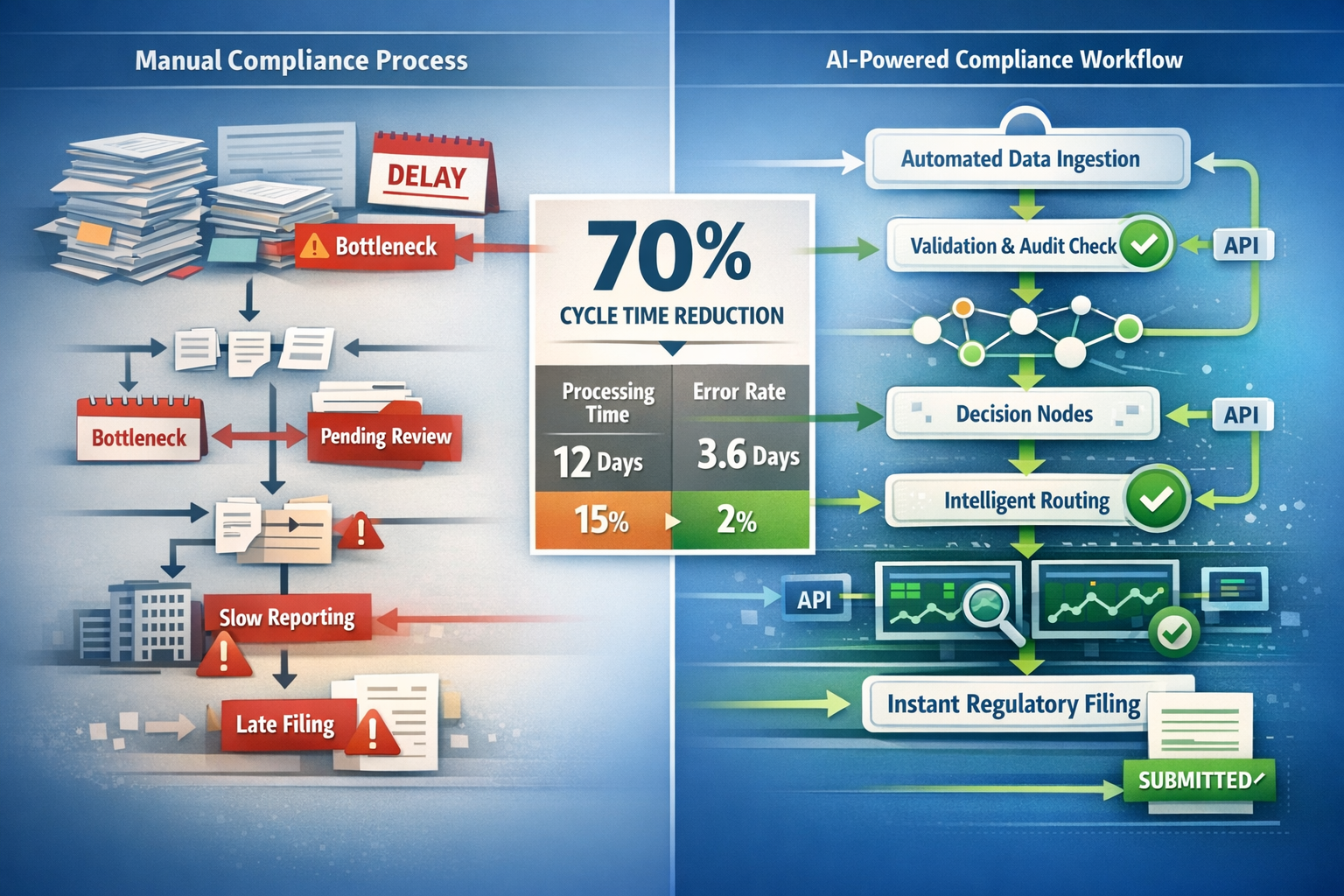
Industry-Specific Agentic Workflows: Tailoring Autonomy for B2B Financial Services SaaS Compliance and Reporting involves deploying custom AI agent designs that handle real-time regulatory monitoring, fraud detection, and automated filing processes specific to financial services requirements. These workflows adapt to evolving compliance standards while reducing manual intervention, with 2026 deployments showing 70% reductions in compliance cycle times compared to traditional manual processes. Financial institutions use these systems to monitor transactions, flag suspicious activity, generate regulatory reports, and maintain audit trails across complex SaaS environments.
Key Takeaways
- Agentic workflows cut compliance cycle times by 70% in 2026 financial services deployments by automating monitoring, detection, and reporting tasks that previously required weeks of manual review
- Eight core compliance components must be addressed: data privacy, security, financial/operational compliance, vendor risk, identity governance, continuous monitoring, license management, and audit readiness[1]
- Real-time monitoring replaces annual check-ins as regulatory perimeters expand to cover technology providers, buy-now-pay-later firms, ESG ratings providers, and crypto companies[2]
- Data maturity determines AI success—organizations need interoperability across fraud, sanctions, money laundering, and corruption detection systems before deploying autonomous agents[3]
- Legacy system gaps create hidden risks when mainframe infrastructure from the 1990s-2000s runs parallel to modern applications, requiring specialized integration strategies[4]
- Unified orchestration connects risk domains including fraud, bribery, corruption, human rights violations, and financial instability through connected technology architectures[3]
- Pilot deployments should start with high-volume, rules-based tasks like transaction monitoring and regulatory filing preparation before expanding to complex judgment calls
What Are Industry-Specific Agentic Workflows for Financial Services Compliance?
Industry-specific agentic workflows for B2B financial services are autonomous AI systems designed to execute compliance and reporting tasks with minimal human intervention. These workflows monitor transactions in real-time, identify regulatory violations, generate required reports, and adapt to changing standards without manual reprogramming.
Unlike generic automation tools, these agents understand financial services context. They recognize the difference between legitimate high-value transactions and suspicious patterns, know which regulations apply to specific transaction types, and can route alerts to appropriate compliance teams based on severity and jurisdiction.
Key characteristics include:
- Context awareness: Agents understand financial services terminology, regulatory frameworks (SOX, GDPR, PCI-DSS, AML), and industry-specific risk patterns
- Adaptive learning: Systems update their detection models as new fraud patterns emerge and regulations evolve
- Multi-system orchestration: Agents pull data from core banking systems, payment processors, CRM platforms, and third-party data sources
- Audit trail generation: Every decision and action is logged with reasoning explanations for regulatory review
Financial institutions deploy these workflows because manual compliance processes can't keep pace with transaction volumes or regulatory complexity. A mid-size bank processing 50,000 daily transactions would need dozens of compliance analysts working around the clock to manually review suspicious activity—agentic workflows handle this continuously and flag only the highest-risk cases for human review.
Common mistake: Deploying agents without establishing data governance frameworks first. If transaction data is siloed across systems or quality is inconsistent, agents will produce unreliable results. Address data maturity before automation.
Why Do B2B Financial Services Need Specialized Agentic Workflows?
B2B financial services face unique compliance challenges that generic automation can't address. The regulatory environment is expanding rapidly, with oversight now covering technology providers, buy-now-pay-later platforms, ESG ratings agencies, and cryptocurrency firms alongside traditional banks and investment managers[2].
Three factors drive the need for specialized workflows:
Regulatory complexity and change velocity: Financial institutions must comply with multiple overlapping frameworks (federal, state, international) that update frequently. Generic automation requires manual reconfiguration for each regulatory change; specialized agents monitor regulatory updates and adjust their logic automatically.
Transaction volume and velocity: B2B payment networks process millions of high-value transactions daily. Manual review is impossible at this scale, and simple rule-based systems generate excessive false positives that overwhelm compliance teams.
Interconnected risk domains: Financial crime involves fraud, money laundering, sanctions violations, and corruption—often simultaneously. Specialized agents maintain unified views across these domains, detecting patterns that span multiple risk categories[3].
The competitive advantage is measurable. Institutions using AI-powered automation for compliance monitoring can process regulatory filings in days instead of weeks, reducing time-to-market for new products and services while maintaining stronger risk controls.
Decision rule: Choose specialized agentic workflows if your organization processes more than 10,000 transactions monthly, operates across multiple jurisdictions, or faces regulatory audits more than twice annually. For smaller operations with simpler compliance needs, traditional rule-based automation may suffice.
Legacy infrastructure creates particular challenges. Many financial institutions run parallel systems—mainframe platforms from the 1990s-2000s handling core transactions alongside modern web applications for customer interaction[4]. This creates visibility gaps where suspicious activity can hide between systems. Specialized agents bridge these gaps by monitoring cross-system activity patterns.
What Are the Eight Core Components of SaaS Compliance in Financial Services?
SaaS compliance management in financial services requires addressing eight interconnected components that form a comprehensive governance framework[1]:
| Component | Purpose | Agentic Workflow Application |
|---|---|---|
| Data Privacy | Protect customer PII, ensure consent management, comply with GDPR/CCPA | Agents monitor data access patterns, flag unauthorized queries, automate consent tracking |
| Data Security | Prevent breaches, encrypt sensitive data, manage access controls | Continuous vulnerability scanning, automated patch management, anomaly detection |
| Financial/Operational Compliance | Meet SOX, SOC 2, PCI-DSS requirements | Automated control testing, evidence collection, exception reporting |
| Vendor Risk Management | Assess third-party SaaS provider security and compliance | Automated vendor assessments, continuous monitoring of vendor security posture |
| Identity & Access Governance | Manage user permissions, enforce least privilege | Automated access reviews, privilege escalation detection, orphaned account cleanup |
| Continuous Monitoring | Real-time compliance status tracking | 24/7 automated monitoring with intelligent alerting for policy violations |
| License Compliance | Track software usage, prevent license violations | Usage monitoring, license optimization recommendations, compliance reporting |
| Audit Readiness | Maintain evidence trails, respond to audit requests | Automated evidence collection, audit trail generation, report preparation |
These components work together—a data security breach (component 2) can trigger data privacy violations (component 1) and create audit findings (component 8). Agentic workflows maintain connections between components, so an alert in one domain automatically triggers relevant checks in related areas.
Implementation priority: Start with continuous monitoring and data security, as these provide the foundation for other components. Organizations that deploy monitoring first can baseline normal activity patterns before adding more sophisticated fraud detection and vendor risk capabilities.
Edge case: Companies using multiple SaaS platforms (CRM, ERP, payment processing, analytics) need agents that can work across different API architectures and data formats. Choose workflow platforms with pre-built connectors for common financial services SaaS tools, or budget additional time for custom integration development.
How Do Agentic Workflows Enable Real-Time Fraud Detection and Transaction Monitoring?
Agentic workflows transform fraud detection from a reactive, batch-processing function into a continuous, real-time operation. Instead of reviewing transactions hours or days after they occur, agents analyze activity as it happens and flag suspicious patterns within seconds[3].
The workflow operates in three stages:
Data ingestion and normalization: Agents continuously pull transaction data from multiple sources (payment processors, core banking systems, wire transfer networks) and normalize it into a consistent format for analysis.
Multi-model risk scoring: Each transaction passes through multiple detection models simultaneously:
- Rule-based checks: Agents apply regulatory thresholds (e.g., transactions over $10,000 require enhanced due diligence)
- Pattern recognition: Machine learning models compare transactions to historical patterns and peer group behavior
- Network analysis: Agents map relationships between accounts, identifying suspicious connections
- Behavioral analysis: Systems detect deviations from established customer behavior patterns
Intelligent routing and case management: Based on risk scores and violation types, agents automatically route alerts to appropriate teams, generate preliminary investigation reports, and escalate time-sensitive cases.
The speed advantage is substantial. Traditional fraud detection systems might review transactions in nightly batch processes, meaning fraudulent activity could continue for 24 hours before detection. Agentic workflows detect anomalies within seconds and can automatically block suspicious transactions pending review.
Practical example: A B2B payment processor using agentic workflows detected a compromised vendor account within 90 seconds when the account suddenly initiated wire transfers to new international recipients. The agent blocked the transactions, alerted the fraud team, and initiated account lockdown procedures—preventing $2.3 million in losses.
Common mistake: Setting detection thresholds too aggressively, which generates excessive false positives and causes alert fatigue. Start with conservative thresholds that flag only high-confidence violations, then gradually tighten as the system learns your normal activity patterns and compliance teams build confidence in the technology.
Organizations can enhance these workflows by integrating smart routing capabilities that use large language models to categorize and prioritize incoming alerts based on urgency and potential impact.
How Do You Address Legacy System Integration Challenges?
Legacy system integration represents one of the biggest technical challenges when implementing agentic workflows for compliance. Many financial institutions operate mainframe systems from the 1990s-2000s that handle core transaction processing, alongside modern cloud-based applications for customer interaction and analytics[4].
Three integration approaches work in practice:
1. API Gateway Pattern
Deploy middleware that translates between legacy system protocols (COBOL, mainframe databases) and modern REST APIs that agents can consume. This creates a unified data access layer without requiring changes to core systems.
- Choose this if: Legacy systems are stable and well-documented, IT teams have mainframe expertise
- Timeline: 3-6 months for initial gateway deployment
- Risk: Gateway becomes a single point of failure; requires redundancy and monitoring
2. Event Stream Replication
Capture transaction events from legacy systems using change data capture (CDC) tools and replicate them to modern data stores that agents can access in real-time.
- Choose this if: You need real-time access to legacy data but can't modify core systems
- Timeline: 2-4 months for initial replication setup
- Risk: Data latency between systems; requires careful synchronization monitoring
3. Hybrid Monitoring Agents
Deploy specialized agents that can directly query both legacy and modern systems, correlating activity across platforms to detect cross-system patterns.
- Choose this if: You have complex workflows spanning multiple systems and need comprehensive visibility
- Timeline: 4-8 months for full deployment
- Risk: Higher complexity; requires expertise in both legacy and modern technologies
Critical consideration: Legacy systems often lack detailed audit logging. Before deploying agentic workflows, audit what transaction metadata your legacy systems actually capture. If critical compliance data (timestamps, user IDs, transaction origins) isn't logged, you'll need to implement enhanced logging before agents can provide meaningful monitoring.
Insider risk example: One institution discovered that their legacy wire transfer system didn't log which employee initiated transfers—only which manager approved them. This gap made detecting insider fraud nearly impossible until they implemented enhanced logging that captured the full approval chain[4].
Start with read-only integration to minimize risk to production systems. Once agents demonstrate value through monitoring and reporting, you can expand to write operations like automated case creation or transaction blocking.
What Decision Framework Should Guide Agentic Workflow Implementation?
Implementing Industry-Specific Agentic Workflows: Tailoring Autonomy for B2B Financial Services SaaS Compliance and Reporting requires a structured decision framework that matches automation capabilities to organizational readiness and regulatory requirements.
Assessment Phase (Month 1-2)
Start by evaluating four readiness dimensions:
Regulatory scope: List all applicable regulations (SOX, PCI-DSS, AML, GDPR, etc.) and identify which have the highest audit frequency or penalty risk. Prioritize workflows that address these first.
Data maturity: Score your data quality, accessibility, and governance on a 1-5 scale:
- 1-2 (Low): Data is siloed, quality is inconsistent, no central governance—address these issues before deploying agents
- 3 (Medium): Data is accessible but requires significant cleaning; start with pilot workflows on highest-quality data sources
- 4-5 (High): Data is well-governed and accessible; proceed with full workflow deployment
System integration readiness: Map all systems involved in compliance processes. Identify which have modern APIs, which require middleware, and which need custom integration work.
Team capabilities: Assess whether your compliance and IT teams have experience with AI/ML systems, API integration, and workflow automation. Plan training if gaps exist.
Pilot Selection Criteria
Choose your first agentic workflow based on these factors:
- High volume, rules-based tasks: Transaction monitoring and regulatory filing preparation are ideal starting points because they have clear success criteria and measurable time savings
- Low judgment complexity: Avoid workflows that require nuanced human judgment (like assessing reputational risk) until agents prove reliable on simpler tasks
- Clear data sources: Select processes where required data is already centralized and high-quality
- Measurable impact: Choose workflows where you can quantify improvements (cycle time, error rates, cost per transaction)
Decision rule: If your data maturity score is below 3, invest 3-6 months improving data governance before deploying agents. Organizations that skip this step typically see 40-60% accuracy rates that undermine confidence in automation.
Scaling Strategy
After successful pilots, expand using this sequence:
- Horizontal scaling: Deploy proven workflows across additional business units or transaction types
- Vertical integration: Connect workflows to upstream and downstream processes (e.g., link transaction monitoring to case management and regulatory filing)
- Advanced capabilities: Add predictive analytics, natural language processing for unstructured data, and complex multi-step decision workflows
Organizations using automated email intent detection have found similar phased approaches work well—starting with simple categorization before advancing to automated responses.
What Performance Metrics Demonstrate Agentic Workflow Value?
Measuring the business impact of Industry-Specific Agentic Workflows: Tailoring Autonomy for B2B Financial Services SaaS Compliance and Reporting requires tracking metrics across four categories: efficiency, accuracy, risk reduction, and cost.
Efficiency Metrics
Cycle time reduction: Time from compliance event to resolution
- Baseline: Manual transaction review averages 45-60 minutes per case
- Target: Automated workflows should reduce this to 5-10 minutes for routine cases
- 2026 benchmark: Leading implementations achieve 70% cycle time reductions[2]
Processing capacity: Number of transactions or cases handled per day
- Baseline: Manual teams typically review 20-30 cases per analyst per day
- Target: Agentic workflows should enable analysts to oversee 200-300 cases per day (reviewing only flagged exceptions)
Time to regulatory filing: Days from period close to submission
- Baseline: Manual processes average 15-20 business days
- Target: Automated workflows should reduce this to 3-5 business days
Accuracy Metrics
False positive rate: Percentage of alerts that don't represent actual violations
- Baseline: Rule-based systems often generate 70-80% false positives
- Target: Agentic workflows should achieve 30-40% false positive rates initially, improving to 15-20% after 6 months of learning
Regulatory finding rate: Audit findings per examination
- Baseline: Track your current rate before implementation
- Target: 40-50% reduction in findings within 12 months
Risk Reduction Metrics
Detection speed: Time from violation to detection
- Baseline: Batch processing systems detect issues in 24-48 hours
- Target: Real-time monitoring should detect violations within minutes
Coverage rate: Percentage of transactions monitored
- Baseline: Manual review typically covers 5-10% of transactions through sampling
- Target: Agentic workflows should achieve 100% coverage
Cost Metrics
Cost per transaction reviewed: Total compliance cost divided by transactions processed
- Baseline: Manual review costs $2-5 per transaction
- Target: Automated workflows should reduce this to $0.30-0.80 per transaction
Compliance staff productivity: Cases handled per full-time equivalent (FTE)
- Baseline: 5,000-7,500 cases per FTE annually with manual processes
- Target: 30,000-50,000 cases per FTE with agentic workflows (analysts focus on complex exceptions)
Tracking approach: Establish baseline metrics during your pilot phase (months 1-3), then measure monthly improvements. Most organizations see initial efficiency gains within 60 days but require 6-9 months to achieve full accuracy and cost benefits as systems learn organizational patterns.
Edge case: If your metrics don't improve within 90 days, investigate three common causes: insufficient data quality, overly complex workflows that require too much human intervention, or inadequate agent training on your specific compliance requirements.
What Implementation Roadmap Works for Financial Services Organizations?
Successful deployment of Industry-Specific Agentic Workflows: Tailoring Autonomy for B2B Financial Services SaaS Compliance and Reporting follows a phased approach spanning 12-18 months from initial assessment to full-scale operation.
Phase 1: Discovery & Assessment (Months 1-2)
- Conduct compliance process inventory (which processes exist, who performs them, current cycle times)
- Assess data maturity and system integration requirements
- Identify regulatory priorities based on audit frequency and penalty risk
- Define success metrics and baseline current performance
- Select pilot workflow and assemble cross-functional team (compliance, IT, legal, audit)
Deliverables: Process documentation, data assessment report, pilot workflow selection, project charter
Phase 2: Pilot Design & Development (Months 3-4)
- Design pilot workflow architecture and data flows
- Develop or configure agentic workflow platform
- Build integrations to required data sources
- Create monitoring dashboards and alert routing logic
- Develop training materials for compliance team
- Establish governance framework (who approves agent decisions, escalation procedures, override protocols)
Deliverables: Working pilot system, integration documentation, training materials, governance policies
Phase 3: Limited Deployment & Testing (Months 5-8)
- Deploy pilot workflow in production with limited scope (e.g., one business unit or transaction type)
- Run parallel operations (agents and manual processes) to validate accuracy
- Monitor metrics weekly and adjust agent logic based on false positive rates
- Train compliance team on agent oversight and exception handling
- Document lessons learned and workflow refinements
Deliverables: Validated pilot results, accuracy metrics, refinement recommendations
Phase 4: Scaling & Integration (Months 9-14)
- Expand successful workflows to additional business units and transaction types
- Integrate workflows with upstream and downstream systems (case management, regulatory filing, audit management)
- Deploy additional workflow types based on pilot success
- Establish ongoing monitoring and continuous improvement processes
- Build internal expertise through knowledge transfer from vendors/consultants
Deliverables: Enterprise-wide deployment, integrated workflow ecosystem, internal support capabilities
Phase 5: Optimization & Expansion (Months 15-18)
- Implement advanced capabilities (predictive analytics, natural language processing, complex multi-step workflows)
- Optimize agent performance based on 12+ months of operational data
- Expand to adjacent use cases (vendor risk management, third-party monitoring, ESG compliance)
- Develop roadmap for next-generation capabilities
Deliverables: Optimized workflows, expansion roadmap, ROI documentation
Common pitfalls to avoid:
- Skipping parallel operations: Organizations that turn off manual processes immediately often discover accuracy issues too late. Run parallel operations for at least 60 days.
- Inadequate change management: Compliance teams may resist automation if they fear job loss. Emphasize that agents handle routine tasks while humans focus on complex judgment calls and relationship management.
- Over-customization: Excessive customization creates maintenance burdens. Use out-of-box capabilities where possible and customize only for genuine business requirements.
- Neglecting governance: Without clear policies on when humans must review agent decisions, organizations risk regulatory violations. Establish governance frameworks before deployment.
Organizations can accelerate timelines by leveraging existing AI marketing automation platforms that already have financial services compliance capabilities built in.
How Do Agentic Workflows Adapt to Evolving Regulatory Requirements?
One of the most valuable capabilities of agentic workflows is their ability to adapt to regulatory changes without requiring complete system redesigns. As regulatory perimeters expand to cover new entity types and compliance requirements evolve, workflows must adjust automatically[2].
Three adaptation mechanisms enable this flexibility:
1. Regulatory Intelligence Integration
Advanced agentic platforms integrate with regulatory intelligence services that monitor rule changes, guidance updates, and enforcement actions across jurisdictions. When new requirements are published, agents automatically:
- Identify which workflows are affected
- Flag gaps between current monitoring logic and new requirements
- Recommend rule updates to compliance teams
- Implement approved changes through configuration rather than code modifications
2. Dynamic Rule Management
Instead of hard-coding compliance rules, modern workflows use dynamic rule engines where compliance teams can adjust thresholds, add new detection patterns, and modify routing logic through user interfaces—no programming required.
Example: When a regulator lowers the threshold for enhanced due diligence from $10,000 to $5,000, compliance teams update a single configuration parameter rather than modifying code and redeploying systems.
3. Continuous Learning Models
Machine learning components within agentic workflows continuously update their detection models based on:
- New fraud patterns identified by compliance teams
- Regulatory enforcement actions against peer institutions
- Emerging risks identified through industry intelligence sharing
- False positive feedback from human reviewers
Practical application: When new payment fraud schemes emerge (like business email compromise variations), agents learn to recognize these patterns from a small number of confirmed cases and begin flagging similar activity across all monitored transactions.
Governance consideration: While adaptation is valuable, uncontrolled changes create audit risks. Implement version control for all rule changes, maintain change logs that document why modifications were made, and require compliance officer approval before deploying significant logic updates.
Regulatory trend to watch: US regulators are increasing focus on AI governance and model risk management[6][7]. Organizations using agentic workflows should document how agents make decisions, maintain human oversight of high-risk determinations, and be prepared to explain agent logic during examinations.
What Vendor Selection Criteria Matter for Financial Services Compliance Platforms?
Selecting the right platform for Industry-Specific Agentic Workflows: Tailoring Autonomy for B2B Financial Services SaaS Compliance and Reporting requires evaluating vendors across technical capabilities, regulatory expertise, and operational support.
Essential Technical Capabilities
- Pre-built financial services connectors: Platform should include ready-to-use integrations for common systems (core banking platforms, payment processors, CRM systems) to reduce implementation time
- Flexible workflow engine: Look for low-code/no-code configuration tools that let compliance teams modify workflows without IT involvement
- Real-time processing: Platform must handle streaming data and provide sub-second response times for transaction monitoring
- Explainable AI: Agents must provide clear reasoning for their decisions to support regulatory examinations and internal audits
- Audit trail completeness: System should log all agent actions, decision factors, and human overrides with tamper-proof timestamps
Regulatory Expertise
- Financial services specialization: Prefer vendors with deep financial services experience over generalist automation platforms
- Compliance framework coverage: Verify the platform supports your specific regulatory requirements (SOX, PCI-DSS, AML, etc.)
- Regulatory update service: Check whether vendor provides ongoing updates as regulations change
- Examination support: Ask whether vendor provides expert support during regulatory examinations
Operational Support
- Implementation methodology: Evaluate vendor's track record with similar deployments—request customer references and average time-to-value
- Training and enablement: Assess quality of training programs for both technical teams and compliance users
- Ongoing support: Understand support SLAs, escalation procedures, and whether vendor provides dedicated customer success management
- Roadmap alignment: Review vendor's product roadmap to ensure planned capabilities align with your future needs
Evaluation Process
Create weighted scorecard: Assign weights to each criterion based on your priorities (e.g., regulatory expertise might be 30%, technical capabilities 40%, operational support 30%)
Conduct proof of concept: Test top 2-3 vendors with real data from your pilot workflow. Measure accuracy, performance, and ease of use.
Reference checks: Speak with 3-5 current customers at similar institutions. Ask about implementation challenges, ongoing support quality, and realized ROI.
Total cost of ownership: Calculate 3-year TCO including licenses, implementation services, ongoing support, and internal resources required.
Decision rule: Choose vendors that score above 80% on your weighted scorecard and have at least three successful implementations at institutions similar to yours. Avoid vendors without proven financial services expertise, even if their technology appears superior—regulatory nuances matter more than raw technical capabilities.
Red flags to watch for:
- Vendors that can't provide detailed case studies from financial services clients
- Platforms requiring extensive custom development for basic compliance use cases
- Unclear data security and privacy practices
- Limited or no regulatory examination support
- Vague answers about how agents make decisions and whether logic is explainable
Frequently Asked Questions
What is the typical ROI timeline for agentic compliance workflows?
Most financial institutions see positive ROI within 12-18 months of full deployment. Initial efficiency gains appear within 60-90 days of pilot launch, but full cost benefits require 6-9 months as systems learn organizational patterns and false positive rates decline. Organizations processing high transaction volumes (100,000+ monthly) often achieve ROI within 9-12 months.
Can agentic workflows completely replace compliance staff?
No. Agentic workflows handle routine, high-volume tasks but require human oversight for complex judgment calls, relationship management, and regulatory interpretation. Most organizations redeploy compliance staff to higher-value activities like strategic risk assessment, regulatory relationship management, and complex case investigation rather than reducing headcount.
How do you ensure agentic workflows don't create new compliance risks?
Implement strong governance frameworks that define when human review is required, maintain comprehensive audit trails of all agent decisions, conduct regular validation testing to verify accuracy, and establish clear escalation procedures for edge cases. Also maintain human oversight of high-risk decisions (large transactions, new customer relationships, unusual patterns).
What data quality standards are required before deploying agents?
Data should be at least 90% complete (no critical fields missing), 95% accurate (values match reality), and accessible in near-real-time (latency under 5 minutes for transaction data). If your data doesn't meet these thresholds, invest in data quality improvements before deploying agents to avoid poor accuracy rates that undermine confidence.
How do agentic workflows handle exceptions and edge cases?
Well-designed workflows include explicit exception handling logic that routes unusual cases to human reviewers with appropriate context and recommended actions. Agents should flag when they encounter situations outside their training data or confidence thresholds, rather than making potentially incorrect automated decisions.
Are there specific regulations governing the use of AI in financial services compliance?
Regulatory frameworks are evolving. US regulators are increasing focus on AI governance, model risk management, and explainability requirements[6][7]. Organizations should document how agents make decisions, maintain human oversight of high-risk determinations, and be prepared to explain agent logic during examinations. Consult legal counsel on current requirements in your jurisdictions.
What's the difference between agentic workflows and traditional RPA?
Traditional robotic process automation (RPA) follows fixed scripts and breaks when processes change. Agentic workflows use AI to understand context, adapt to variations, learn from feedback, and make decisions based on multiple factors rather than simple if-then rules. Agents can handle unstructured data, ambiguous situations, and evolving requirements that would require reprogramming RPA bots.
How long does it take to implement a pilot agentic workflow?
Typical pilot implementations take 3-4 months from kickoff to production deployment, including design, development, integration, and testing. Organizations with mature data infrastructure and clear requirements can sometimes compress this to 2-3 months. Complex integrations with legacy systems may extend timelines to 5-6 months.
Can agentic workflows work with legacy mainframe systems?
Yes, but integration requires middleware or specialized agents that can translate between legacy protocols and modern APIs. Organizations typically use API gateway patterns, event stream replication, or hybrid monitoring agents to bridge legacy and modern systems. Budget additional time (2-4 months) for legacy integration work.
What happens if an agentic workflow makes a compliance error?
Establish clear accountability frameworks before deployment that define organizational responsibility for agent decisions. Maintain comprehensive audit trails showing agent reasoning, implement regular validation testing, and ensure human oversight of high-risk decisions. Most regulators expect organizations to demonstrate appropriate governance and oversight rather than perfect accuracy.
How do you measure whether agentic workflows are actually improving compliance?
Track four metric categories: efficiency (cycle time reduction, processing capacity), accuracy (false positive rates, regulatory findings), risk reduction (detection speed, coverage rate), and cost (cost per transaction, staff productivity). Establish baselines before implementation and measure monthly improvements. Most organizations see measurable improvements within 90 days.
Do you need specialized staff to manage agentic workflows?
Initially, yes. Successful implementations require teams with both compliance expertise and technical skills in AI/ML, API integration, and workflow automation. Many organizations partner with vendors or consultants during implementation and then build internal capabilities through knowledge transfer. After 12-18 months, most organizations can manage workflows with existing compliance and IT staff who have received appropriate training.
Conclusion
Industry-Specific Agentic Workflows: Tailoring Autonomy for B2B Financial Services SaaS Compliance and Reporting represents a fundamental shift from reactive, manual compliance processes to proactive, automated risk management. Organizations deploying these systems in 2026 are achieving 70% reductions in compliance cycle times while improving accuracy, expanding monitoring coverage, and reducing costs.
Success requires more than just implementing technology. Financial institutions must first establish strong data governance, assess integration requirements with legacy systems, and develop clear frameworks for human oversight and agent accountability. The eight core components of SaaS compliance—data privacy, security, financial compliance, vendor risk, identity governance, continuous monitoring, license management, and audit readiness—must work together through connected agentic workflows rather than siloed point solutions.
The regulatory environment continues to expand, with oversight now covering technology providers, alternative payment platforms, ESG ratings agencies, and cryptocurrency firms alongside traditional financial institutions[2]. Organizations that deploy adaptive agentic workflows can respond to these changes through configuration updates rather than system redesigns, maintaining compliance as requirements evolve.
Actionable next steps:
Conduct a compliance process inventory to identify high-volume, rules-based tasks suitable for initial automation (target completion: 2-4 weeks)
Assess your data maturity across completeness, accuracy, accessibility, and governance—address gaps before deploying agents (target completion: 4-8 weeks)
Select a pilot workflow based on clear success criteria, measurable impact, and available high-quality data sources (target completion: 2 weeks)
Evaluate 2-3 specialized vendors with proven financial services compliance expertise through proof-of-concept testing (target completion: 8-12 weeks)
Establish governance frameworks defining when human review is required, escalation procedures, and accountability for agent decisions (target completion: 4 weeks)
Launch a limited pilot with parallel operations to validate accuracy before full deployment (target completion: 3-4 months)
Organizations that take a structured, phased approach—starting with data foundations, proving value through focused pilots, and scaling systematically—consistently achieve better outcomes than those attempting enterprise-wide deployments without adequate preparation. The technology is proven, the business case is clear, and the competitive advantage for early adopters is substantial.
The question is no longer whether to deploy agentic workflows for compliance, but how quickly your organization can implement them effectively while competitors gain efficiency and risk management advantages.
References
[1] Saas Compliance Management – https://zylo.com/blog/saas-compliance-management/
[2] Financial Services It Trends – https://www.auvik.com/franklyit/blog/financial-services-it-trends/
[3] The Big Compliance And Tprm Blog Of The Year – https://www.moodys.com/web/en/us/kyc/resources/insights/the-big-compliance-and-tprm-blog-of-the-year.html
[4] Managing Insider Risk B2b Payments Trends Watch 2026 – https://www.bottomline.com/resources/blog/managing-insider-risk-b2b-payments-trends-watch-2026
[6] Four Us Regulatory Trends For 2026 For Compliance Leaders – https://complyadvantage.com/insights/four-us-regulatory-trends-for-2026-for-compliance-leaders/
[7] Introducing Top 10 Trends Risk Compliance 2026 – https://www.navex.com/en-us/blog/article/introducing-top-10-trends-risk-compliance-2026/
