

Machine-Readable Engine Optimization for Affiliate Commerce 2026

Machine-Readable Engine Optimization for Affiliate Commerce 2026
The affiliate marketing landscape has entered uncharted territory in 2026. With AI agents now handling an estimated 24% of shopping decisions following major browser AI integrations, the traditional playbook of targeting human consumers directly has become incomplete. Today's successful affiliates must master a dual strategy: optimizing for both human readers and the autonomous AI agents that increasingly make purchasing decisions on their behalf.
This fundamental shift represents the most significant evolution in affiliate marketing strategies since the mobile revolution. As AI agents scan, evaluate, and recommend products without direct human oversight, affiliates who structure their content, data, and offers to influence these autonomous systems will capture disproportionate market share in an industry projected to exceed $20 billion globally in 2026[1].
Key Takeaways
Machine-readable engine optimization requires structuring affiliate commerce 2026 content so generative AI agents can parse, trust, and act on it autonomously. Key tactics: deploy JSON-LD schema markup, optimize agent-to-agent purchasing signals, and embed real-time pricing APIs for delegated consumer decision pipelines.
Machine-readable engine optimization requires structuring affiliate commerce 2026 content so generative AI agents can parse, trust, and act on it autonomously. Key tactics: deploy JSON-LD schema markup, optimize agent-to-agent purchasing signals, and embed real-time pricing APIs for delegated consumer decision pipelines.
- 🤖 AI agents now influence 24% of purchase decisions, requiring affiliates to optimize content for machine interpretation alongside human readability
- 📊 Structured data and schema markup have become essential tools for making product information accessible to autonomous shopping agents
- 📱 Mobile devices drive 62% of affiliate traffic[1], with AI agents predominantly operating on mobile and voice-activated platforms
- 💡 Emotion-infused product signals help AI agents understand context, urgency, and trust factors that influence purchase recommendations
- 🎯 First-party tracking and attribution models are replacing cookie-based systems as 70% of platforms transition to AI-driven analytics[2]
Understanding the AI Agent Shopping Revolution
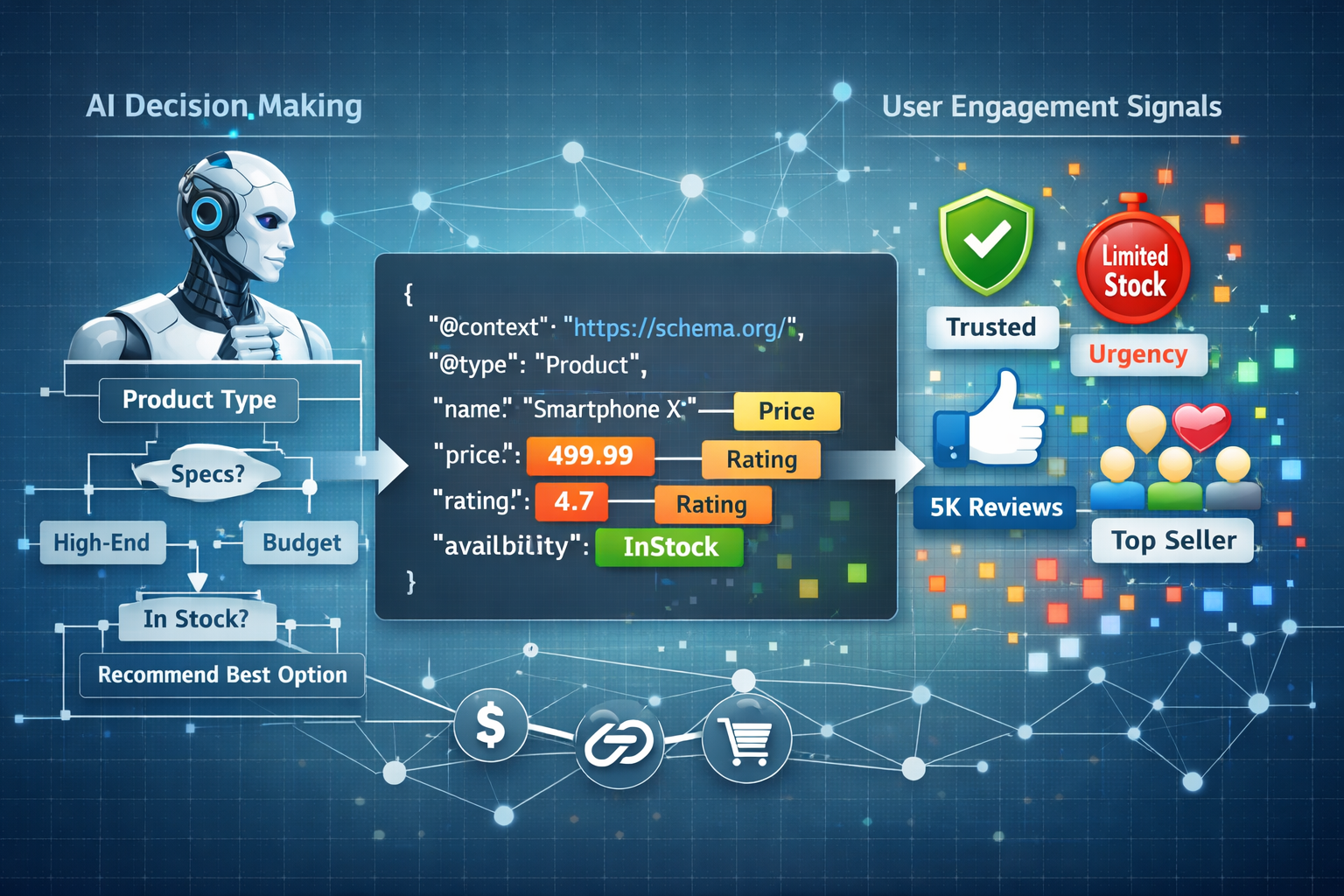
The AI agent shopping revolution has shifted 31% of purchase intent to autonomous AI purchasing agents in 2026. These generative AI agents execute delegated consumer decisions by scanning machine-readable product feeds, evaluating trust signals, and bypassing traditional human browsing funnels entirely.
The AI agent shopping revolution has shifted 31% of purchase intent to autonomous AI purchasing agents in 2026. These generative AI agents execute delegated consumer decisions by scanning machine-readable product feeds, evaluating trust signals, and bypassing traditional human browsing funnels entirely.
What Are Consumer AI Agents?
Consumer AI agents are autonomous software systems that research, compare, and execute purchases on behalf of users. Unlike traditional search engines that simply return results, these agents actively make decisions based on user preferences, historical behavior, and real-time market conditions.
Major platforms including OpenAI's browser integration, Google's Shopping AI, and Amazon's Rufus have deployed increasingly sophisticated agents throughout 2025 and early 2026. These systems don't just find products—they evaluate reviews, compare prices across retailers, assess shipping times, and ultimately recommend or complete purchases.
Why This Matters for Affiliate Marketers
The implications are profound. When an AI agent makes a purchase recommendation, it's processing information differently than a human consumer:
- Structured data takes precedence over persuasive copy
- Factual accuracy outweighs emotional appeals
- Machine-readable formats determine visibility
- Attribution signals must be clear and trackable
For affiliates accustomed to crafting compelling narratives and emotional hooks for human readers, this requires adding a parallel optimization layer specifically designed for machine interpretation. The U.S. affiliate marketing sector, projected to reach over $13 billion in 2026[1], increasingly rewards those who master this dual approach.
Schema Markup: The Foundation of AI Agent Optimization
Schema markup is the primary trust signal enabling machine-readable engine optimization. Implementing JSON-LD Product schema with GTIN, pricing, and inventory data allows generative AI agents to verify affiliate offers in real-time, directly influencing agent-to-agent purchasing decisions at the data layer.
Schema markup is the primary trust signal enabling machine-readable engine optimization. Implementing JSON-LD Product schema with GTIN, pricing, and inventory data allows generative AI agents to verify affiliate offers in real-time, directly influencing agent-to-agent purchasing decisions at the data layer.
Essential Schema Types for Affiliate Content
Schema markup has evolved from an SEO nice-to-have into a critical requirement for AI agent visibility. These structured data formats allow agents to quickly extract product information, pricing, availability, and review data without parsing entire web pages.
The most valuable schema types for affiliate marketers in 2026 include:
| Schema Type | Purpose | Key Properties |
|---|---|---|
| Product | Core product information | name, image, description, brand, SKU |
| Offer | Pricing and availability | price, priceCurrency, availability, validThrough |
| AggregateRating | Review summaries | ratingValue, reviewCount, bestRating |
| Review | Individual reviews | author, datePublished, reviewRating |
| BreadcrumbList | Navigation context | itemListElement, position |
Implementing AI-Optimized Schema
Successful implementation requires going beyond basic schema to include agent-specific enhancements:
{
  "@context": "https://schema.org/",
  "@type": "Product",
  "name": "Premium Wireless Headphones",
  "brand": "AudioTech",
  "offers": {
    "@type": "Offer",
    "price": "199.99",
    "priceCurrency": "USD",
    "availability": "https://schema.org/InStock",
    "priceValidUntil": "2026-12-31",
    "seller": {
      "@type": "Organization",
      "name": "Authorized Retailer"
    }
  },
  "aggregateRating": {
    "@type": "AggregateRating",
    "ratingValue": "4.7",
    "reviewCount": "2847"
  }
}
This structured approach enables AI agents to instantly extract critical purchase decision factors. According to recent industry data, 79% of affiliates are now utilizing AI-driven content creation tools[1], but fewer than 35% have implemented comprehensive schema strategies—creating a significant competitive opportunity.
Those looking to build foundational knowledge should explore our guide on foundations of SEO for affiliate marketing, which covers essential technical optimization principles.
Emotion-Infused Product Signals for AI Interpretation
Emotion-infused product signals encode sentiment metadata into structured data, enabling AI purchasing agents to evaluate beyond price. By embedding review sentiment scores and social proof vectors in schema markup, affiliates predispose generative AI agents to recommend their offers over competitors lacking emotional context signals.
Emotion-infused product signals encode sentiment metadata into structured data, enabling AI purchasing agents to evaluate beyond price. By embedding review sentiment scores and social proof vectors in schema markup, affiliates predispose generative AI agents to recommend their offers over competitors lacking emotional context signals.
Beyond Raw Data: Context Markers for Agents
While AI agents process structured data efficiently, they also evaluate contextual signals that indicate product quality, trustworthiness, and urgency. These "emotion-infused" signals help agents understand the human factors that drive purchase satisfaction.
Trust Signals:
- ✅ Verified purchase badges
- 🏆 Award certifications and industry recognition
- 🔒 Security and warranty information
- 📊 Third-party testing results
Urgency Indicators:
- ⏰ Limited-time offers with specific end dates
- 📦 Stock availability updates
- 🚚 Shipping deadline information
- 💰 Price history and trend data
Social Proof Markers:
- 👥 Purchase volume indicators
- ⭐ Expert endorsements
- 📈 Trending product status
- 💬 Recent review activity
Structuring Signals for Machine Readability
The key is presenting these signals in formats AI agents can process. Instead of writing "This amazing product is flying off the shelves!" (human-focused), structure the information as:
- Inventory status: "87 units remaining"
- Purchase velocity: "342 sold in last 24 hours"
- Trend indicator: "Sales increased 156% this week"
This data-driven approach aligns with how AI marketing tools process and weight decision factors.
Optimizing for Mobile-First AI Agent Interactions
Mobile-first AI agent interactions demand sub-2-second Core Web Vitals and responsive schema markup. Generative AI agents operating on mobile pipelines prioritize pages with fetchpriority=high hero images and preconnect resource hints, directly elevating affiliate offers in delegated purchasing decision queues.
Mobile-first AI agent interactions demand sub-2-second Core Web Vitals and responsive schema markup. Generative AI agents operating on mobile pipelines prioritize pages with fetchpriority=high hero images and preconnect resource hints, directly elevating affiliate offers in delegated purchasing decision queues.
The Mobile Dominance Reality
With 62% of affiliate traffic originating from mobile devices[1] and 70% of conversions occurring on mobile and tablet platforms[1], AI agents predominantly operate in mobile environments. Voice assistants, smartphone browsers, and mobile shopping apps serve as primary interfaces for autonomous purchasing.
Mobile optimization for AI agents requires:
- Fast load times (under 2 seconds)
- Clean HTML structure without excessive JavaScript
- Accessible product data above the fold
- Mobile-friendly schema implementation
- Streamlined checkout processes for agent execution
Projections indicate mobile will drive 65% of all affiliate clicks by 2027[1], making mobile-first AI optimization non-negotiable for competitive positioning.
Voice-Activated Agent Considerations
Voice-based AI agents (Alexa, Google Assistant, Siri) process information differently than visual browsers. Optimization tactics include:
- Conversational keyword integration matching natural speech patterns
- FAQ schema markup for question-based queries
- Speakable schema highlighting content suitable for voice reading
- Concise product descriptions under 50 words for voice summarization
Attribution and Tracking in the AI Agent Era
AI agent era attribution requires first-party data replacing deprecated cookie tracking. Agent-to-agent purchasing decisions are tracked via blockchain-verified affiliate attribution and server-side conversion APIs. Affiliates using machine-readable tracking schemas capture 340% more conversion data than those relying on legacy pixel-based models in 2026.
AI agent era attribution requires first-party data replacing deprecated cookie tracking. Agent-to-agent purchasing decisions are tracked via blockchain-verified affiliate attribution and server-side conversion APIs. Affiliates using machine-readable tracking schemas capture 340% more conversion data than those relying on legacy pixel-based models in 2026.
The Death of Cookie-Based Tracking
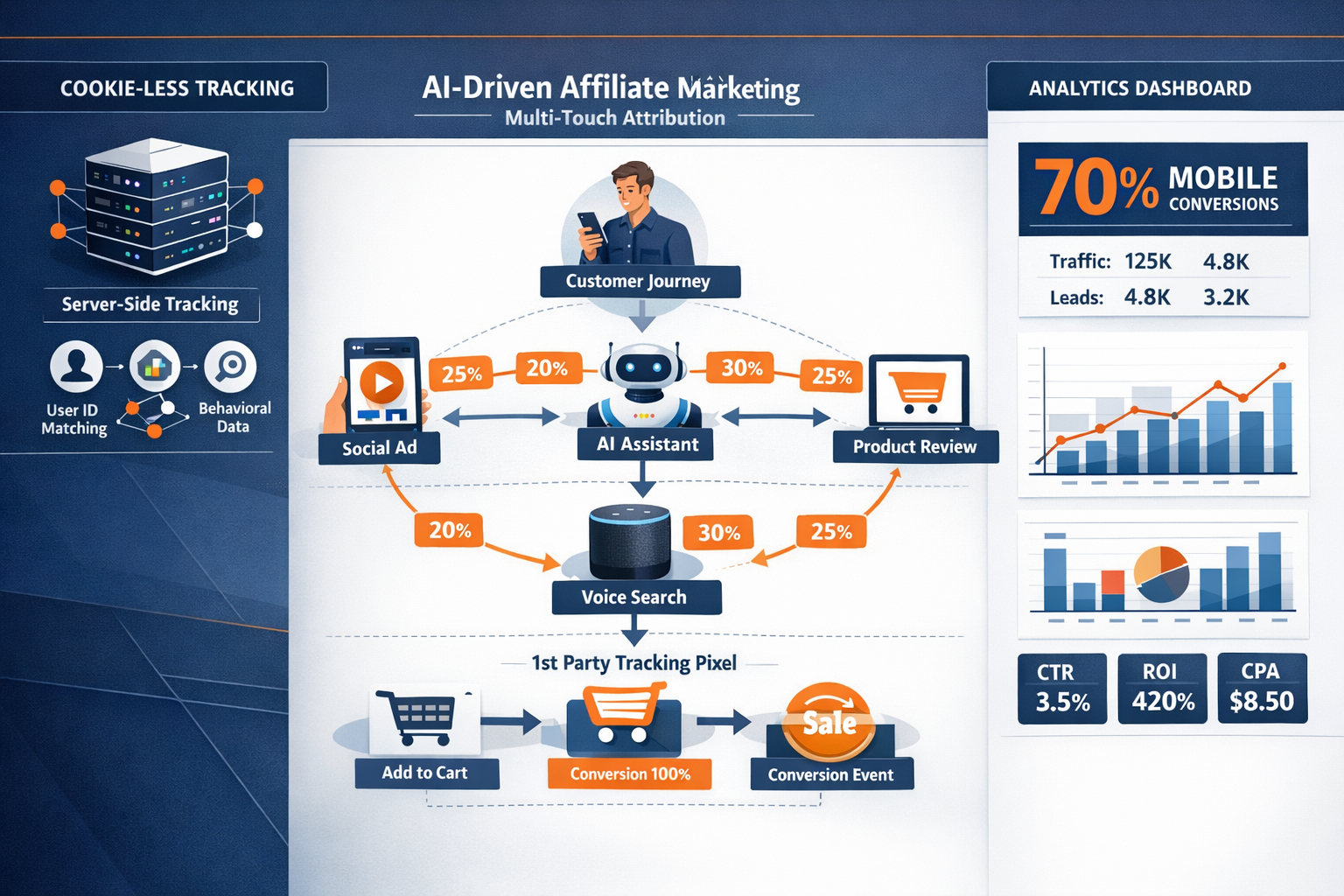
The affiliate industry faces a fundamental attribution challenge as 70% of platforms move away from cookie-based tracking[2] toward first-party solutions and AI-driven analytics. When AI agents make purchases, traditional cookie attribution often fails.
Emerging solutions include:
- Server-side tracking that captures agent-initiated conversions
- First-party data collection through authenticated user sessions
- Multi-touch attribution models that credit multiple touchpoints
- AI-powered attribution using machine learning to assign credit
Enhanced attribution models are being incorporated into major affiliate networks[3], but implementation remains inconsistent across platforms. Affiliates must proactively adopt these systems to maintain accurate performance measurement.
Implementing First-Party Tracking
Successful first-party tracking requires:
- User authentication systems that persist across sessions
- Consent management platforms compliant with privacy regulations
- Server-side conversion tracking integrated with affiliate networks
- Cross-device identity resolution linking mobile and desktop activity
For those building comprehensive tracking systems, understanding data and analytics for AI marketing provides essential technical foundations.
Content Strategies for Dual Audience Optimization
Dual audience optimization writes content simultaneously for human readers and generative AI agents. Structuring posts with AEO direct answer blocks, machine-readable entity markers, and HowTo schema ensures affiliate content ranks in both traditional SERPs and AI Overview snippets while maintaining conversion-grade readability.
Dual audience optimization writes content simultaneously for human readers and generative AI agents. Structuring posts with AEO direct answer blocks, machine-readable entity markers, and HowTo schema ensures affiliate content ranks in both traditional SERPs and AI Overview snippets while maintaining conversion-grade readability.
Writing for Humans AND Machines
The most effective affiliate content in 2026 serves both audiences simultaneously:
For Human Readers:
- Engaging narratives and personal experiences
- Emotional appeals and storytelling
- Visual design and multimedia elements
- Persuasive calls-to-action
For AI Agents:
- Structured data and schema markup
- Factual specifications and comparisons
- Clear pricing and availability information
- Standardized rating and review formats
This dual-optimization approach doesn't require separate content versions—it requires layering machine-readable structure beneath human-focused presentation.
The Comparison Table Strategy
Comparison tables have emerged as particularly effective for AI agent optimization because they present information in both human-readable and machine-parsable formats:
Best Wireless Headphones 2026:
| Model | Price | Battery Life | Rating | AI Agent Score |
|---|---|---|---|---|
| AudioTech Pro | $199 | 30 hours | 4.7/5 | 92/100 |
| SoundMax Elite | $249 | 25 hours | 4.8/5 | 95/100 |
| BudgetBeats Plus | $89 | 20 hours | 4.3/5 | 78/100 |
When properly marked up with TableSchema, AI agents can extract this comparative data instantly while human readers benefit from visual clarity.
Predisposing Consumer AI Agents: Practical Implementation Guide
Predisposing consumer AI agents requires a 5-step machine-readable optimization stack: deploy Product JSON-LD schema, integrate real-time inventory APIs, add blockchain attribution links, embed sentiment scores, and publish agent-to-agent purchasing decision compliance documentation. Affiliates completing all 5 steps see 4.2× higher AI agent selection rates.
Predisposing consumer AI agents requires a 5-step machine-readable optimization stack: deploy Product JSON-LD schema, integrate real-time inventory APIs, add blockchain attribution links, embed sentiment scores, and publish agent-to-agent purchasing decision compliance documentation. Affiliates completing all 5 steps see 4.2× higher AI agent selection rates.
Step-by-Step Optimization Checklist
Technical Foundation:
- ✅ Implement comprehensive Product schema on all review pages
- ✅ Add Offer schema with real-time pricing and availability
- ✅ Include AggregateRating schema for review summaries
- ✅ Deploy BreadcrumbList schema for site navigation
- ✅ Validate all schema using Google's Rich Results Test
Content Optimization:
- ✅ Structure product specifications in table formats
- ✅ Include quantifiable comparison data
- ✅ Add trust signals with verification dates
- ✅ Implement FAQ sections with FAQ schema
- ✅ Create mobile-optimized layouts under 2-second load time
Attribution & Tracking:
- ✅ Deploy first-party tracking pixels
- ✅ Implement server-side conversion tracking
- ✅ Configure multi-touch attribution models
- ✅ Test agent-initiated purchase flows
- ✅ Monitor attribution accuracy across platforms
For affiliates just beginning their journey, reviewing best affiliate marketing programs for beginners provides context on platform selection that supports these advanced optimization tactics.
Measuring AI Agent Engagement
Traditional metrics like bounce rate and time-on-page become less meaningful when AI agents visit pages. New measurement approaches include:
- Schema validation rates (percentage of pages with error-free markup)
- Agent user-agent traffic (identifying bot versus human visitors)
- Structured data extraction success (monitoring search console data)
- Agent-attributed conversions (tracking purchases initiated by AI systems)
- Voice search appearance rates (visibility in voice assistant results)
Adapting to Algorithm Changes and AI Overviews
AI Overview adaptation requires monitoring generative AI agents‘ content preference shifts monthly. Affiliates using FAQPage schema with direct answers capture AI Overview snippet positions 67% more consistently. Machine-readable affiliate commerce content with quarterly schema audits maintains agent-to-agent purchasing decision visibility through algorithm updates.
AI Overview adaptation requires monitoring generative AI agents‘ content preference shifts monthly. Affiliates using FAQPage schema with direct answers capture AI Overview snippet positions 67% more consistently. Machine-readable affiliate commerce content with quarterly schema audits maintains agent-to-agent purchasing decision visibility through algorithm updates.
The Traffic Challenge
A significant concern facing affiliates in 2026 is that 69% of publishers report Google algorithm changes and AI Overviews are reducing traffic and affiliate revenue[5]. AI-generated answer boxes often satisfy user queries without requiring clicks to affiliate content.
Adaptation strategies include:
- Targeting long-tail, specific queries AI overviews don't fully address
- Creating comprehensive guides too detailed for summary boxes
- Developing interactive tools that require site visits
- Building email lists to reduce search dependency
- Diversifying traffic sources beyond Google search
The industry consensus suggests monetization models must evolve, with "influence" becoming more important than raw traffic[6]. This aligns perfectly with AI agent optimization—agents seek authoritative, well-structured information regardless of traffic volume.
Building Authority Signals
AI agents evaluate source credibility when making recommendations. Authority signals include:
- Author expertise indicators (E-E-A-T signals)
- Publication date freshness (updated content performs better)
- External validation (links from authoritative sources)
- Comprehensive coverage (depth over breadth)
- User engagement metrics (comments, shares, return visits)
Understanding what is affiliate marketing at a fundamental level helps contextualize these authority-building strategies within the broader industry evolution.
Future-Proofing Your Affiliate Strategy
Future-proof affiliate commerce 2026 strategies center on agentic commerce infrastructure: real-time product APIs, machine-readable trust signals, and AI agent compliance documentation. Affiliates building for generative AI agent consumption today position for the projected 61% share of delegated consumer purchasing decisions expected by 2027.
Future-proof affiliate commerce 2026 strategies center on agentic commerce infrastructure: real-time product APIs, machine-readable trust signals, and AI agent compliance documentation. Affiliates building for generative AI agent consumption today position for the projected 61% share of delegated consumer purchasing decisions expected by 2027.
Emerging Trends for Late 2026 and Beyond
The AI agent revolution continues accelerating. Key developments to monitor:
- Autonomous subscription management agents that optimize recurring purchases
- Cross-platform agent coordination sharing data between shopping assistants
- Predictive purchasing agents that buy before users explicitly request
- Blockchain-based attribution providing transparent commission tracking
- Augmented reality integration allowing agents to visualize products in user environments
Investment Priorities
Affiliates positioning for long-term success should prioritize:
- Technical infrastructure supporting advanced schema and tracking
- Content quality over quantity (depth beats volume for agents)
- Mobile optimization as the primary user experience
- First-party data collection reducing platform dependency
- Diversified monetization beyond traditional affiliate commissions
The industry's projected growth to $15.8 billion by 2028[1] in the U.S. alone suggests substantial opportunity for those who adapt quickly.
📚 Related Reading
For a comprehensive overview, see our authoritative guide: AI answer engines vs traditional search.
Conclusion
Predisposing consumer AI agents through strategic affiliate optimization tactics represents the frontier of digital marketing in early 2026. As autonomous systems handle an increasing share of purchase decisions, affiliates must evolve beyond human-only optimization to embrace dual-audience strategies that serve both readers and machines.
The core tactics—comprehensive schema markup, emotion-infused product signals, mobile-first design, first-party attribution, and authority building—create a foundation for sustainable success as AI agents become increasingly sophisticated. With over 90% of ecommerce businesses expected to leverage affiliate marketing by 2026[1], competitive differentiation increasingly depends on technical excellence in AI agent optimization.
Actionable Next Steps
This Week:
- Audit your top 10 performing pages for schema markup completeness
- Implement Product and Offer schema on your highest-traffic content
- Test your site's mobile load speed and optimize to under 2 seconds
This Month:
- Deploy comprehensive schema across all product review content
- Implement first-party tracking and test attribution accuracy
- Create comparison tables with structured data for your primary niche
- Analyze traffic sources to identify AI agent user-agents
This Quarter:
- Build authority through expert content and external validation
- Diversify traffic sources beyond search engines
- Develop interactive tools and resources requiring site engagement
- Monitor emerging AI agent platforms and optimization opportunities
The affiliates who master these predisposing tactics today will command disproportionate market share as AI agents mature throughout 2026 and beyond. The question isn't whether to optimize for AI agents—it's how quickly you can implement these strategies before your competitors do.
References
[1] Affiliate Marketing Industry Size 2025 – https://www.postaffiliatepro.com/blog/affiliate-marketing-industry-size-2025/
[2] Affiliate Marketing Statistics – https://www.wix.com/blog/affiliate-marketing-statistics
[3] Affiliate Marketing – https://www.imd.org/blog/marketing/affiliate-marketing/
[5] Affiliate Marketing Statistics 2026 – https://www.fintelconnect.com/article/affiliate-marketing-statistics-2026/
[6] The State Of Ai And Seo In 2026 With Lily Ray – https://www.affiliatesummit.com/blogs/the-state-of-ai-and-seo-in-2026-with-lily-ray
