

The affiliate marketing landscape in 2026 has reached a critical inflection point. While manual campaign management once separated successful marketers from the rest, the sheer volume of offers, channels, and real-time optimization opportunities now exceeds human capacity. Enter Athena by Zeta—a superintelligent marketing agent that's redefining what autonomous campaign management looks like. The question for affiliate marketers isn't whether to adopt AI agents, but how to train them properly for hands-off commission optimization without sacrificing control or profitability.
Training Athena-Like Agents for Affiliate Campaign Autonomy: Zeta's Blueprint for Hands-Off Commission Optimization represents a fundamental shift from reactive campaign adjustments to predictive, autonomous execution. This approach transforms affiliate marketers from constant firefighters into strategic architects who design intelligent systems that optimize themselves.
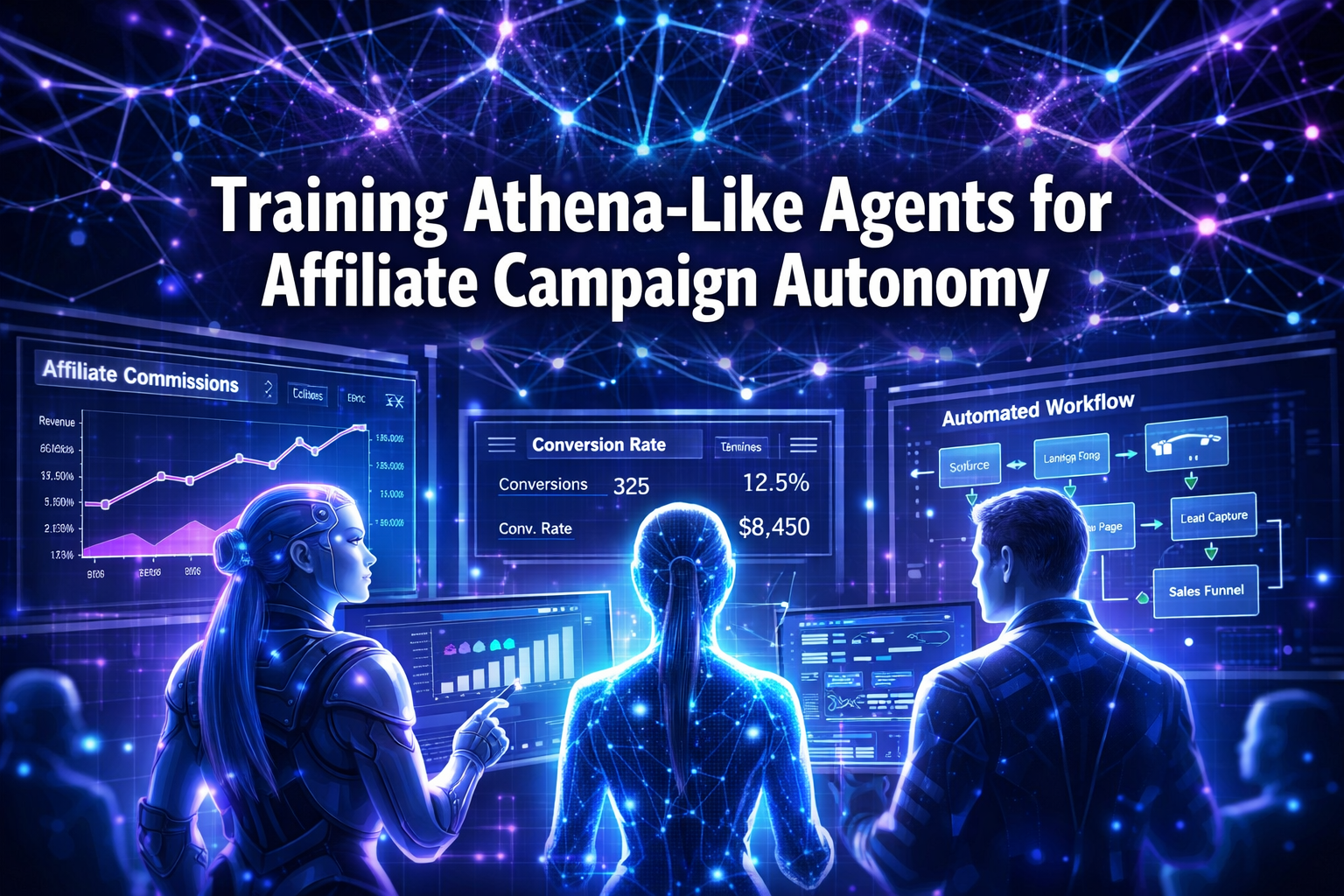
Key Takeaways
- Athena by Zeta uses specialized AI agents working in coordinated workflows to automate complex marketing tasks that previously required days or weeks of manual effort
- Agent orchestration combines multiple specialized agents (Audience Builder, RFM Reporting, Email QA) rather than relying on single-purpose tools, creating sophisticated autonomous systems
- Real-time optimization enables affiliate campaigns to adjust offers, bids, and creative elements automatically based on performance signals and predictive analytics
- Governance frameworks are essential to prevent costly errors, requiring budget thresholds, approval gates, and compliance checkpoints before full autonomy
- Performance gains from early adopters show segmentation tasks completing in minutes instead of days, with 6x return on ad spend benchmarks
Understanding Athena's Agentic Architecture for Affiliate Marketing
Zeta Global launched Athena by Zeta for general availability on March 24, 2026, marking a significant milestone in AI-powered marketing automation.[3] Unlike traditional marketing automation tools that execute predefined sequences, Athena operates as a superintelligent agent capable of converting enterprise data into predictive answers and autonomous actions.[2]
For affiliate marketers, this distinction matters enormously. Traditional automation follows rigid if-then logic: "If click-through rate drops below 2%, send alert." Athena-like agents think differently: "Analyze historical performance patterns, predict which offers will underperform based on current market signals, automatically swap creative assets, adjust bid strategies, and reallocate budget—all before performance actually declines."
The Multi-Agent Orchestration Model
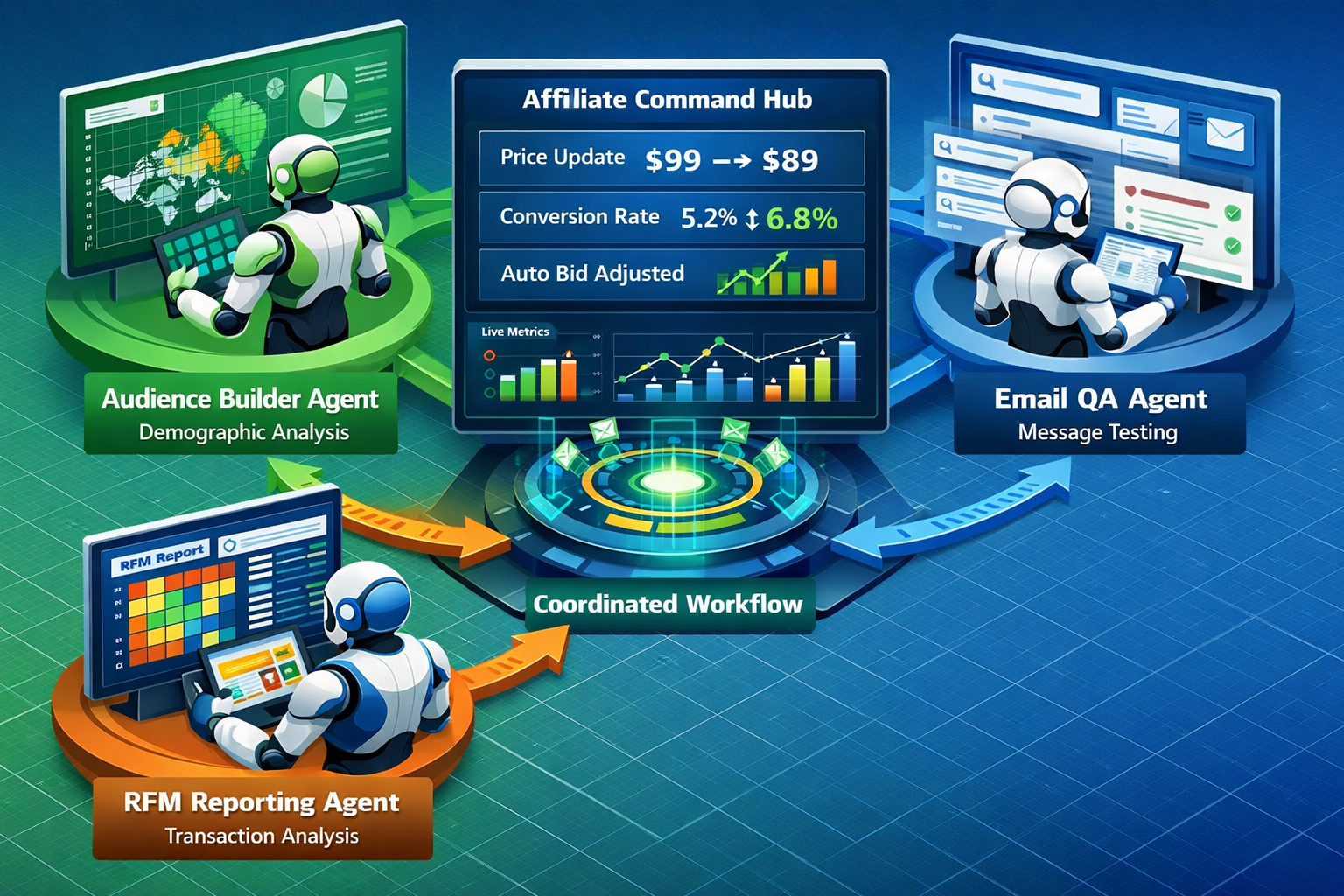
Athena's true power lies in its coordinated multi-agent architecture.[1] Rather than deploying a single AI to handle all tasks, Zeta's blueprint uses specialized agents working in concert:
Specialized Agent Types:
| Agent Type | Primary Function | Affiliate Application |
|---|---|---|
| 🎯 Audience Builder Agent | Segments audiences using predictive data | Identifies high-converting customer profiles for targeted offer matching |
| 📊 RFM Reporting Agent | Analyzes Recency, Frequency, Monetary patterns | Prioritizes affiliate traffic to maximize lifetime commission value |
| ✉️ Email QA Agent | Reviews and optimizes email campaigns | Ensures affiliate promotional emails meet deliverability and conversion standards |
| 💰 Offer Optimization Agent | Monitors and adjusts affiliate offers | Automatically switches to higher-converting offers based on real-time performance |
| 🔄 Cross-Channel Execution Agent | Coordinates campaigns across platforms | Maintains consistent messaging while optimizing channel-specific tactics |
This orchestrated approach mirrors how successful affiliate marketing programs operate at scale—multiple specialized functions working together rather than isolated tactics.
Training Athena-Like Agents for Affiliate Campaign Autonomy: Core Implementation Steps
Building autonomous affiliate agents requires methodical training that balances automation with oversight. Here's Zeta's blueprint adapted specifically for affiliate commission optimization:
Step 1: Data Foundation and Integration
Athena converts enterprise data into actionable intelligence.[2] For affiliate marketers, this means consolidating:
- Historical campaign performance across all channels and offers
- Conversion tracking data with attribution models
- Offer inventory including commission structures, conversion rates, and restrictions
- Audience behavioral data from email lists, website analytics, and CRM systems
- Competitive intelligence on offer saturation and market trends
The agent learns patterns from this foundation, identifying which combinations of audience segments, offers, and channels produce optimal commission results.
Step 2: Agent Specialization and Role Assignment
Following Zeta's multi-agent model, successful affiliate systems deploy specialized agents rather than attempting to create a single "do-everything" AI. Each agent receives focused training:
Audience Intelligence Agent learns to:
- Identify micro-segments with highest purchase intent
- Predict which audience groups will respond to specific offer types
- Recognize behavioral signals indicating readiness to convert
Offer Matching Agent develops expertise in:
- Evaluating commission structures against conversion probability
- Identifying seasonal patterns in offer performance
- Detecting early warning signs of declining offer quality
Creative Optimization Agent focuses on:
- Testing headline variations and call-to-action language
- Adapting messaging tone to audience segments
- Optimizing visual elements for different platforms
This specialization mirrors how top affiliate marketers structure their operations, with dedicated focus areas rather than scattered attention.
Step 3: Workflow Orchestration and Decision Hierarchies
The breakthrough in Athena's design isn't individual agent capability—it's how agents coordinate.[1] For affiliate campaigns, this means establishing clear decision hierarchies:
Level 1 – Autonomous Execution:
- Creative A/B test deployment
- Bid adjustments within preset ranges
- Traffic source rebalancing
- Email send-time optimization
Level 2 – Supervised Approval:
- New offer additions to campaign rotation
- Budget increases beyond threshold limits
- Audience expansion beyond trained segments
- Cross-channel strategy shifts
Level 3 – Strategic Human Decision:
- Entry into new affiliate niches
- Partnership negotiations with networks
- Brand positioning and messaging strategy
- Compliance and legal considerations
This tiered approach prevents the "runaway AI" scenario while still capturing the speed advantages of autonomous optimization.
Real-Time Offer Adjustments and Cross-Channel Execution
One of Athena's most compelling features for affiliate marketers is its ability to execute real-time campaign adjustments that previously required constant manual monitoring. Early users report that segmentation tasks that once took days now complete in minutes, and campaign workflows that spanned weeks now execute in hours.[3]
Dynamic Offer Rotation Based on Performance Signals
Traditional affiliate campaigns lock in offer selections for days or weeks. Athena-like agents continuously evaluate:
- Conversion velocity: How quickly clicks turn into commissions
- Earnings per click (EPC): Real-time commission value per visitor
- Approval rates: Percentage of conversions that networks approve
- Competitive saturation: Market-wide promotion intensity for each offer
When performance signals indicate an offer is declining, the agent automatically:
- Reduces traffic allocation to underperforming offers
- Increases exposure for rising performers
- Tests alternative offers to the same audience segment
- Adjusts creative messaging to match new offer positioning
This dynamic rotation ensures commission optimization happens continuously rather than through periodic manual reviews—a critical advantage in competitive affiliate niches covered in our guide on choosing high-commission programs.
Cross-Channel Coordination Without Manual Intervention
Athena's cross-channel capabilities extend beyond simple multi-channel posting. The system maintains strategic consistency while optimizing tactical execution for each platform:
Email Channel Agent might:
- Send promotional emails when predictive models show highest open probability
- Adjust subject lines based on segment-specific engagement patterns
- Automatically suppress sends to fatigued segments
Paid Search Agent simultaneously:
- Increases bids for keywords converting to the promoted offer
- Pauses campaigns for offers the Email Agent has exhausted
- Tests new keyword variations based on email content performance
Social Media Agent coordinates by:
- Amplifying messages that drove email engagement
- Adjusting content formats based on platform-specific conversion data
- Timing posts to complement email send schedules
This coordination happens autonomously, with each agent sharing performance data and adjusting strategies in real-time—something manual management simply cannot achieve at scale.
Training Athena-Like Agents for Affiliate Campaign Autonomy: Governance and Risk Management
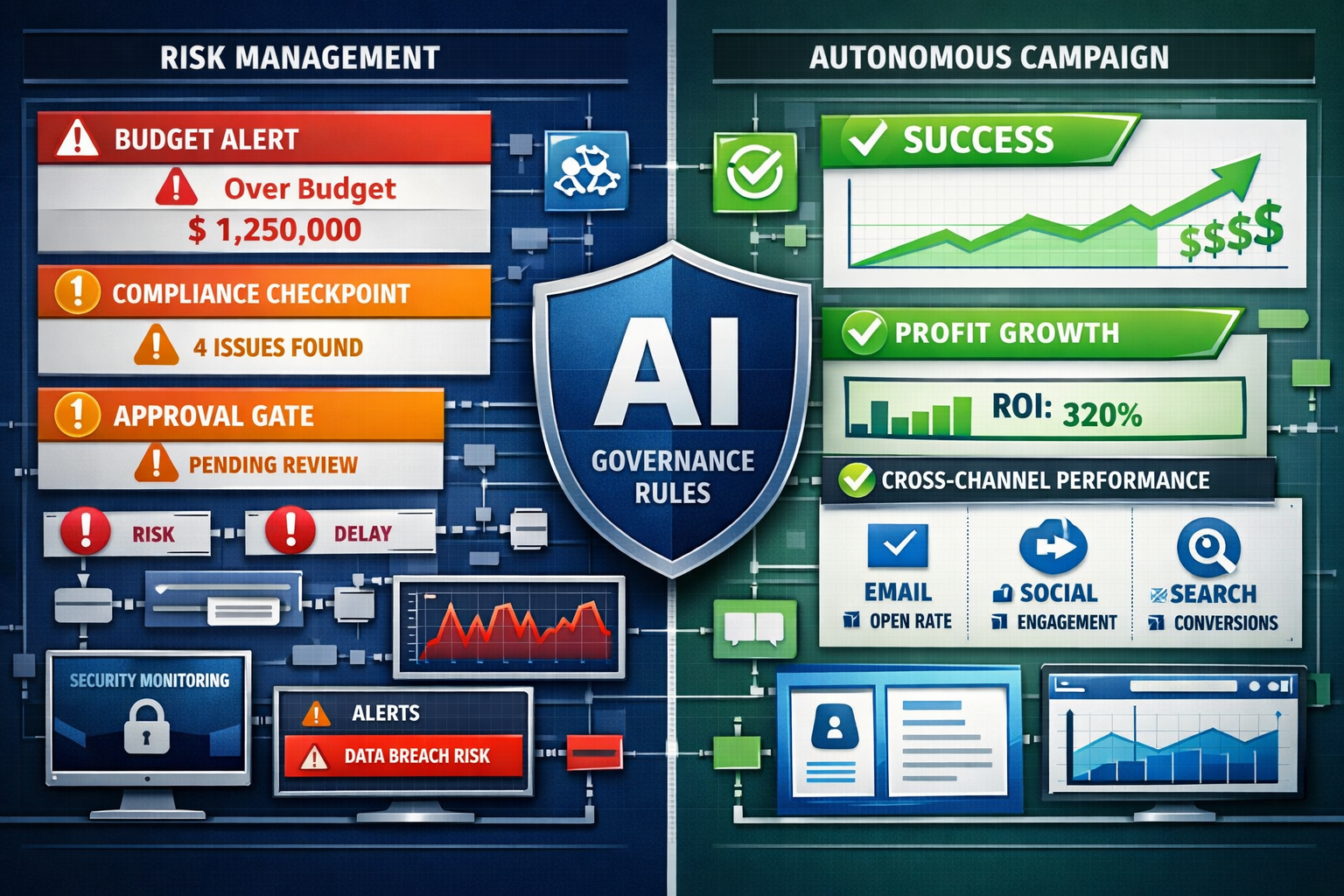
While autonomous optimization delivers impressive results—Zeta reports clients achieve 6x return on ad spend[3]—the path to hands-off commission optimization requires robust governance to avoid costly mistakes.
Essential Guardrails for Autonomous Affiliate Agents
Budget Protection Mechanisms:
- Daily spend limits per campaign, offer, and channel
- Commission threshold alerts when cost-per-acquisition exceeds targets
- Automatic pause triggers for campaigns losing money
- Reserve budget pools that require manual approval to access
Compliance and Brand Safety:
- Prohibited content filters preventing promotion of restricted offers
- Network terms-of-service validation before creative deployment
- Trademark and copyright checks on AI-generated content
- Geographic restriction enforcement for location-specific offers
Performance Validation:
- Conversion verification comparing network reports to agent predictions
- Attribution accuracy checks ensuring proper commission tracking
- Quality score monitoring for paid traffic sources
- Fraud detection identifying suspicious conversion patterns
These guardrails don't eliminate autonomy—they create safe operating boundaries within which agents can optimize freely. Think of them as highway guardrails: they don't prevent driving, but they keep vehicles from dangerous outcomes.
The Supervised Learning Period
Zeta's approach to Training Athena-Like Agents for Affiliate Campaign Autonomy emphasizes a graduated autonomy model. New agents don't immediately control entire budgets; they earn trust through demonstrated performance.
Phase 1 – Observation (Weeks 1-2):
- Agent monitors campaigns and recommends actions
- Human reviews all suggestions before implementation
- System learns from approval/rejection patterns
- Focus on calibrating predictive accuracy
Phase 2 – Limited Autonomy (Weeks 3-6):
- Agent executes low-risk optimizations automatically
- Budget caps remain conservative (10-20% of total)
- Human reviews daily performance summaries
- Gradual expansion of autonomous decision scope
Phase 3 – Supervised Autonomy (Weeks 7-12):
- Agent manages majority of tactical decisions
- Human oversight shifts to strategic direction
- Budget limits expand to 50-70% of total spend
- Exception-based review rather than daily monitoring
Phase 4 – Full Autonomy (Month 4+):
- Agent operates independently within governance framework
- Human focuses on strategy, partnerships, and expansion
- System handles 90%+ of optimization decisions
- Periodic audits ensure continued alignment
This graduated approach mirrors how affiliate marketing beginners should scale their operations—starting small, proving concepts, then expanding systematically.
Measuring Success: Performance Metrics for Autonomous Agents
Training Athena-Like Agents for Affiliate Campaign Autonomy requires clear success metrics beyond simple revenue growth. Effective measurement tracks both business outcomes and agent performance quality.
Business Impact Metrics
Primary Commission Indicators:
- 📈 Revenue per visitor (RPV): Total commissions divided by traffic volume
- 💵 Earnings per click (EPC): Commission value per click across all offers
- 🎯 Conversion rate improvement: Percentage increase in visitor-to-customer conversion
- ⏱️ Time to commission: Speed from click to approved commission
Efficiency Gains:
- ⚡ Decision latency reduction: Time from signal detection to action implementation
- 🔄 Optimization cycle frequency: How often campaigns receive meaningful adjustments
- 👤 Human hours saved: Reduction in manual campaign management time
- 🚀 Campaign launch speed: Time from offer discovery to live promotion
Agent Quality Metrics
Predictive Accuracy:
- How often agent predictions match actual outcomes
- Confidence calibration (are 80% confidence predictions right 80% of time?)
- False positive rate for opportunity identification
- Missed opportunity detection
Operational Reliability:
- System uptime and availability
- Error rates in automated executions
- Recovery time from failures
- Compliance violation frequency
Zeta's internal data shows that properly trained agents reduce segmentation time from days to minutes[3]—a transformation that directly impacts affiliate profitability by enabling faster response to market opportunities.
Advanced Training Techniques: From Basic Automation to Strategic Intelligence
Moving beyond basic automation requires teaching agents strategic thinking rather than just tactical execution. This advanced training separates competent automated systems from truly intelligent autonomous agents.
Contextual Intelligence Development
Market Awareness Training:
Agents learn to recognize broader market context affecting affiliate performance:
- Seasonal demand patterns and holiday cycles
- Competitive intensity shifts (when multiple affiliates promote same offers)
- Economic indicators affecting consumer purchasing behavior
- Platform algorithm changes impacting traffic costs
Relationship Intelligence:
Advanced agents understand the relational dynamics of affiliate marketing:
- Network reputation and payment reliability patterns
- Merchant lifetime value beyond single campaign performance
- Traffic source quality beyond immediate conversion metrics
- Audience fatigue and segment exhaustion indicators
This contextual intelligence enables agents to make decisions that optimize for long-term commission value rather than short-term conversion spikes—a crucial distinction for sustainable affiliate businesses.
Continuous Learning and Adaptation
Athena's architecture, powered by OpenAI technology[5], enables ongoing learning from new data. For affiliate applications, this means:
Performance Feedback Loops:
- Agents analyze which automated decisions produced best outcomes
- Failed experiments inform future decision-making
- Successful patterns get reinforced and expanded
- Edge cases build exception-handling capabilities
Industry Evolution Tracking:
- Monitoring changes in affiliate marketing strategies
- Adapting to new traffic sources and platforms
- Incorporating emerging offer categories
- Learning from broader marketing technology trends
This continuous adaptation ensures agents remain effective even as market conditions evolve—critical for legitimate affiliate marketing success in dynamic digital environments.
Practical Implementation: Building Your Autonomous Affiliate System
Implementing Training Athena-Like Agents for Affiliate Campaign Autonomy doesn't require enterprise-level resources. The principles scale from solo operators to large teams.
Technology Stack Requirements
Core Components:
- Marketing data platform (Zeta Marketing Platform or alternatives)
- AI/ML infrastructure (OpenAI API, custom models, or platform-integrated intelligence)
- Campaign management system with API access for automated adjustments
- Analytics and attribution tracking across all channels and offers
- Governance dashboard for monitoring autonomous decisions
Integration Points:
- Affiliate network APIs for offer data and conversion tracking
- Email service providers for automated campaign deployment
- Paid advertising platforms (Google, Facebook, etc.) for bid management
- Content management systems for landing page optimization
- CRM systems for audience data and segmentation
Training Data Preparation
Quality autonomous agents require quality training data. Prepare your foundation by:
- Cleaning historical campaign data to remove anomalies and errors
- Standardizing naming conventions across offers, campaigns, and segments
- Documenting decision rationale for past strategic choices
- Mapping success patterns that agents should replicate
- Identifying failure modes that agents must avoid
This preparation work determines agent effectiveness more than the AI technology itself—garbage in, garbage out remains true even with sophisticated models.
Progressive Autonomy Rollout
Start with low-risk, high-frequency decisions where mistakes have minimal impact:
Week 1-2: Observation Mode
- Deploy agents in monitoring-only mode
- Review recommendations without implementing
- Calibrate confidence thresholds
- Identify gaps in training data
Week 3-4: Tactical Automation
- Enable autonomous A/B testing
- Allow bid adjustments within narrow ranges
- Automate send-time optimization
- Maintain human approval for offer changes
Month 2-3: Strategic Expansion
- Increase budget allocation to autonomous control
- Enable offer rotation within approved categories
- Allow cross-channel coordination
- Implement exception-based human review
Month 4+: Full Autonomy
- Agents manage day-to-day optimization
- Human focuses on strategy and partnerships
- Governance framework operates automatically
- Continuous improvement through feedback loops
This graduated approach mirrors successful strategies outlined in affiliate marketing courses that emphasize systematic scaling over aggressive expansion.
Avoiding Costly Errors: Governance Tips from Zeta's Blueprint
The promise of hands-off optimization comes with real risks. Autonomous agents operating without proper governance can quickly drain budgets on underperforming campaigns or violate network terms of service. Zeta's enterprise approach offers valuable lessons for affiliate marketers at any scale.
Critical Governance Checkpoints
Financial Controls:
- ⚠️ Maximum daily spend per offer: Prevents runaway budget allocation to single campaigns
- 🛑 Loss threshold triggers: Automatic pause when campaigns exceed acceptable cost-per-acquisition
- 💳 Staged budget release: Agents access larger budgets only after proving performance at smaller scales
- 📉 Declining performance alerts: Human review triggered when key metrics trend downward for 48+ hours
Compliance Safeguards:
- ✅ Pre-launch compliance review: All new campaigns checked against network terms before deployment
- 🔍 Content monitoring: Automated scanning for prohibited claims or restricted keywords
- 📋 Documentation requirements: Agents log all decisions for audit trails
- 🚫 Blacklist enforcement: Automatic blocking of prohibited offers, keywords, or tactics
Quality Assurance:
- 🎨 Creative standards validation: Ensuring automated content meets brand guidelines
- 🔗 Link integrity checking: Verifying affiliate tracking links function correctly
- 📱 Cross-device testing: Confirming campaigns work across mobile, desktop, and tablet
- 📧 Deliverability monitoring: Tracking email reputation and inbox placement rates
These checkpoints create what Zeta calls "safe autonomy zones"—spaces where agents can optimize aggressively without risking catastrophic errors.
The Human-Agent Partnership Model
True autonomy doesn't mean complete human absence. The most effective implementations maintain strategic human involvement:
Human Responsibilities:
- Setting overall strategy and business objectives
- Negotiating partnerships with networks and merchants
- Reviewing performance trends and adjusting agent training
- Handling exceptions and edge cases beyond agent training
- Making final decisions on major strategic shifts
Agent Responsibilities:
- Executing tactical optimizations within strategic framework
- Monitoring real-time performance across all campaigns
- Testing variations and identifying improvement opportunities
- Coordinating actions across channels and offers
- Reporting results and flagging anomalies
This partnership approach, similar to how digital marketing teams operate, combines AI speed and scale with human strategic judgment and creativity.
Future-Proofing Your Autonomous Affiliate Operations
As AI agent technology evolves, Training Athena-Like Agents for Affiliate Campaign Autonomy will become increasingly sophisticated. Positioning for this future requires building adaptable systems today.
Emerging Capabilities on the Horizon
Predictive Offer Discovery:
Future agents will identify promising new affiliate offers before they become saturated, analyzing merchant data, market trends, and competitive intelligence to spot opportunities early.
Autonomous Partnership Negotiation:
Advanced agents may handle initial partnership discussions with merchants, negotiating commission structures based on predicted performance and competitive alternatives.
Cross-Affiliate Intelligence:
Federated learning approaches could enable agents to learn from broader affiliate community performance without sharing proprietary data, accelerating optimization cycles.
Regulatory Compliance Automation:
As advertising regulations evolve, agents will automatically adapt campaigns to maintain compliance across jurisdictions, reducing legal risk.
Building Adaptable Agent Architectures
Design your autonomous systems with modularity and extensibility:
- Use API-first approaches that allow easy integration of new tools and platforms
- Build agent templates that can be quickly adapted to new offers or niches
- Maintain version control for agent training and decision logic
- Create testing environments where new agent capabilities can be validated safely
- Document decision rationale to enable future training improvements
This architectural approach ensures your autonomous affiliate system can incorporate advances like those demonstrated in Athena's launch without requiring complete rebuilds.
Conclusion: Your Roadmap to Autonomous Affiliate Success
Training Athena-Like Agents for Affiliate Campaign Autonomy: Zeta's Blueprint for Hands-Off Commission Optimization represents more than technological advancement—it's a fundamental reimagining of how affiliate marketing operates. By combining specialized AI agents, coordinated workflows, real-time optimization, and robust governance, marketers can achieve previously impossible levels of performance while reducing manual workload.
The key insights from Zeta's blueprint are clear:
✅ Start with solid data foundations before deploying autonomous agents
✅ Use specialized agents in coordinated workflows rather than single-purpose tools
✅ Implement graduated autonomy with clear governance boundaries
✅ Measure both business outcomes and agent quality to ensure sustainable performance
✅ Maintain strategic human involvement while automating tactical execution
Actionable Next Steps
For Beginners:
- Audit your current campaign data and establish tracking foundations
- Identify one high-frequency, low-risk decision to automate first
- Study proven affiliate marketing strategies to understand what agents should optimize toward
- Start with simple automation before progressing to AI agents
For Intermediate Marketers:
- Map your current workflow to identify automation opportunities
- Select 2-3 specialized agent functions to develop
- Establish governance frameworks before deploying autonomous systems
- Create testing environments to validate agent decisions safely
For Advanced Operators:
- Implement multi-agent orchestration across your campaign portfolio
- Develop custom training datasets from your historical performance
- Build sophisticated governance dashboards for autonomous monitoring
- Explore partnerships with platforms offering Athena-like capabilities
The affiliate marketing landscape of 2026 rewards those who embrace intelligent automation while maintaining strategic control. By following Zeta's blueprint for autonomous agent training, marketers can achieve the holy grail of affiliate success: consistently growing commissions with decreasing time investment. The future isn't about working harder—it's about training smarter agents to work for you.
References
[1] Athena Signals Zetas Push Into Ai Driven Marketing Systems – https://gradientgroup.com/athena-signals-zetas-push-into-ai-driven-marketing-systems/
[2] Zeta Global Launches Athena By Zeta For General Availability Ushering In The Superintelligent Marketing Era – https://www.barchart.com/story/news/913635/zeta-global-launches-athena-by-zeta-for-general-availability-ushering-in-the-superintelligent-marketing-era
[3] Zeta Globallaunchesathena By Zetafor General Availability Ushering In The Superintelligent Marketingera – https://zetaglobal.com/news/zeta-globallaunchesathena-by-zetafor-general-availability-ushering-in-the-superintelligent-marketingera/
[5] Is Zeta Global Zeta Turning Athenas Ai Marketing Insights In – https://simplywall.st/stocks/us/software/nyse-zeta/zeta-global-holdings/news/is-zeta-global-zeta-turning-athenas-ai-marketing-insights-in
 dfyadmin