

Last updated: March 24, 2026
Quick Answer
Agentic AI Command Centers: Centralizing Control for Scaling Multi-Agent Deployments in High-Ticket B2B SaaS represents the enterprise standard for managing multiple autonomous AI agents through a unified orchestration platform. These command centers prevent agent sprawl, enforce governance policies, and enable seamless coordination across CRM, ERP, and custom workflows. Organizations using centralized command centers report 3x faster scaling velocity compared to siloed agent deployments, with built-in compliance and audit capabilities essential for high-value B2B environments.
Key Takeaways
- Command centers are now the industry standard for enterprises deploying multiple AI agents, with 70% of multi-agent deployments expected to adopt centralized orchestration platforms by 2028 [1]
- Three core capabilities define modern command centers: orchestration (coordinating agent handoffs), governance (compliance guardrails), and adaptability (modular architecture for updates)
- Agent sprawl is the primary risk when scaling without centralized control, creating conflicts, redundancies, and compliance gaps across enterprise systems
- 2026 deployments show 3x faster scaling when using command centers versus managing agents independently, with significantly reduced deployment time and operational overhead
- Gartner reports 40% of enterprise applications now embed task-specific AI agents, up from single-digit adoption just years prior [2]
- Human-in-the-loop governance has become standard for high-risk B2B scenarios, balancing autonomy with accountability through defined intervention thresholds
- Full observability and audit trails are critical for regulated industries, providing complete visibility into every agent decision and action
- Lifecycle management features include version control, staging environments, rollback capabilities, and emergency kill switches for production safety
- Integration with existing systems (Salesforce, SAP, Microsoft Dynamics) happens through the command center's orchestration layer, not point-to-point connections
- ROI becomes measurable through centralized metrics, performance tracking, and unified reporting across all agent activities
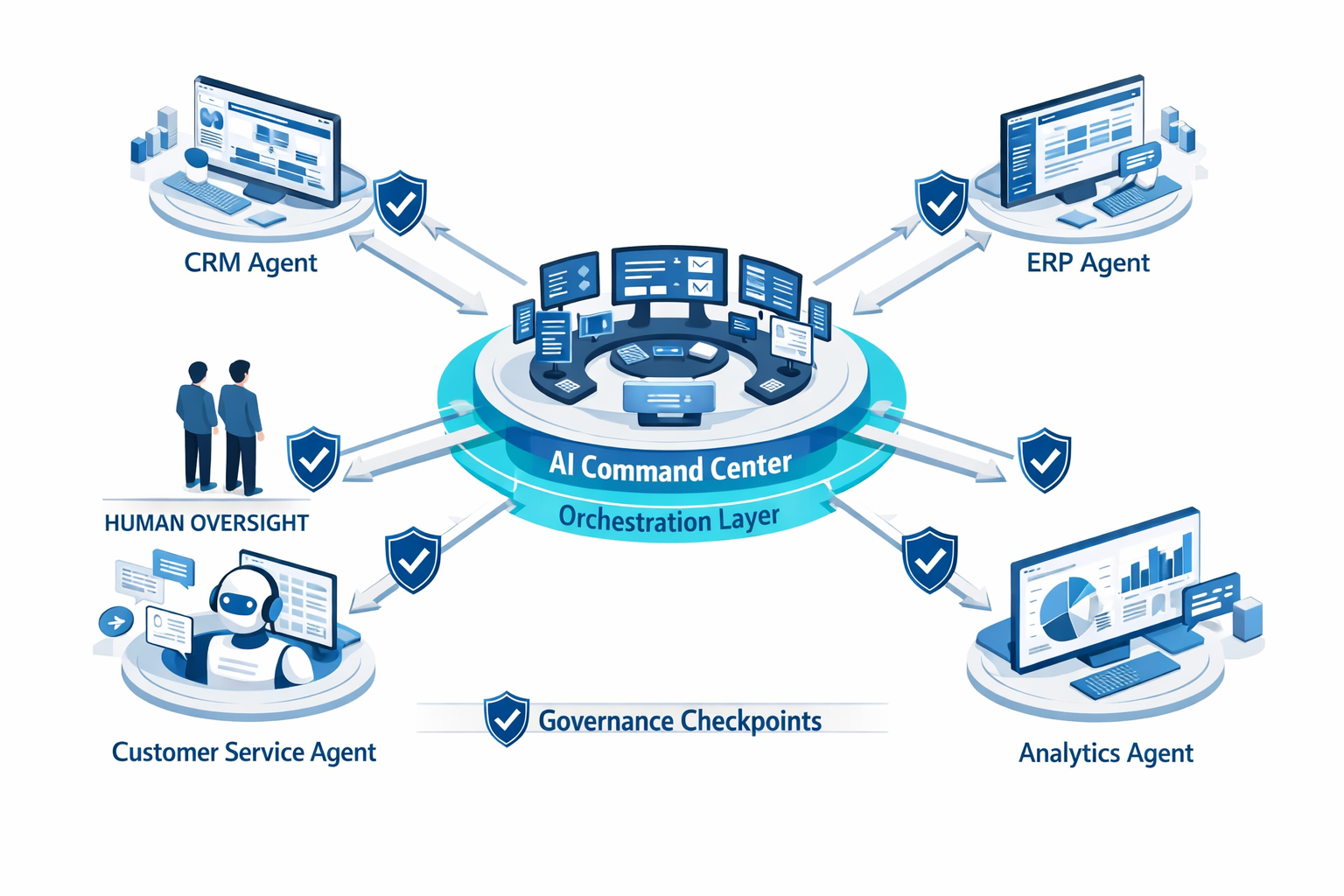
What Are Agentic AI Command Centers and Why Do They Matter?
Agentic AI Command Centers function as centralized orchestration platforms that manage, monitor, and coordinate multiple autonomous AI agents across enterprise systems. They matter because organizations scaling beyond single-agent deployments face exponential complexity without unified control, leading to what industry experts call "agent sprawl"—isolated agents operating in silos that create conflicts, redundancies, and governance gaps.
The command center architecture solves this by providing:
- Unified orchestration layer that coordinates task allocation, agent communication, and workflow handoffs
- Centralized governance framework enforcing policies, compliance rules, and security protocols across all agents
- Single control plane for monitoring, managing, and troubleshooting agent activities in real-time
- Standardized integration points connecting agents to enterprise systems like CRM, ERP, and databases
Choose a command center if: You're deploying three or more specialized agents, operating in regulated industries, managing high-ticket B2B transactions, or need audit trails for compliance. Skip it if you're running a single experimental agent with limited scope.
The shift to command centers reflects enterprise maturity in AI deployment. Early adopters experimented with standalone agents; successful organizations now recognize that scaling requires architectural discipline. As AI tools and automation strategies become more sophisticated, the need for centralized control becomes non-negotiable.
How Do Command Centers Prevent Agent Sprawl in Enterprise Deployments?
Command centers prevent agent sprawl by establishing a single source of truth for agent management, replacing the chaotic pattern where different departments deploy agents independently without coordination. Agent sprawl occurs when organizations race ahead with adoption faster than governance, leaving agents operating in isolation—a recipe for disaster according to industry analysis [1].
Prevention mechanisms include:
- Centralized agent registry tracking every deployed agent, its purpose, permissions, and dependencies
- Conflict resolution protocols preventing multiple agents from executing contradictory actions on the same data
- Resource allocation management ensuring agents don't compete for system resources or API rate limits
- Policy enforcement engine applying consistent rules across all agents regardless of deployment origin
- Visibility dashboard showing all agent activities, preventing shadow AI deployments
Common mistake: Allowing business units to deploy agents independently "just to experiment." This creates technical debt that becomes expensive to consolidate later. Instead, establish the command center first, then enable controlled experimentation within its framework.
Edge case: Legacy systems may have agents already deployed before command center adoption. Migration strategies should include discovery tools to identify existing agents, risk assessment to prioritize integration, and phased onboarding to minimize disruption.
Organizations that implement command centers early report significantly fewer integration conflicts and faster time-to-value for new agent deployments. The architecture scales linearly rather than exponentially as agent count increases.
What Are the Three Core Capabilities of Modern Command Centers?
Modern command centers deliver three essential capabilities that distinguish them from basic agent management tools: orchestration, governance, and adaptability. These capabilities work together to enable safe, scalable, and efficient multi-agent operations in high-ticket B2B SaaS environments [1].
Orchestration
Orchestration coordinates seamless handoffs between humans, robots, and agents across complex workflows. The command center acts as traffic controller, routing tasks to appropriate agents based on specialization, availability, and current workload.
Key orchestration functions:
- Task decomposition and assignment across multiple agents
- Inter-agent communication protocols and message queuing
- Workflow state management and progress tracking
- Exception handling when agents encounter scenarios outside their scope
- Load balancing to prevent bottlenecks
Governance
Governance provides built-in guardrails ensuring agents make safe and compliant autonomous decisions. This capability is non-negotiable for regulated industries and high-value transactions where mistakes carry significant consequences.
Governance components include:
- Policy definition and enforcement mechanisms
- Approval workflows for high-risk decisions
- Compliance rule engines aligned with industry regulations
- Access control and permission management
- Audit logging for forensic analysis
Adaptability
Adaptability enables modular architectures that allow organizations to add new models, data sources, or capabilities without disrupting existing operations. This future-proofs investments as AI technology evolves rapidly.
Adaptability features:
- Plugin architecture for new agent types
- API-first design for third-party integrations
- Model-agnostic frameworks supporting multiple LLMs
- Configuration-driven behavior changes without code updates
- Backward compatibility during platform upgrades
Choose enhanced governance if: You operate in healthcare, finance, or other heavily regulated sectors. Prioritize orchestration if: You have complex workflows spanning multiple systems. Focus on adaptability if: You expect rapid technology evolution or frequent capability additions.
For organizations exploring high-ticket B2B marketing strategies, these capabilities translate directly to customer value propositions around safety, efficiency, and future-readiness.
How Do Command Centers Enable Governance and Compliance at Scale?
Command centers enable governance and compliance through comprehensive observability, traceability, and control mechanisms that provide full visibility into every decision an agent makes. This creates audit trails essential for regulated industries and high-ticket B2B deployments where accountability cannot be compromised [1].
Governance mechanisms include:
Decision traceability: Every agent action links back to the input data, reasoning process, and policy rules that influenced the decision. This creates a complete chain of custody for forensic analysis or regulatory audits.
Human-in-the-loop controls: Agents execute independently within defined thresholds, but escalate to humans for high-risk, ambiguous, strategic, or exceptional scenarios. The command center manages these escalation queues and approval workflows [2].
Policy enforcement layers:
- Pre-execution validation checking proposed actions against compliance rules
- Real-time monitoring detecting policy violations during execution
- Post-execution audits reviewing completed actions for compliance drift
- Automated remediation triggering corrective actions when violations occur
Kill switch capabilities: Emergency override controls allow immediate suspension of individual agents or entire agent groups if they deviate from mission parameters. This is standard in modern command centers as a critical safety feature [1].
Compliance reporting: Automated generation of audit reports, compliance certifications, and regulatory filings based on centralized agent activity logs.
Common mistake: Treating governance as an afterthought added after agents are deployed. Successful organizations build governance into the command center architecture from day one, making compliance automatic rather than manual.
Edge case: Multi-jurisdictional deployments require region-specific policy enforcement. Advanced command centers support geofenced policy rules that automatically apply based on data location or customer jurisdiction.
Protiviti predicts 70% of organizations will deploy autonomous or semi-autonomous AI agents in 2026, making governance frameworks mandatory rather than optional [4]. Organizations without robust governance face regulatory penalties, customer trust erosion, and operational risks that outweigh automation benefits.
What Enterprise Systems Integrate With Agentic AI Command Centers?
Agentic AI Command Centers integrate with core enterprise systems through standardized orchestration layers, eliminating the need for point-to-point connections between individual agents and each system. This hub-and-spoke architecture dramatically reduces integration complexity as agent count scales.
Primary integration categories:
Customer Relationship Management (CRM):
- Salesforce for customer data, opportunity tracking, and sales automation
- HubSpot for marketing automation and lead management
- Microsoft Dynamics 365 for unified customer engagement
- Agents access customer context, update records, and trigger workflows
Enterprise Resource Planning (ERP):
- SAP for financial management and supply chain operations
- Oracle ERP Cloud for comprehensive business processes
- NetSuite for integrated business management
- Agents coordinate procurement, inventory, and financial transactions
Communication platforms:
- Slack for team collaboration and notifications
- Microsoft Teams for enterprise communication
- Email systems for customer and internal correspondence
- Agents participate in conversations and route messages appropriately
Data warehouses and analytics:
- Snowflake for cloud data warehousing
- Databricks for data lakehouse architecture
- Tableau and Power BI for visualization and reporting
- Agents query data, generate insights, and populate dashboards
Custom applications and APIs:
- Internal tools built on proprietary platforms
- Industry-specific software (legal, healthcare, manufacturing)
- Legacy systems through API gateways or middleware
- Agents extend functionality without modifying core systems
Integration approaches:
- Native connectors for popular platforms with pre-built authentication and data mapping
- RESTful APIs for modern cloud applications supporting standard protocols
- Webhook subscriptions for event-driven agent triggers and real-time updates
- Database connections for direct data access where API options don't exist
- Middleware adapters for legacy systems requiring protocol translation
Choose native connectors if: You use standard enterprise platforms and need rapid deployment. Use custom API integration if: You have proprietary systems or unique requirements. Consider middleware if: You're connecting to legacy systems without modern APIs.
This architecture enables agents to work across systems seamlessly, similar to how AI marketing automation coordinates activities across multiple marketing platforms. The command center handles authentication, rate limiting, error handling, and retry logic centrally rather than duplicating this logic in every agent.
What Results Do Organizations See From Command Center Deployments?
Organizations deploying Agentic AI Command Centers in 2026 report 3x faster scaling velocity compared to managing agents independently, with measurable improvements in deployment time, operational efficiency, and governance compliance. These results come from real-world implementations across high-ticket B2B SaaS environments.
Quantified outcomes:
Scaling velocity: Organizations with command centers deploy new agents in days rather than months, because integration, governance, and monitoring infrastructure already exists. The marginal cost of adding agents decreases significantly after the first few deployments.
Deployment time reduction:
- Initial agent deployment: 60-70% faster with command center infrastructure
- Subsequent agents: 80-85% faster due to reusable components
- System integrations: 90% faster using existing connectors
- Governance setup: Near-zero incremental time after initial framework
Operational efficiency gains:
- Reduced agent conflicts and redundant work
- Lower maintenance overhead through centralized management
- Faster troubleshooting with unified observability
- Decreased technical debt from standardized architecture
Compliance improvements:
- Complete audit trails without custom logging in each agent
- Automated policy enforcement reducing manual oversight
- Faster regulatory reporting through centralized data
- Reduced compliance violations through consistent governance
Cost optimization:
- Lower integration costs through shared infrastructure
- Reduced redundant API calls and resource consumption
- Decreased personnel time managing disparate agents
- Better ROI visibility through unified metrics
Common pattern: Organizations see modest improvements with their first 2-3 agents, then exponential benefits as they scale beyond five agents. The command center's value compounds as complexity increases.
Comparison: Organizations managing agents independently report linear or worse scaling curves, where each new agent adds proportionally more complexity. Command centers break this pattern by absorbing complexity centrally.
Edge case: Very small deployments (1-2 agents) may not justify command center overhead initially. However, organizations planning to scale should implement the architecture early to avoid costly migration later.
Industry analysts predict 70% of multi-agent deployments will adopt centralized orchestration platforms by 2028, driven by these compelling results [1]. Early adopters gain competitive advantages in deployment speed and operational maturity, particularly valuable in high-commission B2B affiliate programs where speed to market matters.
How Do Organizations Implement Lifecycle Management for Agent Deployments?
Organizations implement lifecycle management through command center features that control agent creation, versioning, testing, deployment, monitoring, and retirement. This discipline prevents production incidents and enables continuous improvement of agent capabilities over time [1].
Lifecycle stages and controls:
1. Creation and Development
- Agent specification defining purpose, scope, and constraints
- Development environment with sandbox data and systems
- Version control integration tracking changes and configurations
- Code review and approval workflows before progression
2. Testing and Validation
- Staging environments mirroring production without live data
- Automated test suites validating expected behaviors
- Performance benchmarking against success criteria
- Security scanning for vulnerabilities and policy violations
3. Deployment and Activation
- Gradual rollout strategies (canary deployments, blue-green switches)
- Feature flags enabling controlled activation
- Rollback plans and automated reversion triggers
- Production monitoring activation and alert configuration
4. Monitoring and Optimization
- Real-time performance dashboards tracking key metrics
- Anomaly detection identifying behavioral drift
- Usage analytics informing optimization opportunities
- Cost tracking and resource consumption monitoring
5. Maintenance and Updates
- Version upgrades with backward compatibility testing
- Configuration changes without code redeployment
- Model updates and retraining cycles
- Integration updates as connected systems evolve
6. Retirement and Decommissioning
- Graceful shutdown procedures preserving data integrity
- Dependency analysis ensuring no orphaned workflows
- Archive and audit trail preservation for compliance
- Knowledge transfer documenting lessons learned
Kill switch implementation: Modern command centers include emergency override controls at multiple levels—individual agent suspension, agent group deactivation, and full system pause. These controls activate instantly without waiting for graceful shutdown, essential for containing incidents [1].
Common mistake: Deploying agents directly to production without staging validation. This creates preventable incidents that erode trust in the AI system. Always use staging environments that mirror production architecture.
Edge case: Agents that learn continuously from production data require additional governance around model drift. Implement automated retraining schedules, validation checkpoints, and human review of learned behaviors before production deployment.
Successful lifecycle management transforms agent deployment from risky one-time events into repeatable, reliable processes. This operational maturity is essential for scaling to dozens or hundreds of agents across the enterprise.
What Does the Future Hold for Agentic AI Command Centers?
The future of Agentic AI Command Centers centers on increased autonomy, cross-platform orchestration, and AI-to-AI negotiation protocols as enterprises move from managing individual agents to coordinating entire agent ecosystems. Industry predictions for 2026-2028 show rapid evolution in both capabilities and adoption rates.
Emerging capabilities:
Advanced autonomous decision-making: Agents will handle increasingly complex scenarios with minimal human intervention, using sophisticated reasoning chains and multi-step planning. Command centers will manage these capabilities through tiered autonomy levels based on risk profiles [2].
Cross-platform orchestration: Command centers will coordinate agents across multiple cloud providers, on-premises systems, and edge devices, managing distributed agent networks that span organizational boundaries. This enables industry-wide agent collaboration for complex workflows.
AI-to-AI negotiation protocols: Agents from different organizations will negotiate terms, resolve conflicts, and coordinate activities through standardized protocols managed by their respective command centers. This enables B2B automation at unprecedented scales.
Predictive governance: Machine learning models will predict potential policy violations or agent conflicts before they occur, enabling proactive intervention rather than reactive remediation. This shifts governance from enforcement to prevention.
Self-optimizing orchestration: Command centers will automatically adjust task routing, resource allocation, and workflow patterns based on performance data, continuously improving efficiency without manual tuning.
Adoption trajectory:
According to industry analysis, 70% of organizations will deploy autonomous or semi-autonomous AI agents in 2026 [4], with centralized orchestration platforms becoming standard by 2028 [1]. This represents a decisive shift from experimentation to operational deployment in production environments.
Gartner reports that 40% of enterprise applications are embedding task-specific AI agents by 2026, up from low single-digit adoption just years prior [2]. This rapid growth creates urgent demand for command center architectures that prevent chaos as agent counts multiply.
Market implications:
Organizations investing in command center infrastructure now gain first-mover advantages in operational maturity, competitive positioning, and talent attraction. Late adopters face expensive technical debt migration and competitive disadvantages in deployment speed.
The command center market itself is consolidating around platforms offering comprehensive orchestration, governance, and adaptability rather than point solutions. Enterprises prefer integrated platforms over assembling capabilities from multiple vendors.
Strategic considerations:
Invest early if: You're in competitive markets where deployment speed matters, regulated industries requiring robust governance, or high-ticket B2B environments where mistakes are costly.
Wait if: You're still experimenting with single agents, have limited technical resources, or operate in low-risk environments where manual oversight is sufficient.
For organizations building AI marketing strategies, command centers represent the infrastructure layer enabling scalable, reliable, and compliant AI operations. The question is no longer whether to adopt centralized orchestration, but when and how to implement it effectively.
How Should Organizations Start Their Command Center Journey?
Organizations should start their command center journey by assessing current agent deployments, defining governance requirements, and implementing a phased rollout beginning with pilot projects before enterprise-wide scaling. This approach balances speed with risk management while building organizational capability.
Phase 1: Assessment (2-4 weeks)
Inventory existing agents:
- Document all deployed or planned AI agents
- Map agent purposes, data sources, and system integrations
- Identify redundancies, conflicts, and governance gaps
- Assess technical debt from siloed implementations
Define requirements:
- Governance policies aligned with regulatory obligations
- Integration needs based on enterprise system landscape
- Scalability targets for agent count and transaction volume
- Security and compliance requirements specific to your industry
Evaluate platforms:
- Compare command center solutions against requirements
- Assess vendor maturity, roadmap, and support capabilities
- Consider build vs. buy based on technical resources
- Validate integration capabilities with your existing systems
Phase 2: Architecture Design (3-6 weeks)
Design orchestration layer:
- Define task routing logic and workflow patterns
- Establish inter-agent communication protocols
- Plan integration architecture for enterprise systems
- Design monitoring and observability framework
Build governance framework:
- Create policy rule sets and enforcement mechanisms
- Define human-in-the-loop escalation criteria
- Establish audit logging and reporting standards
- Design emergency override and kill switch procedures
Plan deployment strategy:
- Select pilot agents for initial implementation
- Define success criteria and measurement approach
- Create rollback and contingency plans
- Establish training and change management programs
Phase 3: Pilot Deployment (6-12 weeks)
Implement core infrastructure:
- Deploy command center platform in staging environment
- Configure integrations with 2-3 key enterprise systems
- Implement governance policies and monitoring dashboards
- Conduct security and compliance validation
Migrate pilot agents:
- Onboard 2-3 existing agents to command center control
- Validate orchestration and governance functionality
- Test emergency procedures and rollback capabilities
- Gather feedback from technical teams and end users
Measure results:
- Track deployment time, operational efficiency, and governance compliance
- Compare pilot metrics against baseline performance
- Identify optimization opportunities and pain points
- Document lessons learned and best practices
Phase 4: Scaling Strategy (3-6 months)
Expand agent portfolio:
- Onboard additional agents in waves of 3-5
- Prioritize high-value use cases with clear ROI
- Maintain governance standards as complexity increases
- Continuously optimize orchestration patterns
Build organizational capability:
- Train additional teams on command center operations
- Develop internal expertise in agent development and management
- Create documentation and runbooks for common scenarios
- Establish centers of excellence for AI governance
Optimize and mature:
- Implement advanced features like predictive governance
- Expand integration coverage to additional systems
- Refine policies based on operational experience
- Share success stories and build executive support
Quick wins to prioritize:
- Agents with clear ROI and measurable business impact
- Use cases in regulated processes requiring audit trails
- Workflows spanning multiple systems benefiting from orchestration
- High-frequency tasks where automation multiplies value
Common mistake: Trying to migrate all agents simultaneously, creating overwhelming complexity and change management challenges. Instead, phase the rollout to build confidence and capability incrementally.
Edge case: Organizations with urgent compliance requirements may need to prioritize governance implementation even before full orchestration capabilities. Command centers support modular adoption of capabilities based on priority.
For organizations exploring AI tools and automation, the command center becomes the foundation enabling safe, scalable, and strategic AI deployment. Success comes from treating it as an architectural investment rather than a tactical tool purchase.
Frequently Asked Questions
What is an Agentic AI Command Center?
An Agentic AI Command Center is a centralized orchestration platform that manages, monitors, and coordinates multiple autonomous AI agents across enterprise systems. It provides unified control, governance enforcement, and integration management for scaling multi-agent deployments safely.
How many agents do you need before requiring a command center?
Organizations typically need a command center when deploying three or more specialized agents, operating in regulated industries, or managing high-value transactions requiring audit trails. Single-agent deployments may not justify the infrastructure investment initially.
What's the difference between agent management and orchestration?
Agent management focuses on individual agent operations (monitoring, updates, configuration), while orchestration coordinates interactions between multiple agents, systems, and humans. Orchestration adds workflow coordination, task routing, and conflict resolution capabilities.
Can command centers work with agents from different vendors?
Yes, modern command centers use model-agnostic architectures supporting agents built on various LLMs and frameworks. They provide standardized integration layers regardless of underlying agent technology, though native integrations may offer better performance.
How long does command center implementation take?
Pilot implementations typically take 6-12 weeks including assessment, architecture design, and initial agent onboarding. Full enterprise scaling extends to 3-6 months depending on agent count, integration complexity, and organizational change management requirements.
What ROI should organizations expect from command centers?
Organizations report 3x faster scaling velocity, 60-85% deployment time reduction, and significant operational efficiency gains. ROI becomes positive typically after onboarding 5-7 agents when efficiency gains outweigh infrastructure investment.
Do command centers replace human oversight?
No, command centers enhance human oversight through better visibility, control, and governance tools. They implement human-in-the-loop workflows for high-risk decisions while automating routine oversight tasks, making human judgment more effective and scalable.
How do command centers handle agent failures?
Command centers include automated error detection, retry logic, fallback procedures, and escalation workflows. They provide kill switches for emergency suspension and rollback capabilities to restore previous agent versions if failures occur.
What security considerations apply to command centers?
Command centers require robust authentication, authorization, encryption for data in transit and at rest, audit logging, and compliance with industry regulations. They become high-value targets requiring enterprise-grade security controls.
Can small organizations benefit from command centers?
Small organizations with 1-2 agents may not justify full command center infrastructure initially. However, those planning to scale or operating in regulated industries should consider lightweight orchestration platforms designed for smaller deployments.
How do command centers integrate with existing IT infrastructure?
Command centers integrate through standard protocols including REST APIs, webhooks, database connections, and middleware adapters. They work alongside existing IT infrastructure rather than replacing it, adding orchestration and governance layers.
What happens if the command center itself fails?
Enterprise command centers implement high availability architectures with redundancy, failover capabilities, and disaster recovery procedures. They include degradation modes allowing critical agents to continue operating with reduced functionality during outages.
Conclusion
Agentic AI Command Centers: Centralizing Control for Scaling Multi-Agent Deployments in High-Ticket B2B SaaS has emerged as the enterprise standard for organizations moving beyond experimental AI to production-scale automation. The architecture solves the critical challenge of agent sprawl while enabling the orchestration, governance, and adaptability required for safe and efficient multi-agent operations.
Organizations deploying command centers in 2026 achieve 3x faster scaling velocity, dramatically reduced deployment times, and comprehensive governance capabilities essential for regulated industries and high-value transactions. These results stem from centralized orchestration that coordinates agent interactions, unified governance that enforces policies consistently, and modular architecture that adapts as technology evolves.
The path forward is clear: assess your current agent landscape, define governance requirements, and implement command center infrastructure before complexity overwhelms manual management. Start with pilot projects that demonstrate value, then scale systematically as organizational capability matures.
Actionable next steps:
- Conduct an agent inventory documenting all deployed and planned AI agents across your organization
- Define governance requirements based on regulatory obligations and risk tolerance in your industry
- Evaluate command center platforms comparing capabilities against your specific integration and scalability needs
- Design your orchestration architecture mapping how agents will coordinate across enterprise systems
- Launch a pilot deployment with 2-3 agents to validate approach and measure results
- Build internal capability through training, documentation, and centers of excellence
- Scale systematically onboarding additional agents in controlled waves while maintaining governance standards
The question is no longer whether centralized orchestration is necessary, but how quickly your organization can implement it to capture competitive advantages in deployment speed, operational efficiency, and AI maturity. With 70% of organizations expected to adopt command center architectures by 2028, early movers gain significant first-mover advantages in capability and expertise.
For organizations serious about scaling AI safely and effectively, command centers represent the infrastructure foundation enabling sustainable growth. The investment pays dividends through faster deployment, reduced operational overhead, and confidence that autonomous agents operate within appropriate guardrails as they transform business operations.
References
[1] Ai Agentic Automation Trends – https://naviant.com/blog/ai-agentic-automation-trends/
[2] Top Agentic Ai Trends Watch 2026 How Ai Agents Are Redefining Enterprise Automation – https://www.cloudkeeper.com/insights/blog/top-agentic-ai-trends-watch-2026-how-ai-agents-are-redefining-enterprise-automation
[4] Agentic Ai 2026 Four Predictions – https://centricconsulting.com/blog/agentic-ai-2026-four-predictions/
