

{"cover":"Professional landscape format (1536x1024) hero image with bold text overlay 'Agentic AI in High-Ticket B2B Telecom SaaS: Autonomous Network Provisioning and Service Assurance Workflows' in extra large 70pt white sans-serif font with dark gradient shadow, positioned in upper third. Background shows futuristic telecom network operations center with holographic network topology maps, autonomous AI agents represented as glowing nodes, fiber optic connections, and real-time service assurance dashboards. Color scheme: deep navy blue, electric cyan, white accents. High contrast, editorial quality, magazine cover aesthetic with modern tech atmosphere.","content":["Landscape format (1536x1024) detailed illustration showing autonomous network provisioning workflow in telecom SaaS environment. Split-screen composition: left side displays AI agent dashboard with intent-based commands in natural language, middle shows automated network topology being configured across multi-vendor infrastructure with glowing connection paths, right side features real-time provisioning metrics and service activation timeline. Include visual elements: digital twin network representation, zero-touch configuration indicators, business intent translation layer, and 50% faster rollout statistics overlay. Professional tech aesthetic with blue and green color coding.","Landscape format (1536x1024) technical diagram illustrating service assurance workflow powered by agentic AI. Central focus on Graph Neural Network (GNN) architecture analyzing network digital twin data with mathematical failure propagation tracking. Show predictive maintenance alerts, anomaly detection heat maps across distributed network nodes, and self-healing rerouting paths. Include visual elements: real-time monitoring dashboard, predictive failure indicators with countdown timers, automated ticket generation, and field team coordination interface. Color scheme: orange warning alerts, green healthy nodes, red critical paths, dark background.","Landscape format (1536x1024) infographic comparing traditional telecom operations versus agentic AI-powered autonomous networks. Side-by-side comparison chart showing TM Forum autonomy levels 1-3 (manual/reactive) versus levels 4-5 (autonomous). Include visual metrics: 88% operators at early stages bar graph, downtime reduction percentages, OPEX savings indicators, energy consumption improvements (10-20% reduction), and service delivery speed comparison. Professional business intelligence aesthetic with clear data visualization, icons representing human operators versus AI agents, and upward trend arrows.","Landscape format (1536x1024) conceptual illustration of Operator-as-a-Service (OaaS) architecture replacing legacy OSS/BSS systems. Layered diagram showing integrated service stack: bottom layer with multi-vendor network infrastructure, middle orchestration and automation layer with AI-native operations, top layer with real-time analytics and business intelligence. Include visual elements: fragmented legacy systems being consolidated, unified API layer, intent-based automation engine, and zero-touch edge capabilities. Modern cloud architecture aesthetic with flowing data streams and modular service components.","Landscape format (1536x1024) real-world deployment scenario showing Network as Code implementation in mission-critical environment. Scene depicts emergency response coordination with natural language network programming interface in foreground, where operator types plain English commands. Background shows automated resource prioritization for healthcare services, dynamic traffic steering during congestion, and real-time quality of experience (QoE) monitoring. Include visual elements: command line interface with conversational AI, network slice allocation visualization, priority service lanes, and field technician mobile interface receiving AI-coordinated instructions.","Landscape format (1536x1024) decision framework matrix for implementing agentic AI in telecom SaaS operations. Professional consulting-style diagram with four quadrants analyzing readiness factors: technical infrastructure maturity, organizational autonomy level, use case prioritization, and ROI timeline expectations. Include visual elements: assessment checklist items, traffic light indicators (red/yellow/green), investment priority rankings with network automation at top, and implementation roadmap timeline. Clean business presentation aesthetic with icons, bullet points, and clear decision pathways for high-ticket B2B clients."]
}
Last updated: March 23, 2026
Quick Answer
Agentic AI in High-Ticket B2B Telecom SaaS refers to autonomous AI systems that independently provision network resources, predict service failures, and coordinate remediation workflows without human intervention. These AI agents interpret business intent in natural language, configure multi-vendor infrastructure automatically, and maintain service assurance through predictive analytics and self-healing capabilities. Early 2026 deployments show 50% faster service rollout and measurably reduced downtime for enterprise telecom clients.
Key Takeaways
- Autonomous action replaces reactive insights: AI agents now take direct action on network configurations, moving beyond analytics to execute provisioning and remediation tasks independently[1]
- 88% of operators remain in early autonomy stages: Most telecom organizations operate at TM Forum levels 1-3, but agentic AI is accelerating the shift toward fully autonomous networks[5]
- Natural language network programming is live: Nokia and Google Cloud's "Network as Code" allows operators to request complex network tasks in plain English without manual engineering[3]
- Measurable business impact in 2026: Early adopters report 50% faster service delivery, 10-20% energy consumption reductions, and dramatically lower operational expenses[1]
- Predictive maintenance prevents outages: Graph Neural Networks trained on network digital twins mathematically track failure propagation and resolve issues before customer impact[3]
- Intent-based automation scales without headcount: Operators provision distributed services across multi-vendor environments using model-driven consistency and zero-touch edge capabilities[4]
- Mission-critical reliability achieved: Autonomous networks in healthcare, utilities, and emergency services now anticipate faults and reroute traffic in real time with minimal error tolerance[2]
What Is Agentic AI in High-Ticket B2B Telecom SaaS?
Agentic AI in telecom SaaS represents autonomous software agents that interpret business requirements, make independent decisions, and execute network operations without waiting for human approval. These systems go beyond traditional automation by understanding context, adapting to changing conditions, and coordinating complex workflows across provisioning, assurance, and optimization functions.
In high-ticket B2B telecom environments, agentic AI handles tasks that previously required specialized engineering teams:
- Autonomous network provisioning: AI agents translate business intent ("prioritize bandwidth for emergency services") into technical configurations across routers, switches, and virtual network functions
- Predictive service assurance: Systems continuously monitor network health, predict failures before they occur, and implement corrective actions without creating support tickets
- Self-healing infrastructure: When anomalies are detected, agents automatically reroute traffic, adjust resource allocation, and coordinate with field technicians if physical intervention is needed
- Dynamic optimization: AI continuously tunes network parameters for energy efficiency, quality of experience, and cost optimization based on real-time traffic patterns
The shift from reactive to agentic represents a fundamental change in how telecom operations work. Instead of engineers responding to alerts and manually configuring equipment, AI agents handle routine operations autonomously while escalating only exceptional cases that require human judgment[1].
Choose agentic AI if: Your organization manages complex multi-vendor networks, faces pressure to reduce operational costs, needs to scale service delivery without proportional headcount growth, or serves mission-critical clients with strict uptime requirements.
Common mistake: Treating agentic AI as just another automation tool. True agentic systems make contextual decisions and adapt strategies, not just execute predefined scripts.
How Does Autonomous Network Provisioning Work in Practice?
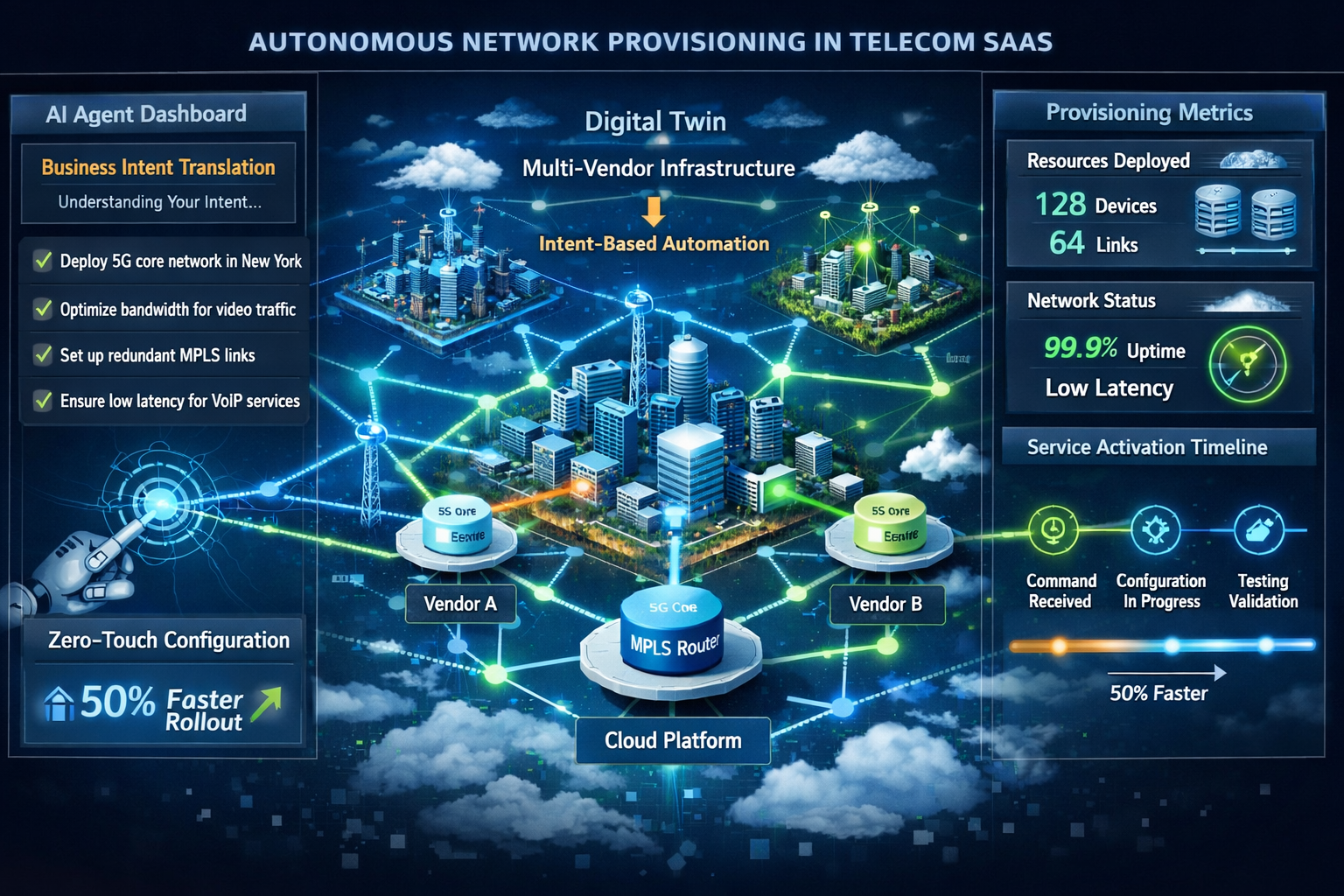
Autonomous network provisioning uses AI agents to interpret service requests, design network configurations, and deploy resources across distributed infrastructure without manual intervention. The process begins when a business user or system submits a request in natural language or through a simplified interface.
The Provisioning Workflow
Step 1: Intent interpretation – The AI agent parses the business requirement and translates it into technical specifications. For example, "Deploy a secure 5G network slice for a healthcare client with 99.99% uptime guarantee" becomes specific bandwidth allocations, latency targets, security policies, and redundancy configurations.
Step 2: Resource discovery and validation – The agent queries the network digital twin to identify available capacity, compatible equipment, and optimal routing paths. It validates that the request can be fulfilled within existing infrastructure constraints or flags capacity limitations.
Step 3: Configuration generation – Using model-driven templates and vendor-specific APIs, the system generates configuration files for all affected network elements. This includes routers, switches, firewalls, orchestration platforms, and monitoring systems.
Step 4: Automated deployment – The agent pushes configurations to target devices through zero-touch provisioning protocols. Changes are staged, tested in isolated environments, and rolled out with automatic rollback capabilities if validation fails.
Step 5: Service activation and verification – Once deployed, the system runs automated tests to confirm the service meets specified performance criteria. The agent updates service catalogs, billing systems, and customer portals simultaneously.
Nokia and Google Cloud demonstrated this capability at MWC 2026, where operators requested complex network reconfigurations using conversational commands. The system handled resource prioritization for emergency response scenarios without requiring network engineers to write configuration scripts[3].
Real-world result: Operators implementing autonomous provisioning report 50% faster service rollout times compared to manual processes, with fewer configuration errors and reduced need for specialized engineering resources[1].
Edge case: Multi-vendor environments with legacy equipment may require hybrid approaches where agentic AI handles modern infrastructure while generating work orders for manual configuration of older systems.
For organizations exploring high-ticket affiliate marketing in the B2B SaaS space, understanding autonomous provisioning capabilities helps position telecom solutions effectively to enterprise clients.
What Role Does Agentic AI Play in Service Assurance?
Service assurance in autonomous networks means maintaining quality, availability, and performance without constant human monitoring. Agentic AI systems continuously analyze network behavior, predict potential failures, and implement corrective actions before customers experience service degradation.
Core Service Assurance Capabilities
Anomaly detection at scale: AI agents monitor thousands of network elements simultaneously, identifying unusual patterns that indicate developing problems. Unlike threshold-based alerts that generate false positives, these systems understand normal behavior variations and flag only genuine anomalies.
Predictive failure analysis: Graph Neural Networks (GNNs) trained on network digital twin data mathematically model how failures propagate through interconnected systems. When a component shows early warning signs, the AI calculates downstream impact and prioritizes remediation based on customer service level agreements[3].
Automated root cause analysis: When issues occur, agents trace problems back to their source by analyzing logs, configuration changes, traffic patterns, and environmental factors. This eliminates the time-consuming manual investigation process that traditionally delays resolution.
Self-healing remediation: For common failure scenarios, AI agents implement fixes automatically. This includes rerouting traffic around failed links, restarting stuck processes, adjusting resource allocations, or failing over to backup systems. The agent documents all actions for compliance and audit purposes.
Field team coordination: When physical intervention is required, agentic systems generate detailed work orders, prioritize based on customer impact, and provide technicians with diagnostic data and recommended solutions through mobile interfaces[1].
Measurable Impact
Autonomous networks deployed in mission-critical environments (healthcare facilities, utility infrastructure, emergency services) now sustain service under extreme conditions by anticipating faults and rerouting traffic in real time. These systems operate with minimal error tolerance, as service interruptions can have life-safety implications[2].
Energy optimization represents another significant benefit. Autonomous configurations achieve 10-20% reductions in idle power consumption by dynamically adjusting network capacity based on traffic patterns while preserving quality of experience during congestion periods[1].
Decision rule: Implement predictive service assurance first in network segments serving high-value clients or mission-critical applications where downtime costs justify the investment in AI infrastructure.
Organizations building AI-powered marketing automation can apply similar predictive and self-healing principles to customer engagement workflows.
Where Do Most Telecom Operators Stand on the Autonomy Journey?
The TM Forum autonomy scale defines six levels (0-5) ranging from manual operations to fully autonomous networks. Current industry data shows that 88% of telecom organizations operate at levels 1-3, meaning they use some automation but still require significant human intervention for network management decisions[5].
Autonomy Level Breakdown
| Level | Description | Current Adoption | Key Characteristics |
|---|---|---|---|
| 0 – Manual | All tasks performed by humans | Declining rapidly | Legacy operations, high labor costs |
| 1 – Assisted | Humans use tools and dashboards | ~40% of operators | Basic monitoring and reporting |
| 2 – Partial | Automated execution of predefined tasks | ~30% of operators | Rule-based automation, human approval required |
| 3 – Conditional | System recommends actions, human approves | ~18% of operators | ML-based insights, human decision-making |
| 4 – High | Autonomous operation in defined scenarios | ~10% of operators | AI makes routine decisions independently |
| 5 – Full | Complete autonomy across all functions | <2% of operators | Self-optimizing networks, human oversight only |
The gap between current state and autonomous operations creates significant opportunity for high-ticket B2B telecom SaaS providers. Network automation has overtaken customer experience as the leading use case for investment, deployment, and ROI impact in 2026[5].
What's Driving the Shift
Investment priority change: Over 60% of operators now consider AI/ML capabilities important when making infrastructure purchasing decisions, signaling strong adoption intent even as large-scale autonomy remains in progress[4].
Generative AI acceleration: The emergence of large language models and agentic AI frameworks is compressing the timeline for moving from level 3 to level 5 autonomy. Systems that previously required months of training data can now understand intent and generate solutions using foundation models[5].
Economic pressure: Operators face mounting pressure to reduce operational expenses while scaling service delivery. Autonomous networks enable growth without proportional increases in engineering headcount, making the business case compelling for high-ticket enterprise deployments[1].
Choose level 4-5 solutions if: Your organization serves enterprise clients with complex SLA requirements, operates multi-vendor infrastructure, or needs to demonstrate measurable OPEX reduction to justify investment.
For professionals exploring smart routing of incoming requests via LLMs, similar intent-based automation principles apply to customer service workflows.
How Does Operator-as-a-Service (OaaS) Enable Agentic AI Workflows?
Operator-as-a-Service delivers orchestration, automation, analytics, and real-time intelligence as an integrated service layer that replaces fragmented OSS/BSS stacks and manual workflows with AI-native operations. OaaS provides the platform foundation that enables agentic AI to function effectively across complex telecom environments[1].
OaaS Architecture Components
Unified orchestration layer: Instead of separate systems for provisioning, assurance, billing, and customer management, OaaS consolidates these functions into a single API-driven platform. This eliminates data silos that prevent AI agents from accessing the information they need to make informed decisions.
Model-driven automation: OaaS platforms use standardized network and service models that abstract vendor-specific implementation details. AI agents work with these models to generate configurations that automatically translate to the correct syntax for each equipment type.
Real-time analytics fabric: Continuous telemetry collection and processing provides AI agents with up-to-the-second network state information. This enables predictive capabilities and rapid response to changing conditions.
Intent-based interfaces: Business users interact with the system using natural language or simplified policy definitions rather than technical configuration parameters. The OaaS layer translates these intents into technical implementations.
Business Outcomes
Early OaaS adopters report dramatically improved scalability, reduced downtime, lower operational expenses, fewer customer service disruptions, and faster service delivery compared to traditional OSS/BSS architectures[1].
The OaaS model particularly benefits high-ticket B2B scenarios where:
- Multi-tenant complexity: Enterprise clients require isolated network slices with custom SLAs, security policies, and performance characteristics
- Rapid service introduction: Competitive pressure demands launching new services in weeks rather than months
- Operational efficiency: Profit margins depend on delivering services without proportional increases in support staff
- Compliance requirements: Regulated industries need detailed audit trails and automated policy enforcement
Implementation consideration: OaaS platforms work best when deployed as complete replacements for legacy systems rather than as overlays. Hybrid approaches that maintain old OSS/BSS alongside new platforms create integration complexity that limits AI agent effectiveness.
Organizations implementing semi-automated client onboarding via email parsing and AI Q&A can apply similar unified platform principles to streamline customer acquisition workflows.
What Are Real-World Use Cases for Agentic AI in Telecom SaaS?
Agentic AI deployments in 2026 focus on high-value scenarios where autonomous operation delivers measurable business impact. These use cases demonstrate how AI agents handle complex workflows that previously required specialized engineering teams.
Priority Use Cases
Emergency response network prioritization: When natural disasters or public safety incidents occur, AI agents automatically reallocate bandwidth, prioritize emergency services traffic, and establish temporary network capacity in affected areas. The system coordinates with first responders and adjusts configurations as situations evolve without waiting for manual approvals[3].
Healthcare service delivery: Medical facilities require guaranteed network performance for telemedicine, remote surgery, and patient monitoring systems. Agentic AI maintains service quality by predicting potential disruptions, implementing redundant paths, and ensuring compliance with healthcare data regulations. The system handles these requirements autonomously while maintaining detailed audit logs[2].
Multi-site enterprise connectivity: Large organizations with distributed locations need consistent network policies, security controls, and performance characteristics across all sites. AI agents provision new locations, manage configuration drift, and optimize routing based on application requirements without requiring per-site engineering[4].
5G network slicing for industrial IoT: Manufacturing facilities and smart city deployments require isolated network slices with specific latency, bandwidth, and reliability characteristics. Agentic systems create and manage these slices dynamically, adjusting resources based on real-time demand patterns[1].
Predictive maintenance for network infrastructure: AI agents monitor equipment health indicators, predict component failures before they occur, and schedule maintenance during low-traffic periods. The system generates work orders with detailed diagnostic information and coordinates with field technicians through mobile interfaces[3].
Deployment Results
Operators implementing these use cases report:
- 50% reduction in service deployment time: From initial request to active service
- 10-20% lower energy consumption: Through intelligent capacity management
- Fewer customer-impacting incidents: Proactive issue resolution before service degradation
- Reduced operational staffing requirements: Autonomous handling of routine tasks
- Improved SLA compliance: Predictive capabilities prevent violations
Choose these use cases first if: Your organization serves mission-critical clients, manages complex multi-vendor environments, or faces competitive pressure to accelerate service delivery while controlling costs.
Common mistake: Attempting to automate everything simultaneously. Successful deployments start with well-defined use cases that deliver clear ROI before expanding to broader autonomous operations.
For businesses exploring AI tools for marketing automation, similar focused use case selection principles apply when prioritizing implementation efforts.
How Should Organizations Evaluate Readiness for Agentic AI Implementation?
Implementing agentic AI in high-ticket B2B telecom SaaS requires assessing technical infrastructure, organizational maturity, and business case alignment. Not every organization is ready for autonomous operations, and premature deployment can create more problems than it solves.
Readiness Assessment Framework
Technical infrastructure evaluation:
- Network digital twin maturity: Do you have accurate, real-time models of your network topology, configurations, and state?
- API accessibility: Can systems programmatically query and modify network elements across all vendors?
- Telemetry coverage: Do you collect comprehensive performance, health, and usage data from all infrastructure components?
- Data quality: Are your configuration management databases, inventory systems, and service catalogs accurate and synchronized?
Organizational autonomy level:
- Current automation baseline: What percentage of network changes happen without human intervention today?
- Decision-making culture: Does your organization trust automated systems to make operational decisions?
- Skills availability: Do you have staff who understand both AI/ML principles and telecom operations?
- Change management capability: Can your organization handle the operational model shift from reactive to proactive management?
Business case validation:
- Cost pressure: Are operational expenses growing faster than revenue, creating urgency for efficiency improvements?
- Service delivery speed: Do competitive pressures require faster deployment cycles than current processes support?
- Scale requirements: Are you adding customers or services faster than you can hire and train operations staff?
- SLA exposure: Do service level agreement penalties create financial risk from manual error or slow response times?
Decision Matrix
| Readiness Factor | Ready for Agentic AI | Need Preparation |
|---|---|---|
| Autonomy level | Currently at TM Forum level 3+ | Operating at levels 0-2 |
| Infrastructure | Modern, API-driven, well-documented | Legacy systems, manual processes |
| Data quality | Accurate, real-time, comprehensive | Incomplete, stale, inconsistent |
| Use case clarity | Specific, measurable, high-value | Vague, exploratory, low-impact |
| Executive support | Funded, prioritized, championed | Skeptical, unfunded, competing priorities |
Implementation path: Organizations at lower readiness levels should focus on foundational capabilities (API enablement, telemetry collection, data quality improvement) before attempting autonomous operations. Those with strong foundations can pilot agentic AI in controlled environments and expand based on measured results.
Budget consideration: High-ticket B2B telecom SaaS implementations typically require 12-18 month commitments with significant upfront investment in platform infrastructure, data preparation, and integration work. ROI becomes measurable after initial use cases demonstrate operational improvements.
Edge case: Highly regulated industries (financial services, healthcare, utilities) may require extended validation and compliance review periods before autonomous systems can operate in production environments.
Organizations building digital marketing capabilities can apply similar readiness assessment frameworks when evaluating AI-powered automation tools.
What Challenges and Risks Come With Autonomous Network Operations?
Deploying agentic AI in mission-critical telecom environments introduces operational, technical, and business risks that require careful management. Understanding these challenges helps organizations prepare mitigation strategies before problems impact customers.
Technical Challenges
Multi-vendor complexity: Telecom networks typically include equipment from multiple vendors, each with proprietary management interfaces, data models, and capabilities. AI agents must translate intent into vendor-specific configurations while maintaining consistency across heterogeneous infrastructure.
Legacy system integration: Most operators maintain legacy equipment that lacks modern APIs or telemetry capabilities. Autonomous systems must handle hybrid environments where some functions operate autonomously while others require manual intervention.
Model accuracy and drift: AI agents make decisions based on trained models that may not account for rare edge cases or evolving network conditions. Models require continuous validation and retraining to maintain accuracy as infrastructure and traffic patterns change.
Failure propagation: When autonomous systems make incorrect decisions, problems can cascade quickly across interconnected network elements. Robust rollback mechanisms and circuit breakers are essential to prevent single errors from causing widespread outages.
Operational Risks
Trust and accountability: Operations teams accustomed to manual control may resist autonomous systems, especially when AI decisions contradict human intuition. Clear accountability frameworks and explainable AI capabilities help build confidence.
Skills gap: Managing autonomous networks requires different expertise than traditional operations. Staff need training in AI/ML principles, data science, and intent-based management rather than just vendor-specific configuration syntax.
Compliance and audit: Regulated industries require detailed documentation of who made what decisions and why. Autonomous systems must maintain comprehensive audit trails that satisfy regulatory requirements even when humans weren't directly involved.
Vendor lock-in: Some OaaS platforms create dependency on specific vendors or cloud providers. Organizations should evaluate portability and interoperability before committing to long-term contracts.
Mitigation Strategies
Staged rollout: Deploy autonomous capabilities incrementally, starting with low-risk use cases in controlled environments. Expand to mission-critical functions only after demonstrating reliability and building operational confidence.
Human-in-the-loop for critical decisions: Configure AI agents to request approval for changes that exceed defined risk thresholds. This balances autonomy with appropriate oversight during the transition period.
Comprehensive monitoring: Implement observability tools that track AI agent decisions, actions taken, and outcomes achieved. This enables rapid detection of anomalous behavior and provides data for continuous improvement.
Regular validation: Establish processes for testing AI models against known scenarios, reviewing decisions made in production, and updating training data to reflect evolving network conditions.
Clear escalation paths: Define when and how autonomous systems should escalate issues to human operators. Ensure 24/7 availability of staff who can intervene when AI agents encounter situations outside their training.
Decision rule: Accept that autonomous systems will occasionally make suboptimal decisions. The goal is to achieve better overall outcomes than manual operations, not perfection in every individual case.
Organizations implementing LLM-powered competitor analysis face similar challenges around model accuracy, data quality, and trust in AI-generated insights.
How Will Agentic AI in Telecom SaaS Evolve Beyond 2026?
The trajectory for agentic AI in high-ticket B2B telecom SaaS points toward increasingly sophisticated autonomous capabilities, broader deployment across operator networks, and integration with emerging technologies that expand what's possible in network management.
Near-Term Evolution (2026-2027)
Expanded autonomy levels: The 88% of operators currently at TM Forum levels 1-3 will progressively move toward levels 4-5 as confidence builds and technology matures. Generative AI and improved foundation models will accelerate this transition by reducing the training data and customization required for autonomous operation[5].
Cross-domain orchestration: AI agents will coordinate not just within network operations but across business support systems, customer experience platforms, and partner ecosystems. This enables end-to-end service delivery automation from initial sales inquiry through provisioning, assurance, and billing.
Federated learning for privacy: Operators will train AI models on aggregated industry data while preserving competitive confidentiality. This allows smaller operators to benefit from collective learning without sharing sensitive network details.
Medium-Term Developments (2027-2029)
Intent-based business operations: Natural language interfaces will extend beyond network configuration to business process automation. Executives will define strategic objectives in plain language and AI agents will translate these into operational policies and network configurations.
Autonomous security response: AI agents will detect, analyze, and respond to security threats in real time without human intervention. This includes isolating compromised network segments, implementing temporary access controls, and coordinating incident response across multiple systems.
Sustainability optimization: Autonomous networks will balance performance, cost, and environmental impact by dynamically adjusting capacity, routing traffic through energy-efficient paths, and scheduling resource-intensive operations during periods of renewable energy availability.
Long-Term Possibilities (2029+)
Self-evolving networks: AI systems will not just operate networks but redesign them, recommending topology changes, technology upgrades, and architectural improvements based on observed performance patterns and business objectives.
Collaborative multi-operator autonomy: In scenarios requiring inter-operator coordination (international connectivity, emergency response, spectrum sharing), AI agents from different organizations will negotiate and implement agreements autonomously within defined policy frameworks.
Cognitive network planning: AI will handle strategic network planning functions currently performed by human experts, including capacity forecasting, technology roadmap development, and investment prioritization based on predicted market trends and competitive dynamics.
What This Means for B2B Telecom SaaS Providers
Platform differentiation: Competitive advantage will increasingly depend on the sophistication of AI capabilities rather than traditional features. Providers must invest in proprietary AI/ML development or partner with specialized AI vendors.
Service model evolution: High-ticket contracts will shift from selling software licenses to outcome-based pricing tied to measurable improvements in network performance, operational efficiency, or customer satisfaction.
Skills transformation: Successful providers will combine deep telecom domain expertise with AI/ML capabilities, data science skills, and experience designing human-AI collaboration workflows.
Ecosystem partnerships: No single vendor can deliver complete autonomous network solutions. Strategic partnerships between infrastructure providers, cloud platforms, AI specialists, and systems integrators will become essential.
Organizations exploring affiliate marketing programs in the B2B SaaS space should consider how autonomous capabilities create new value propositions for enterprise clients.
Frequently Asked Questions
What is the difference between traditional network automation and agentic AI?
Traditional automation executes predefined scripts and workflows based on specific triggers, while agentic AI makes contextual decisions, adapts to changing conditions, and coordinates complex multi-step processes without human intervention. Agentic systems understand intent and generate solutions rather than just executing programmed responses.
How long does it take to implement agentic AI in telecom operations?
Initial pilot deployments typically require 6-12 months for infrastructure preparation, data integration, and use case implementation. Production-scale rollouts across entire networks take 18-24 months. Organizations with modern API-driven infrastructure and strong data quality can move faster than those with legacy systems.
What ROI can operators expect from autonomous network operations?
Early 2026 deployments report 50% faster service delivery, 10-20% energy cost reductions, and measurable decreases in operational staffing requirements[1]. ROI varies based on network complexity, current automation levels, and specific use cases implemented. Most organizations see positive returns within 18-24 months.
Do autonomous networks eliminate the need for network operations staff?
No. Autonomous systems handle routine tasks and allow staff to focus on strategic initiatives, complex problem-solving, and continuous improvement. Organizations shift from reactive operations to proactive management, requiring different skills rather than fewer people. Staff roles evolve toward AI system training, policy definition, and exception handling.
What happens when agentic AI makes a mistake in a production network?
Well-designed autonomous systems include rollback capabilities, change validation, and circuit breakers that limit the impact of incorrect decisions. AI agents maintain detailed logs of all actions taken, enabling rapid diagnosis and correction. Critical decisions can be configured to require human approval before implementation.
Can small and mid-size operators afford agentic AI technology?
OaaS models make autonomous capabilities accessible to smaller operators by delivering functionality as a service rather than requiring large upfront infrastructure investments. Cloud-based platforms and shared AI models reduce the cost barrier compared to building proprietary systems.
How does agentic AI handle multi-vendor network environments?
Modern autonomous platforms use model-driven automation that abstracts vendor-specific implementation details. AI agents work with standardized network models and translate intent into vendor-specific configurations through API adapters. This approach handles heterogeneous infrastructure more effectively than traditional element management systems.
What regulatory or compliance issues affect autonomous network operations?
Regulated industries require detailed audit trails showing who made what decisions and why. Autonomous systems must maintain comprehensive logs of AI agent actions, decision rationale, and outcomes. Some jurisdictions may require human oversight for specific types of network changes. Compliance requirements vary by industry and geography.
How do you measure the success of agentic AI implementations?
Key metrics include service deployment time, mean time to repair, operational cost per subscriber, SLA compliance rates, energy consumption, and customer satisfaction scores. Successful implementations show measurable improvement in these metrics compared to pre-deployment baselines.
What skills do teams need to manage autonomous networks?
Operations staff require understanding of AI/ML principles, data analysis, intent-based policy definition, and system observability. Traditional vendor-specific configuration skills become less critical than the ability to define business objectives, validate AI decisions, and continuously improve autonomous system performance.
Can agentic AI work with existing OSS/BSS systems?
Integration is possible but challenging. Legacy systems often lack the APIs, data quality, and real-time capabilities that autonomous operations require. Hybrid approaches where AI handles modern infrastructure while generating work orders for legacy systems provide a transition path. Long-term success typically requires replacing legacy OSS/BSS with AI-native platforms.
How do you build trust in autonomous systems among operations teams?
Start with low-risk use cases that demonstrate value without threatening critical services. Provide transparency into AI decision-making through explainable AI capabilities. Maintain human oversight for critical decisions during initial deployment. Share success metrics and gradually expand autonomy as confidence builds.
Conclusion
Agentic AI in High-Ticket B2B Telecom SaaS: Autonomous Network Provisioning and Service Assurance Workflows represents a fundamental shift from reactive network management to proactive, self-optimizing operations. The technology has moved beyond theoretical concepts to practical deployments delivering measurable business value in 2026.
Organizations implementing autonomous capabilities report 50% faster service delivery, 10-20% energy cost reductions, and improved reliability through predictive maintenance and self-healing capabilities[1]. These outcomes make compelling business cases for high-ticket enterprise deployments where operational efficiency directly impacts profitability.
The current landscape shows 88% of operators still operating at early autonomy levels (TM Forum 1-3), creating significant opportunity for B2B telecom SaaS providers who can accelerate the transition to levels 4-5[5]. Network automation has become the top investment priority, overtaking customer experience as operators recognize that autonomous operations enable competitive differentiation and sustainable growth.
Success requires more than just deploying AI technology. Organizations must assess readiness across technical infrastructure, organizational culture, and business case alignment. Those with modern API-driven networks, strong data quality, and clear use case focus can implement autonomous capabilities faster than those maintaining legacy systems and manual processes.
Actionable Next Steps
For telecom operators considering agentic AI:
- Assess your current autonomy level using the TM Forum framework
- Identify high-value use cases where autonomous operations deliver clear ROI (emergency response, healthcare services, predictive maintenance)
- Evaluate infrastructure readiness, focusing on API accessibility, telemetry coverage, and data quality
- Start with pilot deployments in controlled environments before expanding to mission-critical functions
- Build internal skills in AI/ML principles, data science, and intent-based management
For B2B telecom SaaS providers:
- Invest in proprietary AI/ML capabilities or establish partnerships with specialized AI vendors
- Develop OaaS platforms that consolidate orchestration, automation, and analytics into unified service layers
- Create outcome-based pricing models tied to measurable improvements in network performance and operational efficiency
- Build reference implementations demonstrating 50%+ service delivery improvements and quantified OPEX reductions
- Establish ecosystem partnerships across infrastructure, cloud, AI, and systems integration domains
For enterprise buyers of telecom services:
- Evaluate service providers based on autonomy capabilities, not just traditional network features
- Prioritize vendors demonstrating predictive service assurance and self-healing infrastructure
- Negotiate SLAs that reflect the reliability improvements autonomous operations enable
- Request transparency into AI decision-making processes and audit trail capabilities
- Plan for collaborative relationships where your business intent drives automated network configuration
The transition to autonomous networks will continue accelerating through 2026 and beyond. Organizations that build foundational capabilities now, starting with focused use cases and expanding based on measured results, will gain competitive advantages that become increasingly difficult to replicate as AI systems learn from operational experience.
The question is no longer whether agentic AI will transform telecom operations, but how quickly your organization can capture the benefits while managing the transition effectively. Those who act decisively while others wait for further proof will establish market leadership positions that compound over time.
References
[1] Telecom Trends Outlook 2026 Operator As – http://news.axon-networks.com/2026/01/telecom-trends-outlook-2026-operator-as.html?m=1
[2] Autonomous Networks In 2026 From Ambition To Accountable Intelligence – https://www.thefastmode.com/expert-opinion/47022-autonomous-networks-in-2026-from-ambition-to-accountable-intelligence
[3] Autonomous Networks At MWC 2026 – https://cloud.google.com/blog/topics/telecommunications/autonomous-networks-at-mwc-2026
[4] Key Telecom Trends 2026 – https://www.tietoevry.com/en/blog/2026/02/key-telecom-trends-2026/
[5] AI In Telco Survey 2026 – https://blogs.nvidia.com/blog/ai-in-telco-survey-2026/