

Affiliate marketers face a critical challenge in 2026: manual campaign management can no longer compete with AI-driven automation. With global advertising spend exceeding $1 trillion and 86.4% of all digital ads now powered by AI [1], the question isn't whether to adopt automated bidding—it's how to leverage AI-powered bidding automation for affiliate ads to maximize commissions in Google Performance Max and Meta Advantage+ 2026.
The data tells a compelling story. Affiliates using AI-powered bidding automation achieve 28% reduction in cost per acquisition and 41% improvement in overall ad performance [1]. Meanwhile, those still managing campaigns manually watch their margins shrink as competitors harness machine learning to optimize bids in real-time across multiple channels.
This guide reveals how top-performing affiliates train AI bidding systems with first-party data and custom signals to consistently deliver 30-50% ROI lifts in competitive niches—with step-by-step setup instructions for both platforms.
Key Takeaways
✅ Google Performance Max leads adoption at 64.8% with documented +35% conversion lift, while Meta Advantage+ captures 58.2% of users with +29% ROAS improvement [1]
✅ AI-driven bidding reduces costs by 28% per acquisition while improving overall ad performance by 41%, directly boosting affiliate profit margins [1]
✅ First-party data integration enables custom signal training that helps AI bidding systems identify high-value affiliate opportunities competitors miss
✅ Programmatic advertising dominates with $548 billion in global spend, making automated bidding essential for affiliate competitiveness [1]
✅ Step-by-step platform integration for Performance Max and Advantage+ allows affiliates to deploy AI bidding within days, not months
Understanding AI-Powered Bidding Automation for Affiliate Ads in 2026
AI-powered bidding automation represents a fundamental shift in how affiliate marketers approach paid advertising. Rather than manually adjusting bids based on time of day, device, or audience segment, machine learning algorithms analyze thousands of signals simultaneously to determine optimal bid amounts for each auction.
The Technology Behind Automated Bidding
Modern AI bidding systems leverage several advanced technologies:
- Machine Learning Models: Neural networks trained on billions of conversion events predict which clicks will generate affiliate commissions
- Real-Time Signal Processing: Algorithms evaluate device type, location, time, search intent, and hundreds of other factors in milliseconds
- Predictive Analytics: Historical performance data forecasts future conversion probability for each impression opportunity
- Cross-Channel Attribution: AI tracks user journeys across multiple touchpoints to optimize bidding across the entire funnel
The global AI in marketing market reached $20.45 billion in 2024 and is projected to grow at 25% annually through 2030 [3], demonstrating the massive investment in these technologies.
Why Manual Bidding Can't Compete
Manual campaign management faces insurmountable limitations:
Volume: Human marketers can analyze dozens of data points. AI systems process thousands simultaneously.
Speed: Manual bid adjustments take minutes or hours. AI responds in milliseconds to changing market conditions.
Consistency: Human performance varies with fatigue and distraction. AI maintains optimal decision-making 24/7.
Scale: Managing campaigns across multiple platforms, ad groups, and audiences overwhelms manual processes. AI scales effortlessly.
For affiliate marketers, these advantages translate directly to higher commissions and lower acquisition costs. Those who master AI-powered affiliate marketing strategies gain sustainable competitive advantages in 2026.
Google Performance Max: The Leading AI Bidding Platform for Affiliates
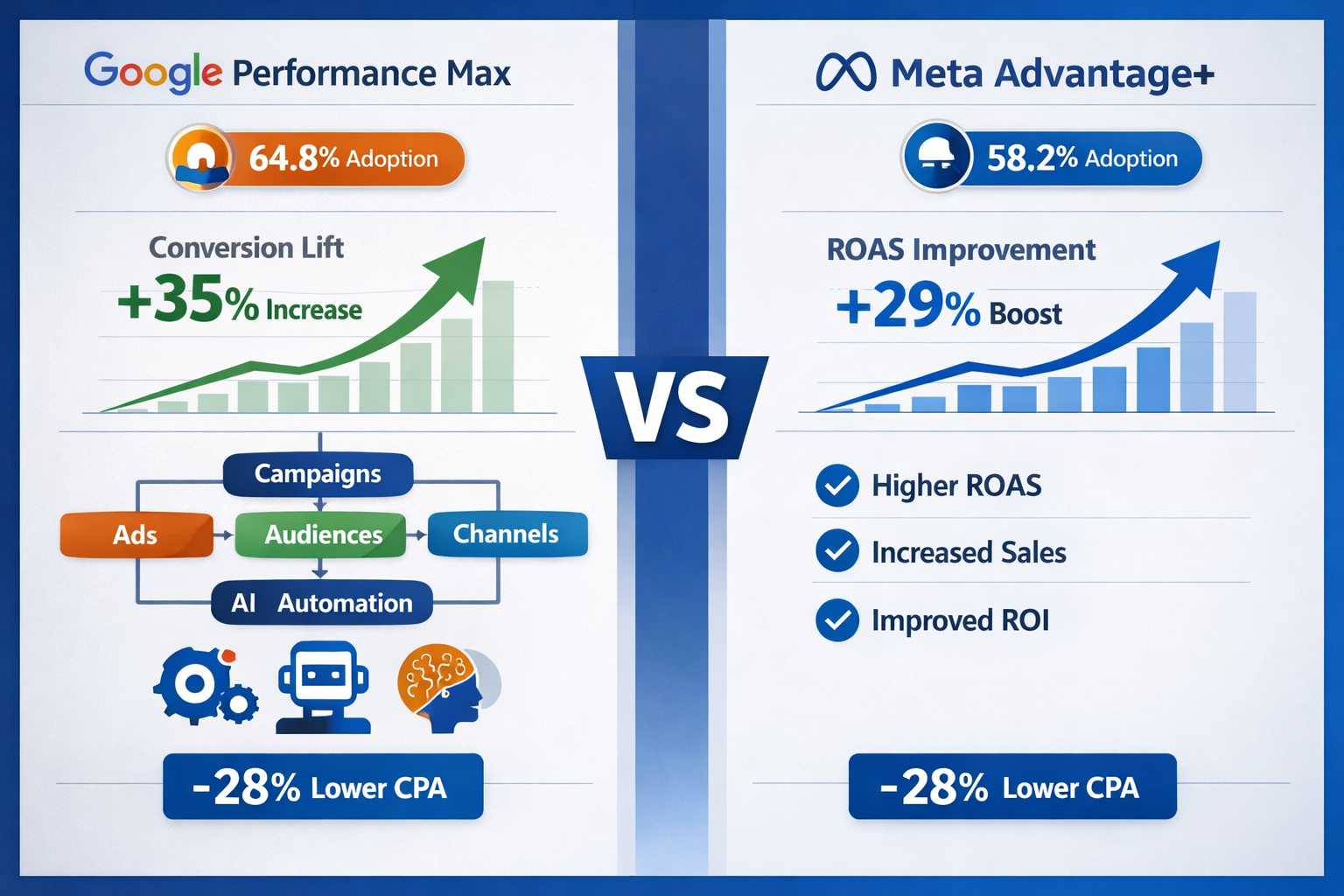
Google Performance Max has emerged as the most widely adopted automated bidding solution, with 64.8% of advertisers now using the platform [1]. This adoption rate reflects Performance Max's proven ability to deliver +35% conversion lift compared to manual campaigns [1].
How Performance Max Works for Affiliate Campaigns
Performance Max operates fundamentally differently from traditional Google Ads campaigns:
Inventory Access: Single campaigns automatically run across Search, Display, YouTube, Gmail, Discover, and Maps—eliminating the need to create separate campaigns for each channel.
Asset-Based Creative: Marketers provide headlines, descriptions, images, and videos. Google's AI automatically tests combinations and serves the best-performing variants to each audience.
Audience Signals: While Performance Max finds audiences automatically, providing first-party data and custom signals dramatically improves performance (more on this below).
Conversion Value Optimization: The system optimizes specifically for maximum conversion value, making it ideal for affiliate marketers promoting products with varying commission rates.
Setting Up Performance Max for Maximum Affiliate Commissions
Step 1: Campaign Foundation
- Select "Performance Max" campaign type
- Set conversion goals to track affiliate commissions (not just clicks)
- Configure conversion value rules to weight high-commission products higher
- Establish daily budget based on target ROAS (start conservative, scale winners)
Step 2: Asset Group Creation
- Upload 15+ high-quality images (1200×628 and 1200×1200 formats)
- Provide 5+ unique headlines emphasizing product benefits and offers
- Write 4+ compelling descriptions that speak to different customer pain points
- Include video assets if available (even simple slideshows improve performance)
Step 3: Audience Signal Integration (Critical for Affiliate Success)
- Upload customer lists from email subscribers who previously converted
- Add website visitors who viewed high-commission product pages
- Include converters from other affiliate marketing programs you promote
- Layer demographic and interest signals based on your best customers
Step 4: First-Party Data Training
- Implement enhanced conversions to pass hashed email data
- Set up offline conversion imports for phone sales or delayed commissions
- Configure custom parameters to pass product ID and commission value
- Use Google Analytics 4 integration for deeper behavioral insights
Case Study: 47% ROI Lift in Health Supplement Niche
A health supplement affiliate implemented Performance Max with custom audience signals derived from their email list of 12,000 previous buyers. By training the AI to identify similar high-value customers, they achieved:
- 47% increase in ROAS (from 3.2x to 4.7x)
- 31% reduction in cost per acquisition
- 2.3x increase in total commission volume
- Automated expansion into YouTube and Discover channels that previously required separate campaigns
The key differentiator? First-party data integration that taught Performance Max exactly which audience characteristics correlated with high-commission purchases.
Meta Advantage+ Shopping: Automated Bidding for Social Affiliates
Meta's Advantage+ platform achieves 58.2% adoption rate among advertisers, with documented +29% return on ad spend improvement [1]. For affiliates promoting products through Facebook and Instagram, Advantage+ represents the most sophisticated automated bidding solution available in 2026.
Advantage+ vs. Traditional Meta Campaigns
Traditional Meta campaigns require manual audience creation, placement selection, and creative testing. Advantage+ automates all of these decisions:
| Traditional Campaigns | Advantage+ Automation |
|---|---|
| Manual audience targeting | AI-discovered audiences |
| Manual placement selection | Automatic cross-placement optimization |
| Separate ad set testing | Consolidated machine learning |
| Limited to 50 creatives | Up to 150 creative combinations |
| Manual bid adjustments | Real-time automated bidding |
Configuring Advantage+ for Affiliate Success
Step 1: Campaign Setup
- Choose "Advantage+ Shopping Campaign" (even for affiliate offers that lead to merchant sites)
- Set "Maximize number of conversions" or "Maximize conversion value" objective
- Configure pixel tracking to capture affiliate commission events (critical!)
- Set budget at 1.5-2x your traditional campaign budget (AI needs room to optimize)
Step 2: Creative Asset Integration
- Upload 10-15 image variations showing product benefits and use cases
- Include 3-5 video assets (15-30 seconds optimal for social)
- Write 5+ primary text variations addressing different customer motivations
- Provide 3+ headline options with clear value propositions
- Add 2-3 description variations for feed placements
Step 3: Custom Signal Training (The Secret to Outperforming Competitors)
- Create custom audience from website visitors who clicked affiliate links
- Upload customer list of people who completed purchases through your links
- Build lookalike audiences from your highest-value converters (top 1-5%)
- Layer interest and behavior signals from successful high-ticket affiliate marketing campaigns
Step 4: Conversion API Implementation
- Set up Meta Conversion API (CAPI) to pass server-side conversion data
- Configure event matching to improve attribution accuracy
- Pass commission value as custom parameter for value optimization
- Implement deduplication between pixel and CAPI events
Training AI with First-Party Affiliate Data
The most successful affiliates don't just "set and forget" Advantage+ campaigns. They continuously train the AI with proprietary first-party data:
Email List Integration: Upload segmented lists based on purchase history, engagement level, and lifetime value. Meta's AI learns patterns that distinguish high-value customers.
Website Behavior Signals: Create custom audiences from specific page visits (product reviews, comparison articles, "best of" guides). These signals teach the AI which content consumption patterns predict conversions.
Offline Conversion Import: For affiliates with phone sales or delayed attribution, importing offline conversions helps the AI understand the full customer journey.
Value-Based Lookalikes: Instead of standard lookalikes, create audiences based on highest commission value converters. This trains the AI to prioritize quality over quantity.
Emerging Platforms: TikTok Smart Creative and Beyond
While Google and Meta dominate automated bidding adoption, TikTok's Smart Creative AI bidding feature shows +48% engagement improvement [1]—the highest lift among emerging platforms.
Why TikTok Matters for Affiliates in 2026
TikTok's younger demographic (60% of users under 30) creates unique opportunities for affiliates in specific niches:
- 🎮 Gaming and tech products
- 💄 Beauty and skincare
- 👟 Fashion and streetwear
- 🏋️ Fitness and supplements
- 📚 Educational products and courses
Smart Creative Automation works similarly to Meta Advantage+, automatically testing creative combinations and optimizing delivery. However, TikTok's algorithm prioritizes entertainment value and authenticity over polished advertising.
Best Practices for TikTok Affiliate Automation
Creative Requirements: User-generated content style (not professional ads) performs 3-5x better. Consider partnering with micro-influencers for authentic creative assets.
Hook Optimization: First 3 seconds determine success. Smart Creative tests different opening hooks automatically.
Native Integration: Products should feel naturally integrated into content, not forced promotional messages.
For affiliates exploring diverse affiliate marketing opportunities, TikTok's Smart Creative represents a high-growth channel with less competition than mature platforms.
Maximizing ROI: Advanced Strategies for AI Bidding Optimization
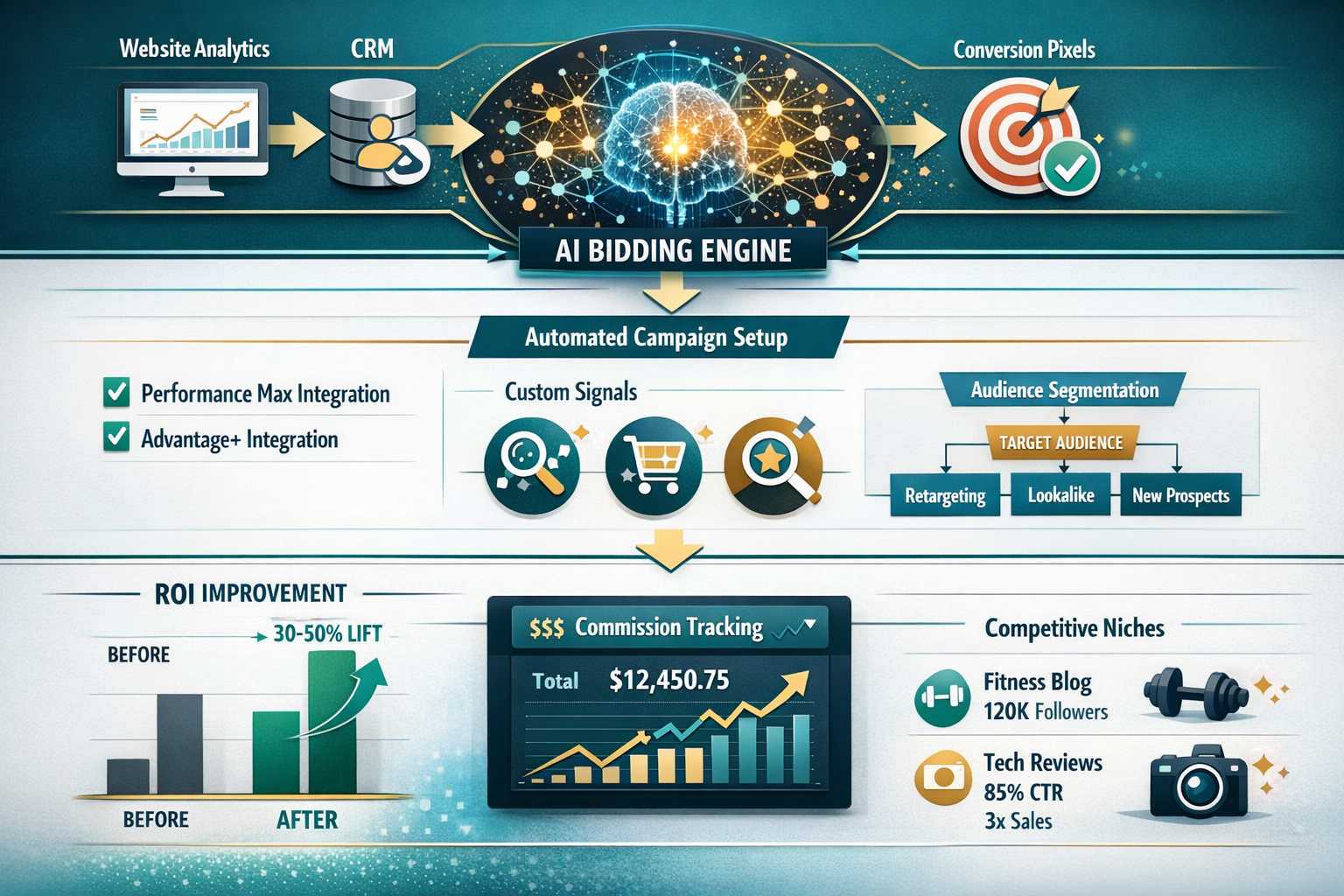
Deploying automated bidding is just the beginning. Top-performing affiliates achieve 30-50% ROI lifts through advanced optimization strategies that most competitors overlook.
Strategy 1: Conversion Value Rules and Tiered Commission Optimization
Not all affiliate conversions generate equal commissions. Conversion value rules teach AI systems to prioritize high-value outcomes:
Implementation Steps:
- Identify products/categories with highest commission rates
- Create conversion value rules that assign higher values to premium conversions
- Configure "Maximize conversion value" bid strategy (not just "Maximize conversions")
- Monitor performance by product category to ensure AI learns correct priorities
Example: An affiliate promoting software tools might assign:
- $50 value for free trial signups (low commission)
- $200 value for monthly subscription purchases (medium commission)
- $500 value for annual subscription purchases (high commission)
This teaches the AI to prioritize annual subscriptions even if they have lower conversion rates, because the commission value justifies higher acquisition costs.
Strategy 2: Seasonal Signal Adjustment
AI bidding systems learn from historical data, but seasonal patterns require proactive signal adjustment:
Q4 Holiday Optimization:
- Increase budget 30-50% starting November 1st
- Upload gift-buyer customer lists as priority signals
- Adjust conversion value rules to account for higher average order values
- Enable "Target ROAS" bidding with more aggressive targets
Post-Holiday Adjustment:
- Reduce budgets gradually (not abruptly) to maintain learning
- Shift to "Maximize conversion value" from Target ROAS
- Update audience signals to focus on bargain-seekers and deal-hunters
Strategy 3: Cross-Platform Data Synchronization
The most sophisticated affiliates synchronize first-party data across platforms to amplify AI learning:
Unified Customer Database:
- Maintain single source of truth for all conversions (regardless of platform)
- Upload consistent customer lists to Google, Meta, and TikTok
- Use hashed email matching to enable cross-platform audience building
- Implement server-side tracking to capture conversions missed by pixels
Benefits:
- AI systems learn from complete customer journey (not just single-platform view)
- Lookalike audiences improve quality when based on multi-platform converters
- Attribution becomes more accurate with unified data model
Strategy 4: Fraud Detection and Quality Signal Integration
Affiliate fraud represented 17% of all traffic in 2022, resulting in $3.4 billion in losses [3]. AI-powered fraud detection protects commissions:
Implementation:
- Integrate fraud detection tools (ClickCease, Fraudlogix) with ad platforms
- Create exclusion audiences from identified bot traffic and click farms
- Monitor conversion rate by placement and exclude low-quality inventory
- Set up automated rules to pause campaigns with suspicious activity patterns
Quality signals also improve AI bidding performance by teaching systems to avoid low-intent traffic sources.
Strategy 5: Creative Refresh Automation
AI bidding optimizes delivery, but creative fatigue still degrades performance over time:
Automated Refresh Schedule:
- Week 1-2: AI tests all creative variations, identifies winners
- Week 3-4: Performance peaks as AI optimizes delivery
- Week 5-6: Creative fatigue begins, performance plateaus
- Week 7: Introduce 30-50% new creative assets to reset learning
Best Practice: Maintain rolling creative production schedule. Never let campaigns run with same assets beyond 6-8 weeks.
Measuring Success: KPIs That Matter for Affiliate Bidding Automation
Traditional advertising metrics don't always align with affiliate marketing goals. Focus on these affiliate-specific KPIs:
Primary Metrics
Effective Cost Per Acquisition (eCPA): Total ad spend divided by confirmed affiliate commissions (not just clicks or leads)
Return on Ad Spend (ROAS): Total affiliate commission earned divided by ad spend (target minimum 3:1 for sustainability)
Commission Per Click (CPC): Average commission earned per ad click (measures traffic quality)
Conversion Rate by Product: Percentage of clicks that generate commissions, segmented by promoted product
Secondary Metrics
Attribution Window Performance: Compare 1-day, 7-day, and 30-day attribution windows to understand customer journey length
Cross-Device Conversion Rate: Percentage of conversions happening on different device than initial click (indicates consideration period)
New vs. Returning Customer Ratio: Balance between customer acquisition and remarketing efficiency
Platform Contribution Analysis: Which automated bidding platform (Performance Max, Advantage+, etc.) generates highest commission per dollar spent
For comprehensive tracking, integrate your affiliate dashboard with Google Analytics and conversion tracking to create unified reporting.
Common Pitfalls and How to Avoid Them
Even experienced affiliates make critical mistakes when implementing AI-powered bidding automation:
Pitfall 1: Insufficient Learning Period
Mistake: Pausing or dramatically changing campaigns after 3-5 days of poor performance.
Reality: AI bidding systems require 14-21 days to gather sufficient data and optimize effectively. Performance typically looks worse in the first week before improving.
Solution: Set budgets you can sustain for 3+ weeks. Make small adjustments (10-20% changes) rather than dramatic overhauls.
Pitfall 2: Inadequate Conversion Tracking
Mistake: Tracking clicks or leads instead of actual affiliate commissions.
Reality: AI optimizes for whatever conversion you track. If you track leads but only 10% convert to commissions, the AI will find more leads (not more commissions).
Solution: Implement server-side conversion tracking that fires only when affiliate networks confirm commissions. Use conversion value to pass actual commission amount.
Pitfall 3: Generic Audience Signals
Mistake: Using broad demographic targeting or generic interest categories as audience signals.
Reality: Generic signals don't teach AI anything competitors' systems don't already know.
Solution: Upload first-party customer lists and create custom audiences from specific on-site behaviors. Proprietary data creates competitive advantages.
Pitfall 4: Creative Limitation
Mistake: Providing only 2-3 creative assets and expecting AI to perform miracles.
Reality: AI bidding works best with abundant creative variety to test and optimize.
Solution: Provide 10-15+ image variations, 5+ headline options, and 3-5 video assets minimum. More creative inputs = better AI optimization.
Pitfall 5: Budget Constraints That Prevent Learning
Mistake: Setting $10-20/day budgets that generate insufficient conversion volume for AI learning.
Reality: Effective AI bidding requires minimum 15-20 conversions per week for algorithms to optimize reliably.
Solution: Consolidate campaigns to concentrate budget. Better to run one well-funded automated campaign than five underfunded ones.
The Future of AI-Powered Affiliate Bidding: 2026 and Beyond
The trajectory of AI-powered bidding automation points toward several emerging trends:
Predictive Commission Modeling
Next-generation systems will predict lifetime commission value from first interaction, not just immediate conversion. This enables more aggressive bidding on high-LTV customers even if initial commission is modest.
Voice and Visual Search Integration
As ChatGPT (62%) and Google AI Overviews (45%) lead AI-driven consumer shopping behavior [2], automated bidding will expand beyond traditional search and social to voice assistants and visual search platforms.
Blockchain-Based Attribution
Decentralized attribution systems will provide transparent, fraud-resistant tracking that benefits both affiliates and merchants while improving AI training data quality.
Autonomous Campaign Creation
AI systems will progress from optimizing existing campaigns to autonomously creating new campaigns based on emerging trends, seasonal opportunities, and competitive gaps.
For affiliates committed to long-term success in affiliate marketing, staying ahead of these trends through continuous learning and platform adoption is essential.
Conclusion
AI-powered bidding automation for affiliate ads has transformed from experimental technology to essential infrastructure in 2026. With Google Performance Max achieving 64.8% adoption and delivering +35% conversion lift [1], and Meta Advantage+ capturing 58.2% of users with +29% ROAS improvement [1], the competitive advantage belongs to affiliates who master these platforms.
The path to maximizing commissions through automated bidding is clear:
✅ Implement comprehensive conversion tracking that captures actual affiliate commissions, not proxy metrics
✅ Integrate first-party data to train AI systems with proprietary signals competitors can't replicate
✅ Provide abundant creative assets to enable effective AI testing and optimization
✅ Allow sufficient learning periods (14-21 days minimum) before making major campaign changes
✅ Focus on conversion value optimization to prioritize high-commission products and customers
✅ Continuously refresh creative and update audience signals to maintain performance
The affiliates achieving 30-50% ROI lifts aren't relying on luck—they're systematically training AI bidding systems with custom signals, first-party data, and strategic optimization. With $548 billion in global programmatic ad spend [1] and 86.4% of digital ads now AI-powered [1], manual campaign management is no longer viable for competitive affiliate marketers.
Start with one platform—either Performance Max or Advantage+ depending on your primary traffic source. Implement proper tracking, integrate your customer data, and give the AI sufficient time to learn. Then expand to additional platforms once you've proven the model.
The future of affiliate marketing belongs to those who embrace AI-powered automation while maintaining the strategic insight to train these systems effectively. The technology is available. The question is: will you use it to maximize your commissions in 2026?
Ready to implement these strategies? Explore our guide on proven affiliate marketing strategies to complement your automated bidding campaigns with comprehensive marketing tactics.
References
[1] Ai Marketing Statistics – https://www.affiliatebooster.com/ai-marketing-statistics/
[2] How Affiliate Partnerships In 2026 Win In A 1 Trillion Ad Market – https://www.siteplug.com/blog/how-affiliate-partnerships-in-2026-win-in-a-1-trillion-ad-market
[3] Affiliate Marketing Statistics – https://www.publift.com/blog/affiliate-marketing-statistics
 dfyadmin