

The affiliate marketing landscape has reached a critical inflection point in 2026. With 70% of affiliate platforms abandoning cookie-based tracking [1], marketers face an urgent question: How can you deliver hyper-personalized offers that boost conversions by 40% while maintaining full compliance with evolving privacy regulations? The answer lies in mastering first-party data strategies for affiliate personalization and building privacy-first AI models in a cookieless world.
The transition from third-party cookies to first-party data isn't just a technical shift—it's a fundamental reimagining of how affiliates collect, analyze, and activate customer insights. This comprehensive guide reveals practical blueprints for data collection, synthetic augmentation techniques, and AI model training that respect user privacy while dramatically improving campaign performance.
Key Takeaways
- Server-to-Server (S2S) attribution has replaced cookie-based tracking as the dominant method, enabling reliable conversion tracking without browser dependencies [2]
- First-party data activation reduces customer acquisition costs by up to 50% and drives 10-15% revenue lifts through improved targeting relevance [6]
- Email lists and progressive profiling remain the highest-value first-party assets, providing owned customer relationships independent of platform changes [4]
- 70% of B2B marketers plan to increase first-party data usage more than any other strategy, signaling strong industry momentum [6]
- AI-powered fraud detection and dynamic segmentation are essential platform features for maintaining data quality in cookieless environments [3]
Understanding First-Party Data Strategies for Affiliate Personalization
The Cookieless Reality of 2026
Third-party cookies are effectively extinct in 2026. Browser restrictions, privacy regulations like GDPR and CCPA, and consumer demand for data control have eliminated the tracking methods affiliates relied on for decades. This shift has forced a complete rethinking of how personalization works in affiliate marketing optimization techniques.
First-party data—information collected directly from your audience through owned channels—now serves as the foundation for all personalization efforts. Unlike third-party cookies that tracked users across the web, first-party data comes from:
- 📧 Email subscriptions and interactions
- 🌐 Website behavior on your owned properties
- 💬 Direct customer communications
- 🛒 Purchase history and transaction data
- 📝 Form submissions and survey responses
The critical advantage? This data belongs to you, persists across sessions, and provides deeper insights into actual customer intent rather than surface-level browsing behavior.
Server-to-Server Attribution: The New Tracking Standard
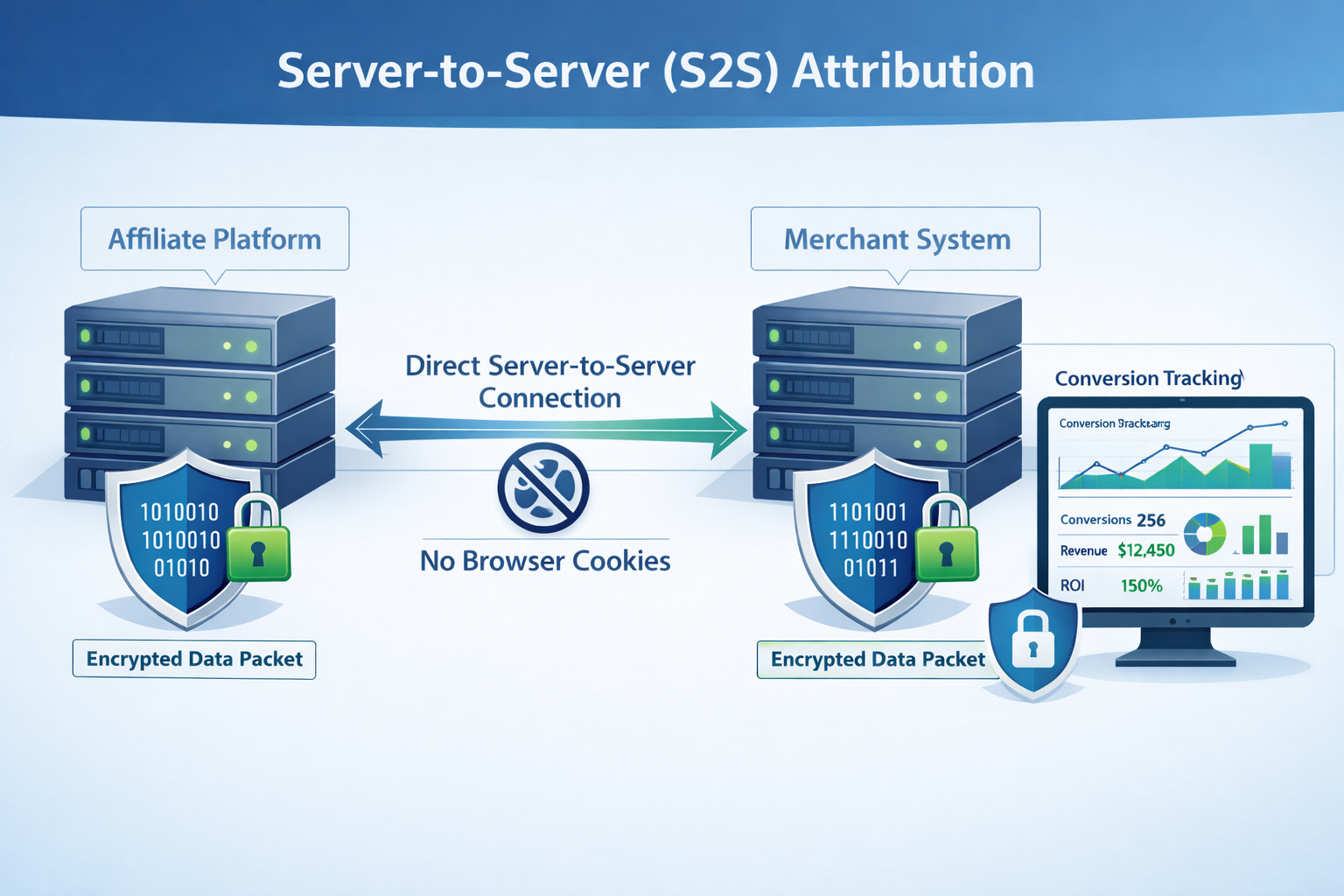
Server-to-Server (S2S) attribution has emerged as the dominant tracking method in 2026 [2]. Instead of relying on browser-based cookies, S2S sends conversion data directly between systems—from the merchant's server to the affiliate platform's server—creating a reliable tracking mechanism independent of browser restrictions.
| Tracking Method | Reliability | Privacy Compliance | Cross-Device | 2026 Adoption |
|---|---|---|---|---|
| Third-Party Cookies | ❌ Low | ❌ Non-compliant | ❌ Limited | 5% |
| First-Party Cookies | ⚠️ Medium | ✅ Compliant | ❌ Limited | 25% |
| S2S Attribution | ✅ High | ✅ Compliant | ✅ Excellent | 70% |
This shift has made Data & Analytics for AI Marketing more critical than ever, as affiliates must now integrate sophisticated tracking infrastructure that operates entirely on first-party relationships.
Building Your First-Party Data Collection Infrastructure
Email Lists: Your Highest-Value Asset
Email lists represent the most valuable first-party data asset for affiliates in 2026 [4]. They provide direct communication channels that no platform can take away, enable sophisticated segmentation, and serve as the foundation for AI-powered personalization.
Effective email collection strategies include:
- Lead magnets offering genuine value (templates, calculators, exclusive research)
- Content upgrades that extend blog posts with downloadable resources
- Interactive tools that solve specific problems while capturing contact information
- Gated premium content positioned at strategic conversion points
The key is moving beyond simple email capture to progressive profiling—collecting qualifying information over time through multiple touchpoints [5]. This approach gathers company size, role, current tools, and specific challenges without overwhelming prospects with lengthy initial forms.
Progressive Profiling and Dynamic Segmentation
Progressive profiling transforms one-time data collection into an ongoing relationship-building process. Each interaction adds layers to customer profiles, enabling increasingly sophisticated personalization without privacy concerns.
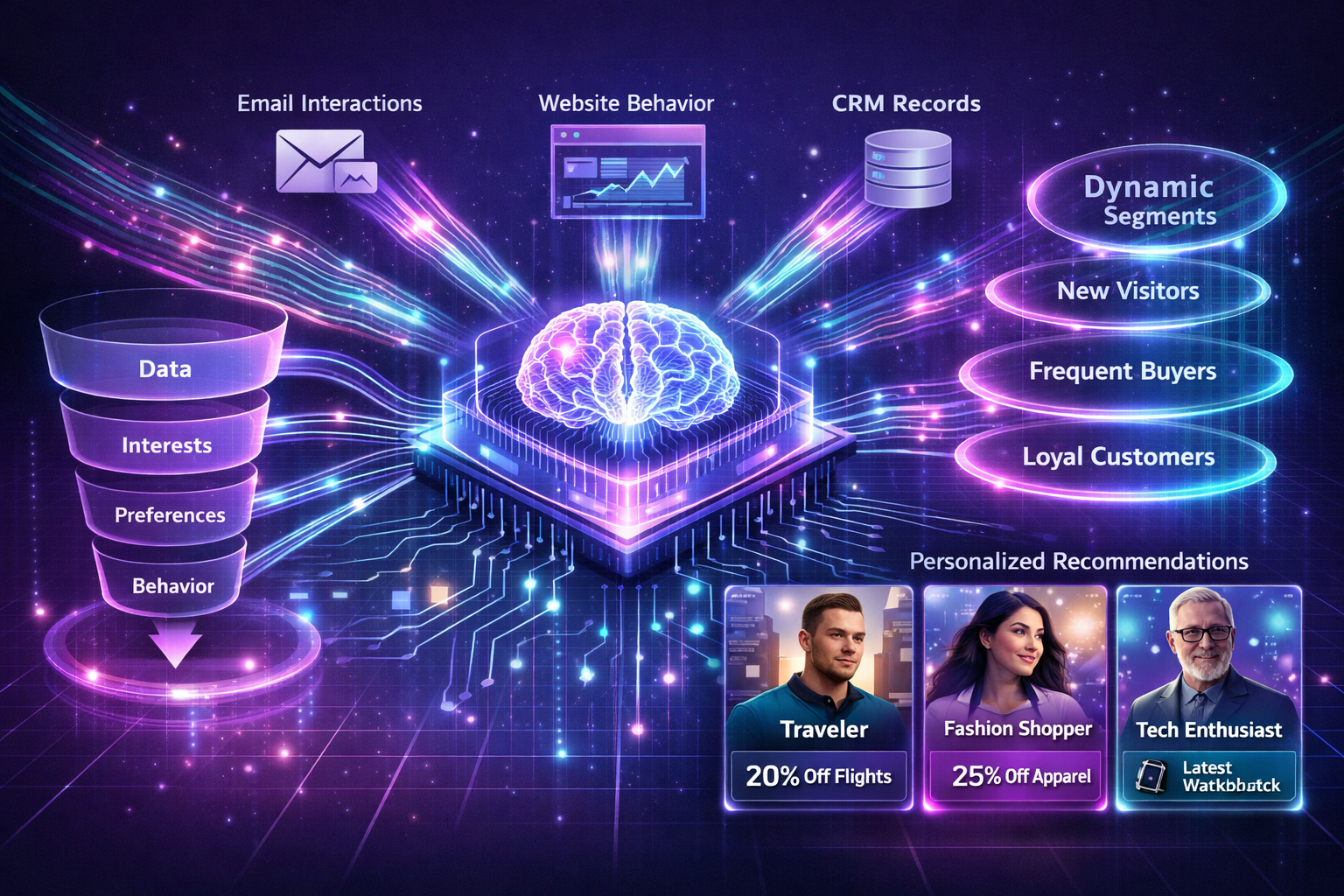
Dynamic segment creation uses logged-in behavior patterns to automatically update customer profiles in real-time [5]. When a prospect downloads three pieces of content about email automation, your AI model automatically tags them as high-intent for marketing automation offers—no manual segmentation required.
This approach aligns perfectly with top strategies for affiliate marketers who need scalable personalization without massive teams.
Interactive Content for Data Generation
Interactive content tools generate first-party data while feeling helpful rather than sales-oriented [5]. Quizzes, assessments, calculators, and configurators guide prospects through decision processes while capturing valuable preference data.
For example, a "Marketing Stack Audit" tool might ask:
- Current monthly ad spend
- Primary traffic sources
- Biggest marketing challenges
- Tools currently in use
- Team size and structure
Each response feeds into your CRM and marketing automation system, enabling granular segmentation for affiliate follow-up. The prospect receives immediate value (personalized recommendations), while you gain rich behavioral data that informs AI model training.
Building Privacy-First AI Models for Affiliate Personalization
Training AI on First-Party Data
The transition to first-party data strategies for affiliate personalization requires rethinking how AI models learn customer preferences. Traditional models relied on vast third-party datasets; privacy-first models must extract maximum intelligence from smaller, owned datasets.
Key techniques for privacy-first AI training:
- Federated learning: Train models across distributed datasets without centralizing sensitive information
- Differential privacy: Add mathematical noise to datasets that preserves patterns while protecting individual identities
- Synthetic data augmentation: Generate artificial training examples that mirror real customer patterns without exposing actual user data
- Transfer learning: Leverage pre-trained models and fine-tune them on your specific first-party data
These approaches enable sophisticated personalization while maintaining full compliance with privacy regulations—a critical consideration for affiliate marketing success.
AI-Powered Fraud Detection in Cookieless Environments
AI-powered fraud detection has become essential as traditional fingerprinting methods lose effectiveness [3]. Without cookies to track suspicious patterns across sites, affiliate networks need intelligent systems that identify fraudulent conversions using first-party behavioral signals.
Modern fraud detection AI analyzes:
- ⏱️ Conversion timing patterns (too fast or suspiciously uniform)
- 🔄 Engagement depth before conversion (bounce vs. genuine interest)
- 📱 Device and location consistency across customer journey
- 💳 Transaction characteristics that deviate from normal patterns
These systems protect affiliate networks from invalid conversions while maintaining the privacy-first approach that defines 2026 marketing standards.
Real-Time Personalization Without Cookies
Real-time personalization in a cookieless world relies on identity foundation—connecting customer interactions across touchpoints using first-party identifiers [6]. When users log in or identify themselves, your system can deliver personalized experiences without tracking cookies.
Implementation blueprint:
- Identity resolution: Match email addresses, phone numbers, or account IDs across channels
- Behavioral scoring: Assign real-time intent scores based on current session activity
- Contextual signals: Use page content, referral source, and time-of-day patterns
- Predictive modeling: Forecast next-best actions based on similar customer journeys
This approach powers the hyper-personalized experiences that drive 40% conversion improvements while respecting user privacy completely.
Measuring Success: Attribution in a Privacy-First World
The Three Operational Shifts
Identity foundation underpins three critical operational shifts for first-party data strategies [6]:
- Onboarding: Moving customer data from collection points into unified profiles
- Activation: Deploying personalized experiences across channels based on unified profiles
- Measurement: Attributing conversions and calculating ROI without third-party tracking
These stages must operate as a connected workflow rather than isolated use cases. Data collected during onboarding immediately feeds activation systems, while measurement insights refine future collection and personalization strategies.
Key Performance Indicators for First-Party Strategies
Measuring success requires new metrics focused on first-party data quality and activation effectiveness:
| Metric | Target | Why It Matters |
|---|---|---|
| First-party data coverage | >60% of audience | Measures personalization reach |
| Profile completeness | >5 data points per user | Enables accurate segmentation |
| Identity match rate | >75% cross-channel | Tracks attribution accuracy |
| Consent rate | >40% opt-in | Indicates value exchange quality |
| CAC reduction | 30-50% improvement | Validates efficiency gains |
| Revenue lift | 10-15% increase | Demonstrates personalization impact |
These metrics provide clear indicators of whether your first-party data strategies for affiliate personalization are delivering measurable business results [6].
Industry Momentum and Future Outlook
The shift to first-party data isn't just happening—it's accelerating dramatically. 67% of brands and 80% of publishers expect to grow first-party data sets in 2026 [6], creating network effects that make first-party affiliate strategies increasingly viable at scale.
This momentum reflects several converging factors:
- ✅ Regulatory certainty: Privacy laws are now established rather than emerging threats
- 📈 Proven ROI: Early adopters demonstrate clear performance advantages
- 🛠️ Mature tooling: Platforms now offer sophisticated first-party data capabilities
- 🤝 Consumer acceptance: Users willingly share data when value exchange is clear
For affiliates, this creates a strategic window. Those who master first-party data strategies now will build sustainable competitive advantages before the market fully matures. The techniques outlined in this guide—from progressive profiling to privacy-first AI models—provide the foundation for long-term success in the cookieless era.
Practical Implementation: Your 90-Day Blueprint
Month 1: Foundation Building
Week 1-2: Audit and Infrastructure
- Inventory all current data collection points
- Implement S2S tracking with affiliate networks
- Set up unified customer data platform (CDP)
- Establish consent management framework
Week 3-4: Collection Mechanisms
- Launch lead magnet campaigns for email collection
- Deploy interactive content tools (quiz, calculator, assessment)
- Implement progressive profiling on key forms
- Create value-exchange messaging for data requests
Month 2: AI Model Development
Week 5-6: Data Preparation
- Clean and standardize first-party datasets
- Create unified customer profiles across touchpoints
- Establish data quality monitoring systems
- Implement privacy-preserving data augmentation
Week 7-8: Model Training
- Train segmentation models on behavioral patterns
- Develop predictive scoring for conversion likelihood
- Build recommendation engines for affiliate offers
- Test fraud detection algorithms
Month 3: Activation and Optimization
Week 9-10: Personalization Launch
- Deploy dynamic content based on customer segments
- Activate email personalization workflows
- Implement real-time offer recommendations
- Launch retargeting campaigns using first-party audiences
Week 11-12: Measurement and Refinement
- Track KPIs against baseline performance
- Analyze segment-level conversion rates
- Refine AI models based on performance data
- Document learnings and scale successful tactics
This blueprint provides a structured path from current state to fully operational first-party data strategies for affiliate personalization, with clear milestones and deliverables at each stage.
Conclusion
First-party data strategies for affiliate personalization represent more than a technical adaptation to privacy regulations—they're a fundamental reimagining of how affiliates build relationships with audiences. By mastering S2S attribution, progressive profiling, and privacy-first AI models, marketers can achieve superior personalization that respects user privacy while delivering 40% conversion improvements and 50% reductions in customer acquisition costs.
The cookieless world of 2026 isn't a limitation; it's an opportunity. Affiliates who embrace first-party data strategies build owned assets that no platform change can disrupt, develop deeper customer relationships that drive lifetime value, and create sustainable competitive advantages in an increasingly crowded market.
Your Next Steps
- Audit your current data collection to identify first-party opportunities
- Implement S2S tracking with your primary affiliate networks
- Launch one lead magnet campaign to begin building your email asset
- Deploy an interactive tool that generates behavioral data while providing value
- Start training AI models on your existing first-party datasets
- Measure and optimize using the KPIs outlined in this guide
The transition to first-party data strategies isn't optional—it's the defining requirement for affiliate success in 2026 and beyond. Those who act now will establish market positions that become increasingly difficult for competitors to challenge. Start building your privacy-first personalization infrastructure today.
For more insights on optimizing your affiliate approach, explore our guides on affiliate marketing optimization techniques and Data & Analytics for AI Marketing.
References
[1] 10 Affiliate Trends Reshaping Affiliate Marketing In 2026 – https://www.affiversemedia.com/10-affiliate-trends-reshaping-affiliate-marketing-in-2026/
[2] Affiliate Marketing Trends And What To Leave Behind – https://www.postaffiliatepro.com/blog/affiliate-marketing-trends-and-what-to-leave-behind/
[3] 5 Trending Features Your Affiliate Platform Needs – https://partnerize.com/resources/blog/5-trending-features-your-affiliate-platform-needs
[4] Affiliate Campaign Strategies – https://easyaffiliate.com/blog/affiliate-campaign-strategies/
[5] First Party Data Collection Strategies – https://www.cometly.com/post/first-party-data-collection-strategies
[6] First Party Data Activation 2026 – https://www.experian.com/blogs/marketing-forward/first-party-data-activation-2026/