

{"cover":"Professional landscape format (1536x1024) hero image featuring bold text overlay 'Low-Code Agentic AI Builders: Empowering Non-Technical Teams' in extra large 72pt white sans-serif font with subtle gradient shadow, positioned center-left. Background shows diverse B2B team members (product manager, operations lead, marketing specialist) collaborating around glowing holographic workflow diagrams with drag-and-drop interface elements, AI agent nodes, and connection pathways floating in modern glass-walled office. Color palette: deep navy blue, electric cyan, white, with orange accent highlights. High contrast, magazine editorial quality, futuristic yet approachable aesthetic, shallow depth of field focusing on workflow visualization.","content":["Landscape format (1536x1024) split-screen comparison image showing left side: frustrated developer buried under tickets labeled 'workflow request', 'automation backlog', 'integration needed' with red warning indicators and timeline stretching months ahead; right side: confident business analyst using visual drag-and-drop interface on large monitor, connecting colorful workflow blocks labeled 'trigger', 'AI agent', 'action' with green checkmarks and '2 days' timeline indicator. Modern office setting, clean UI mockup style, professional lighting, visual contrast emphasizing speed difference.","Landscape format (1536x1024) detailed close-up screenshot mockup of low-code platform interface showing visual workflow canvas with connected nodes: trigger node (calendar icon), decision diamond (AI brain symbol), multiple agent boxes (chat, data analysis, email), and integration endpoints (Salesforce, Slack, HubSpot logos). Cursor hovering over 'Add Agent' button, properties panel on right showing configuration options without code, clean modern UI design, professional software aesthetic, bright interface colors against dark workspace background.","Landscape format (1536x1024) infographic-style illustration showing three-tier platform comparison matrix with columns labeled 'No-Code', 'Low-Code', 'Pro-Code' and rows showing: user personas (business user icon, technical PM icon, developer icon), complexity levels (simple to advanced workflow diagrams), deployment speed (calendar icons: 2 days, 1 week, 1 month), and customization depth (sliding scale bars). Clean corporate design, icons and visual hierarchy, professional color coding (green for no-code, blue for low-code, purple for pro-code).","Landscape format (1536x1024) conceptual illustration of multi-agent orchestration system showing central orchestrator node (conductor icon) connected to five specialized agent circles: customer service agent (headset icon), data retrieval agent (database icon), analysis agent (chart icon), decision agent (brain icon), and action agent (gear icon). Each agent has mini workflow paths and data flow arrows between them, floating in modern digital workspace. Clean vector style, professional tech aesthetic, glowing connection lines, depth and dimension.","Landscape format (1536x1024) real-world application dashboard mockup showing three side-by-side panels: left panel displays customer support ticket queue with AI agent status indicators (processing, resolved, escalated), center panel shows automated lead qualification workflow with prospect cards moving through stages, right panel presents invoice processing pipeline with document thumbnails and approval routing. Modern SaaS interface design, clean data visualization, professional business software aesthetic, realistic UI elements.","Landscape format (1536x1024) strategic decision flowchart visualization showing business user journey: starting with 'Workflow Need' hexagon at top, branching to decision diamonds ('Technical Skills?', 'Customization Depth?', 'Integration Requirements?'), leading to platform recommendation boxes (Microsoft Copilot Studio, Flowise, Langflow, Lyzr) with key feature bullets and ideal use case labels. Clean infographic style, directional arrows, professional color coding, modern business presentation aesthetic."]}
Last updated: March 7, 2026
Key Takeaways
- Low-code agentic AI platforms enable business users to build autonomous workflows in days instead of months, eliminating dependency on scarce engineering resources
- Autonomous agent adoption surged 340% in 2025, driven primarily by visual workflow builders accessible to non-technical teams [1]
- Visual drag-and-drop interfaces now serve as the primary entry point for product managers, operations leads, and business stakeholders to design multi-step AI agents [3]
- Leading platforms (Flowise, Langflow, Microsoft Copilot Studio, Lyzr) provide pre-built templates and integrations that reduce initial setup from weeks to hours
- Multi-agent orchestration has transitioned from niche to mainstream, with specialized agents working collaboratively on complex B2B processes [2]
- Built-in RAG (Retrieval-Augmented Generation) capabilities allow agents to be trained on proprietary company data without model retraining [4]
- Small Language Models (SLMs) reduced inference costs by 50%, making continuous agent operation economically viable for mid-market companies [1]
- Enterprise integration with CRM, collaboration tools, and support systems is now standard, enabling end-to-end process automation across technology stacks [6]
Quick Answer
Low-code agentic AI builders allow non-technical B2B teams—product managers, operations specialists, marketing leads—to design and deploy autonomous AI workflows using visual interfaces instead of writing code. These platforms eliminate engineering bottlenecks by providing drag-and-drop workflow builders, pre-configured agent templates, and native integrations with business systems. In 2026, teams deploy custom agents in 2-5 days rather than waiting months for developer resources, with autonomous agent adoption increasing 340% year-over-year [1].
What Are Low-Code Agentic AI Builders and Why Do B2B Teams Need Them?
Low-code agentic AI builders are platforms that enable users without programming expertise to create autonomous AI agents capable of executing multi-step workflows independently. Unlike traditional automation tools that follow rigid if-then rules, agentic AI can make decisions, retrieve information, interact with multiple systems, and adapt behavior based on context—all configured through visual interfaces rather than code.
B2B teams need these platforms because engineering resources remain the primary constraint in AI adoption. When every workflow customization requires developer involvement, deployment cycles stretch to 8-12 weeks, innovation stalls, and business users lose ownership of their processes. Low-code platforms collapse this timeline to days and return control to domain experts who understand the actual business logic.
Key capabilities that define low-code agentic platforms:
- Visual workflow builders with drag-and-drop node configuration
- Pre-built agent templates for common B2B use cases (lead qualification, customer support, data enrichment)
- Native integrations with CRM, email, project management, and support systems
- Multi-model support allowing teams to switch between GPT-4, Claude, Gemini, and other LLMs based on task requirements [4]
- Built-in knowledge base integration for training agents on proprietary company data
- No-code prompt engineering interfaces for customizing agent behavior and responses [6]
Choose low-code platforms if: Your team has clearly defined workflows, needs rapid iteration, and lacks dedicated AI engineering resources. Avoid if: You require deep model customization, need to build proprietary architectures, or have complex compliance requirements that demand code-level control.
For teams exploring broader AI applications in their marketing and business operations, understanding how AI is transforming marketing strategies provides essential context for agentic workflow deployment.
How Do Low-Code Agentic AI Builders Eliminate Engineering Bottlenecks?
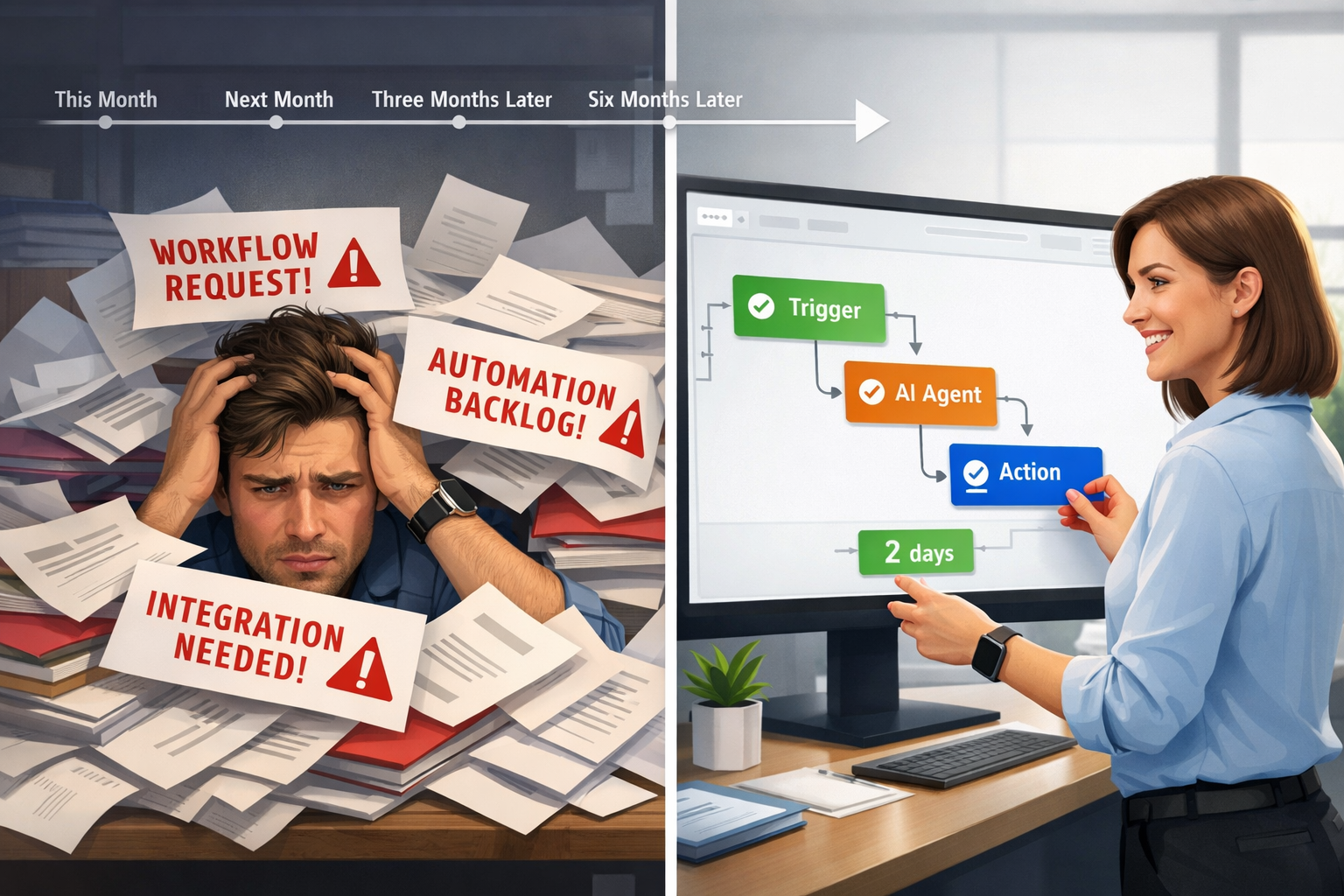
Low-code platforms eliminate engineering bottlenecks by transferring workflow design authority from developers to business users who understand operational requirements. Instead of submitting tickets to engineering teams and waiting in development queues, product managers and operations leads directly configure agents using visual interfaces.
Three mechanisms that remove engineering dependencies:
1. Visual workflow composition – Users map out agent logic by connecting pre-built nodes (triggers, actions, decisions, integrations) on a canvas. No syntax knowledge required. Flowise and Langflow lead this segment with graphical interfaces specifically designed for non-technical users [4].
2. Template-based deployment – Platforms provide pre-configured agent blueprints for common scenarios: customer inquiry routing, lead scoring, invoice processing, meeting scheduling. Teams customize templates rather than building from scratch, reducing initial setup from weeks to hours.
3. No-code integration management – Instead of writing API connectors, users authenticate third-party services through OAuth and configure data mapping through dropdown menus. Microsoft Copilot Studio excels here with native Power Platform integration [5].
Common mistake: Assuming low-code means limited capability. Modern platforms support sophisticated multi-agent orchestration, conditional logic, and complex data transformations—capabilities previously requiring custom development.
Real deployment timeline comparison:
- Traditional development approach: 8-12 weeks (requirements gathering, development sprint, testing, deployment)
- Low-code platform approach: 2-5 days (template selection, workflow configuration, testing, activation)
Edge case: Highly regulated industries (healthcare, financial services) may still require engineering review for compliance validation, but workflow design and iteration happen at business user speed. Lyzr specifically addresses this with enterprise-grade security features designed for regulated sectors [5].
What Features Should B2B Teams Look for in Low-Code Agentic AI Platforms?
B2B teams should prioritize platforms offering visual workflow builders, multi-model flexibility, enterprise integrations, and built-in knowledge management. The right feature set depends on team technical capacity, existing technology stack, and workflow complexity.
Essential Platform Features
| Feature Category | What to Look For | Why It Matters | Leading Platforms |
|---|---|---|---|
| Workflow Builder | Drag-and-drop canvas, node library, conditional logic | Enables non-technical design | Flowise, Langflow [4] |
| Model Support | GPT-4, Claude, Gemini, open-source LLMs | Task-specific optimization | All major platforms [4] |
| Knowledge Base | RAG integration, document upload, vector storage | Proprietary data training | Flowise, Lyzr [4][5] |
| Integrations | CRM, email, Slack, project management APIs | End-to-end automation | Microsoft Copilot Studio [5] |
| Multi-Agent Orchestration | Agent coordination, task delegation, shared context | Complex workflow handling | AutogenStudio, Lyzr [3][5] |
| Prompt Engineering | Visual prompt builder, template library, output control | Response customization | All platforms [6] |
| Deployment Options | Cloud, on-premise, hybrid | Security and compliance | Lyzr (enterprise focus) [5] |
Decision rules for platform selection:
- Choose Microsoft Copilot Studio if: You operate within Microsoft 365 ecosystem and need tight integration with Teams, SharePoint, and Dynamics [5]
- Choose Flowise if: You prioritize conversational agents and need open-source flexibility with visual design [4]
- Choose Langflow if: You focus on complex language model chaining and want granular control over agent logic [4]
- Choose Lyzr if: You operate in regulated industries and require enterprise security with rapid deployment [5]
Common mistake: Selecting platforms based on feature count rather than workflow fit. A platform with 100 integrations provides no value if it doesn't connect to your actual business systems.
For teams building comprehensive digital strategies, understanding search engine optimization fundamentals helps ensure AI-generated content and automated workflows align with discoverability goals.
How Do Visual Workflow Builders Enable Non-Technical Teams to Design Autonomous Agents?
Visual workflow builders enable non-technical teams by translating complex programming logic into graphical representations where users connect functional blocks instead of writing code. Each node represents a discrete action (trigger event, API call, decision point, AI inference), and connections define execution flow.
Core visual elements that replace coding:
Trigger nodes – Define workflow initiation (new email received, form submitted, scheduled time, webhook called)
Agent nodes – Specify AI model, prompt template, input variables, and output format
Decision nodes – Create conditional branching based on agent outputs or data values
Action nodes – Execute operations (send email, update CRM record, create ticket, post to Slack)
Integration nodes – Connect to external systems with pre-configured authentication and data mapping
How non-technical users actually build workflows:
- Select trigger – Choose from dropdown of available event sources
- Add agent node – Pick model (GPT-4, Claude, etc.) and write natural language instructions
- Configure inputs – Map data fields using point-and-click variable selection
- Define outputs – Specify format (text, JSON, structured data) through templates
- Add actions – Connect downstream operations based on agent decisions
- Test and iterate – Run workflows with sample data and refine logic visually
Example workflow: Product manager creates lead qualification agent in 3 hours:
- Trigger: New lead form submission
- Agent: Analyzes submission against ideal customer profile using GPT-4
- Decision: Routes high-quality leads to sales, medium leads to nurture sequence, low leads to generic follow-up
- Actions: Updates CRM, sends Slack notification, triggers email sequence
Edge case: Extremely complex workflows with 20+ decision branches may still benefit from developer involvement for optimization, but initial design and iteration happen at business user speed.
Teams interested in automating content workflows can explore how to integrate AI tools with WordPress for end-to-end publishing automation.
What Role Does Multi-Agent Orchestration Play in B2B Workflow Automation?
Multi-agent orchestration coordinates multiple specialized AI agents working collaboratively on complex tasks, replacing single monolithic agents with teams of focused specialists. This architectural shift became mainstream in 2025 as organizations discovered that specialized agents outperform generalists on multi-step B2B processes [2].
Why multi-agent systems matter for B2B workflows:
Single agents struggle with tasks requiring diverse capabilities—customer service, data retrieval, analysis, decision-making, and action execution. Multi-agent systems assign each capability to a specialized agent, then orchestrate collaboration through a coordinator.
Common multi-agent B2B patterns:
Customer support orchestration:
- Triage agent: Classifies incoming requests by category and urgency
- Knowledge agent: Retrieves relevant documentation and previous resolutions
- Response agent: Crafts personalized replies based on retrieved context
- Escalation agent: Determines when human intervention is required
Sales pipeline automation:
- Research agent: Gathers prospect company information from public sources
- Qualification agent: Scores leads against ideal customer profile
- Personalization agent: Customizes outreach messaging based on research
- Follow-up agent: Manages timing and content of subsequent touchpoints
Invoice processing workflow:
- Extraction agent: Pulls data from invoice documents (OCR + parsing)
- Validation agent: Checks against purchase orders and contracts
- Approval agent: Routes to appropriate stakeholders based on amount and vendor
- Payment agent: Triggers payment processing and updates accounting systems
Platform capabilities for orchestration:
Microsoft AutogenStudio specializes in multi-agent coordination for Azure-committed organizations, simplifying LLM collaboration on single tasks [3]. Lyzr supports solo agents, multi-agent systems, and full orchestration with particular strength in enterprise deployment [5].
Choose multi-agent architecture if: Your workflow requires distinct capabilities (research + analysis + writing), involves multiple decision points, or needs specialized handling at different stages. Stick with single agents if: Your task is straightforward, requires consistent behavior throughout, or involves simple input-output transformation.
How Do Low-Code Platforms Handle Integration with Existing B2B Technology Stacks?
Low-code platforms handle integration through pre-built connectors, OAuth authentication, and visual data mapping interfaces that eliminate custom API development. Wide enterprise integration capability became standard in 2026, with platforms supporting connections to CRM systems, collaboration tools, project management software, and customer support platforms [6].
Integration mechanisms that work without coding:
1. Native connectors – Pre-configured integrations with common B2B tools (Salesforce, HubSpot, Microsoft Dynamics, Zendesk, Slack, Asana, Jira). Users authenticate once and access all API endpoints through dropdown menus.
2. OAuth workflow builders – Visual interfaces for authorizing third-party services. No API key management or authentication code required.
3. Data mapping interfaces – Point-and-click field mapping between systems. Example: Map "lead_email" from form submission to "Email" field in Salesforce contact record.
4. Webhook support – Visual webhook configuration for real-time event triggers from external systems. No server setup or endpoint coding needed.
5. API request builders – For systems without native connectors, visual API request composers allow users to configure HTTP calls through forms instead of code.
Real integration examples:
Marketing automation workflow:
- Trigger: New lead captured in HubSpot
- Agent: Analyzes lead fit using company data and enrichment APIs
- Integration actions: Updates Salesforce opportunity, posts to Slack sales channel, creates task in Asana for account executive
Customer support automation:
- Trigger: New ticket in Zendesk
- Agent: Classifies issue category and retrieves relevant knowledge base articles
- Integration actions: Updates ticket with suggested resolution, assigns to appropriate team queue, sends summary to customer via email
Financial operations workflow:
- Trigger: Invoice received via email
- Agent: Extracts invoice data and validates against purchase orders
- Integration actions: Creates approval task in workflow system, updates accounting software, notifies finance team in Microsoft Teams
Common mistake: Attempting to integrate every available system at once. Start with 2-3 critical integrations, validate the workflow, then expand gradually.
Microsoft Copilot Studio provides the deepest Microsoft ecosystem integration, functioning as a comprehensive conversational AI platform within Power Platform [5].
For teams building scalable business systems, exploring digital marketing strategy fundamentals helps ensure AI workflows support broader growth objectives.
What Are the Cost and Timeline Expectations for Deploying Low-Code Agentic Workflows?
Organizations deploying low-code agentic workflows should expect initial setup in 2-5 days and monthly platform costs ranging from $0 (open-source) to $500+ per user depending on scale and features. The economic shift toward Small Language Models reduced inference costs by 50% in 2025, making continuous agent operation viable for mid-market companies [1].
Typical deployment timeline:
Day 1: Platform selection and setup
- Evaluate 2-3 platforms based on integration requirements
- Create account and configure authentication
- Connect primary business systems (CRM, email, collaboration tools)
Days 2-3: Workflow design and configuration
- Select or customize agent template
- Map workflow logic using visual builder
- Configure prompts and agent behavior
- Set up integration data flows
Day 4: Testing and refinement
- Run workflow with test data
- Validate integrations and data accuracy
- Refine agent prompts based on output quality
- Test edge cases and error handling
Day 5: Production deployment and monitoring
- Activate workflow for live traffic
- Monitor initial performance
- Gather user feedback
- Document workflow for team reference
Cost structure breakdown:
Open-source platforms (Flowise, Langflow):
- Platform cost: $0
- Infrastructure: $50-200/month (cloud hosting, database)
- LLM API costs: $100-500/month depending on volume
- Total: $150-700/month
Commercial platforms (Microsoft Copilot Studio, Lyzr):
- Platform license: $200-500/user/month
- LLM API costs: Included or separate depending on plan
- Enterprise features: Additional cost for advanced security, compliance
- Total: $200-1000+/user/month
ROI calculation example:
- Previous process: 2 hours/day manual lead qualification by sales team member ($50/hour loaded cost)
- Annual cost: $25,000 (500 hours × $50)
- Agent automation cost: $3,600/year (platform + API costs)
- Annual savings: $21,400
- Payback period: 2 months
Edge case: High-volume workflows processing thousands of requests daily may incur significant LLM API costs. Consider SLM deployment for routine tasks and reserve large models for complex decisions.
How Should B2B Teams Choose Between No-Code, Low-Code, and Traditional Development Approaches?
B2B teams should choose based on technical capacity, customization requirements, and deployment urgency. No-code platforms serve business users with zero technical skills, low-code platforms target technical product managers and analysts, and traditional development suits teams needing proprietary architectures.
Decision framework:
Choose No-Code Platforms If:
- User profile: Business stakeholders, operations managers, customer success leads with no programming background
- Workflow complexity: Straightforward processes with clear logic and limited branching
- Customization needs: Standard templates meet 80%+ of requirements
- Timeline: Need deployment within days
- Example platforms: Microsoft Copilot Studio (for Microsoft ecosystem users) [5]
Choose Low-Code Platforms If:
- User profile: Technical product managers, business analysts, or technical operations specialists comfortable with logic and data structures
- Workflow complexity: Multi-step processes requiring conditional logic, data transformation, and system integration
- Customization needs: Templates provide foundation but require significant modification
- Timeline: Need deployment within 1-2 weeks with iteration capability
- Example platforms: Flowise, Langflow, Lyzr [4][5]
Choose Traditional Development If:
- User profile: Engineering teams with AI/ML expertise
- Workflow complexity: Highly specialized requirements, proprietary algorithms, or novel architectures
- Customization needs: No existing platform meets core requirements
- Timeline: Can invest 2-3 months in custom development
- Compliance requirements: Need code-level audit trails and security controls
Hybrid approach: Many organizations use low-code platforms for 80% of workflows and reserve engineering resources for the 20% requiring deep customization. This maximizes business user autonomy while maintaining technical capability for complex scenarios.
Common mistake: Assuming traditional development provides inherently better quality. Low-code platforms now support sophisticated workflows that previously required custom coding, and faster iteration often produces better outcomes than longer development cycles.
Migration path: Start with no-code for simple workflows, graduate to low-code as requirements grow, and escalate to custom development only when platform limitations create genuine constraints.
For teams building sustainable business models around AI capabilities, understanding how to succeed in affiliate marketing provides insights into monetization strategies that can fund ongoing AI innovation.
Frequently Asked Questions
What is the difference between low-code and no-code agentic AI platforms?
No-code platforms require zero technical knowledge and serve pure business users through template-based configuration. Low-code platforms assume basic technical literacy and provide more customization through visual programming, conditional logic, and data transformation capabilities. Both eliminate traditional coding but target different user skill levels.
Can non-technical teams really build production-quality AI agents without developer help?
Yes, for well-defined workflows with clear logic and standard integrations. Non-technical teams successfully deploy customer service agents, lead qualification workflows, and data enrichment processes using visual builders. Complex scenarios requiring custom algorithms or novel architectures still benefit from engineering involvement, but 70-80% of B2B workflows fit low-code capabilities.
How long does it take to deploy a custom agentic workflow using low-code platforms?
Simple workflows deploy in 2-3 days, moderate complexity workflows in 4-5 days, and complex multi-agent orchestrations in 1-2 weeks. This compares to 8-12 weeks for traditional development approaches. Timeline depends on integration complexity, data availability, and team familiarity with the platform.
What are the ongoing costs of running low-code agentic AI workflows?
Open-source platforms cost $150-700/month (infrastructure + LLM API calls), commercial platforms cost $200-1000+/user/month depending on features and volume. Small Language Models reduced inference costs by 50% in 2025, making continuous operation economically viable for mid-market companies [1].
Do low-code platforms support multi-agent orchestration?
Yes, leading platforms including Lyzr, AutogenStudio, and Langflow support multi-agent systems where specialized agents collaborate on complex tasks [2][3][5]. Coordinators manage agent communication, task delegation, and shared context without requiring custom orchestration code.
Can low-code agentic AI integrate with existing CRM and business systems?
All major platforms provide pre-built connectors for common B2B systems (Salesforce, HubSpot, Microsoft Dynamics, Zendesk, Slack, Asana) with OAuth authentication and visual data mapping [6]. Custom integrations use visual API builders for systems without native connectors.
What happens when a low-code workflow outgrows platform capabilities?
Most platforms support export to code or API access for custom extensions. Organizations typically migrate 10-20% of workflows to custom development when requirements exceed platform limits, while maintaining 80% on low-code infrastructure for agility.
Are low-code agentic AI platforms suitable for regulated industries?
Yes, platforms like Lyzr specifically target regulated sectors (banking, healthcare, insurance) with enterprise-grade security, compliance features, and audit trails [5]. Deployment options include on-premise and hybrid models for data sovereignty requirements.
How do teams train AI agents on proprietary company data?
Built-in RAG (Retrieval-Augmented Generation) capabilities allow teams to upload documents, connect knowledge bases, and train agents on proprietary data without model retraining [4]. Agents retrieve relevant context from company data during inference rather than relying solely on pre-trained knowledge.
What skills do team members need to use low-code agentic AI platforms effectively?
Users need basic logical thinking, understanding of their business workflows, and comfort with visual interfaces. No programming required, but technical product managers with data structure knowledge can build more sophisticated workflows. Most platforms provide template libraries that reduce required expertise.
Can multiple team members collaborate on building and maintaining agentic workflows?
Yes, platforms support team collaboration with role-based access, version control, and shared workflow libraries. Multiple stakeholders can contribute to workflow design, testing, and refinement without code conflicts or merge issues.
How do low-code platforms handle errors and exceptions in agentic workflows?
Visual error handling includes retry logic, fallback paths, and notification triggers configured through dropdown menus. Teams define exception behavior (escalate to human, use default response, log and continue) without writing try-catch code.
Conclusion
Low-code agentic AI builders fundamentally shift who controls AI deployment in B2B organizations. By providing visual workflow builders, pre-configured templates, and native integrations, these platforms enable product managers, operations leads, and business stakeholders to design and deploy autonomous agents without waiting for engineering resources. The 340% surge in autonomous agent adoption during 2025 reflects this democratization, as teams discover they can iterate on AI workflows at business speed rather than development cycles [1].
The platforms discussed—Flowise and Langflow for visual development flexibility, Microsoft Copilot Studio for Microsoft ecosystem integration, Lyzr for enterprise security, and AutogenStudio for multi-agent orchestration—represent different approaches to the same core objective: removing technical barriers to agentic AI deployment [3][4][5]. Organizations should select based on existing technology stack, team technical capacity, and workflow complexity rather than feature count.
Actionable next steps for B2B teams:
Identify one high-value workflow currently constrained by engineering availability (lead qualification, customer inquiry routing, data enrichment)
Evaluate 2-3 platforms based on integration requirements with your existing systems and team technical comfort level
Start with a template rather than building from scratch—customize proven patterns to your specific needs
Deploy a pilot workflow within 5 days and measure impact (time saved, accuracy improvement, user satisfaction)
Document and share successful workflows to build organizational capability and identify additional automation opportunities
Graduate complexity gradually—master simple workflows before attempting sophisticated multi-agent orchestration
The shift toward Small Language Models and reduced inference costs makes continuous agent operation economically viable for mid-market companies, not just enterprises [1]. Teams that master low-code agentic platforms in 2026 gain sustainable competitive advantage by maintaining workflow agility without scaling engineering headcount proportionally.
For organizations building comprehensive AI-driven business strategies, exploring AI marketing fundamentals and understanding how to leverage AI for profitable ventures provides broader context for integrating agentic workflows into growth initiatives.
The question is no longer whether non-technical teams can deploy custom AI workflows—the platforms exist and proven patterns are documented. The question is which workflows your team will automate first and how quickly you'll capture the productivity gains already realized by early adopters.
References
[1] Top Ai Agent Builder Platforms Complete Guide – https://www.vellum.ai/blog/top-ai-agent-builder-platforms-complete-guide
[2] Top Ai Agent Companies – https://www.lowcode.agency/blog/top-ai-agent-companies
[3] Best Tools And Platforms For Building Ai Agents In 2026 – https://robustdevs.co/blog/best-tools-and-platforms-for-building-ai-agents-in-2026
[4] Best Ai Agent Builders 2026 – https://www.flowhunt.io/blog/best-ai-agent-builders-2026/
[5] Agent Builder – https://www.lyzr.ai/blog/agent-builder/
[6] Top Ai Agent No Code Platforms In 2026 – https://www.konverso.ai/en/blog/top-ai-agent-no-code-platforms-in-2026
 dfyadmin