

The affiliate marketing landscape in 2026 has transformed dramatically. Gone are the days of waiting weeks to determine which ad creative performs best. Real-Time Agentic Ad Testing: Dynamic Optimization Platforms for Affiliate Campaigns now enable marketers to test, analyze, and optimize advertisements instantly using autonomous AI agents that respond to audience behavior as it happens.
Imagine launching an affiliate campaign and watching an AI agent automatically identify your top-performing ad variations within hours—not weeks—then reallocating your budget to maximize conversions while you sleep. This isn't science fiction. It's the new standard practice that's helping affiliate marketers achieve unprecedented results. 🚀
As AI-assisted testing becomes faster and more accurate, marketers can now leverage agentic optimization recommendations that enable dynamic campaign fine-tuning based on historical performance, trending data, and real-time audience responses [1]. This shift represents the most significant advancement in affiliate marketing strategies since the introduction of programmatic advertising.
Key Takeaways
- Autonomous optimization agents monitor campaigns 24/7 across multiple platforms, automatically reallocating budgets to top performers and pausing underperforming ads in real time
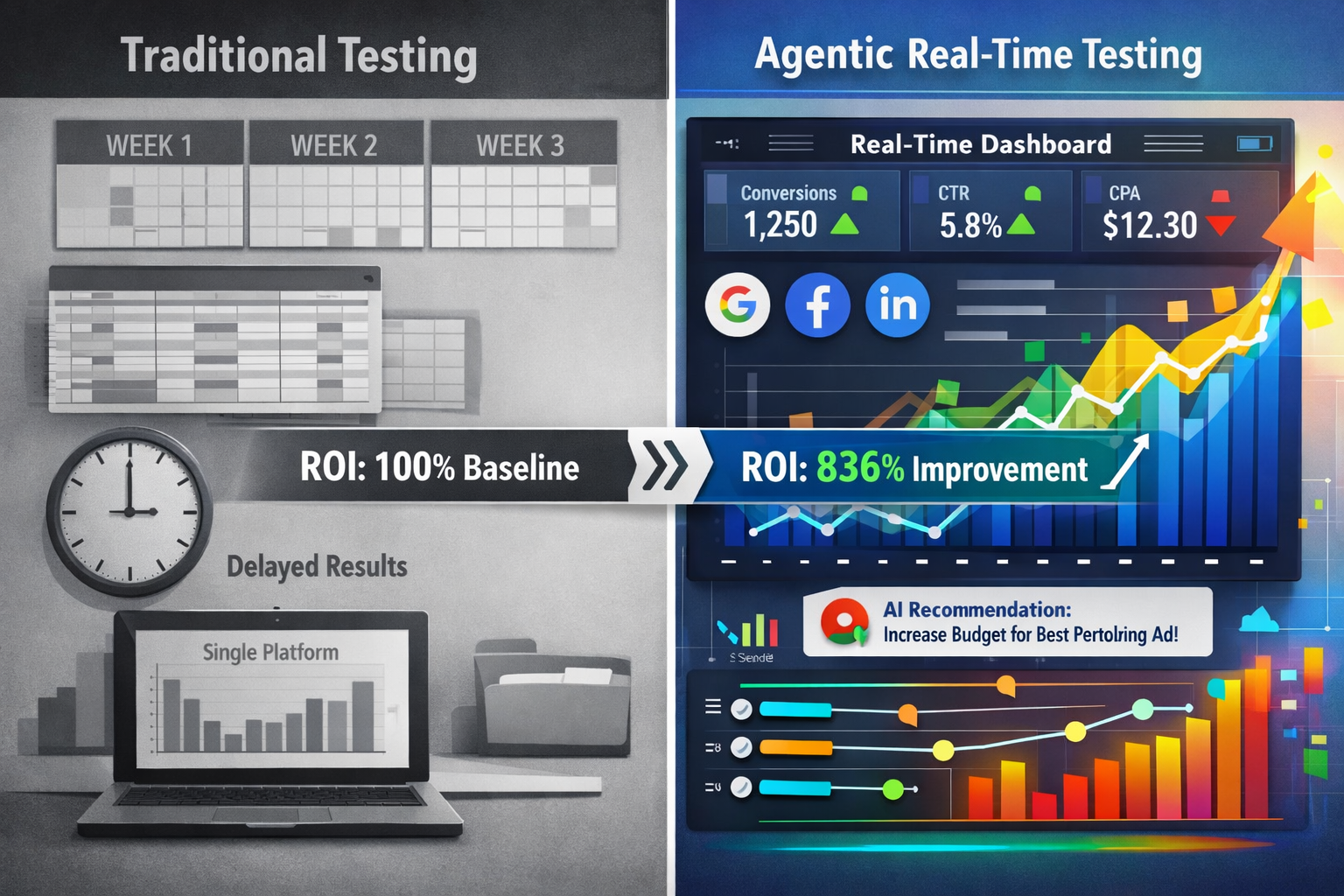
- Companies implementing agentic workflows report ROI improvements of 836% through continuous, autonomous ad performance analysis [2]
- Real-time A/B testing now delivers actionable insights in minutes instead of days, enabling instant campaign pivots based on live audience response data
- Trust and transparency concerns remain the primary adoption barrier, with 60% of ad professionals citing accuracy concerns [5]
- New industry protocols like the Unified Context Protocol (UCP) are accelerating agentic AI adoption by enabling seamless agent communication [5]
Understanding Real-Time Agentic Ad Testing: Dynamic Optimization Platforms for Affiliate Campaigns
What Makes Agentic Testing Different?
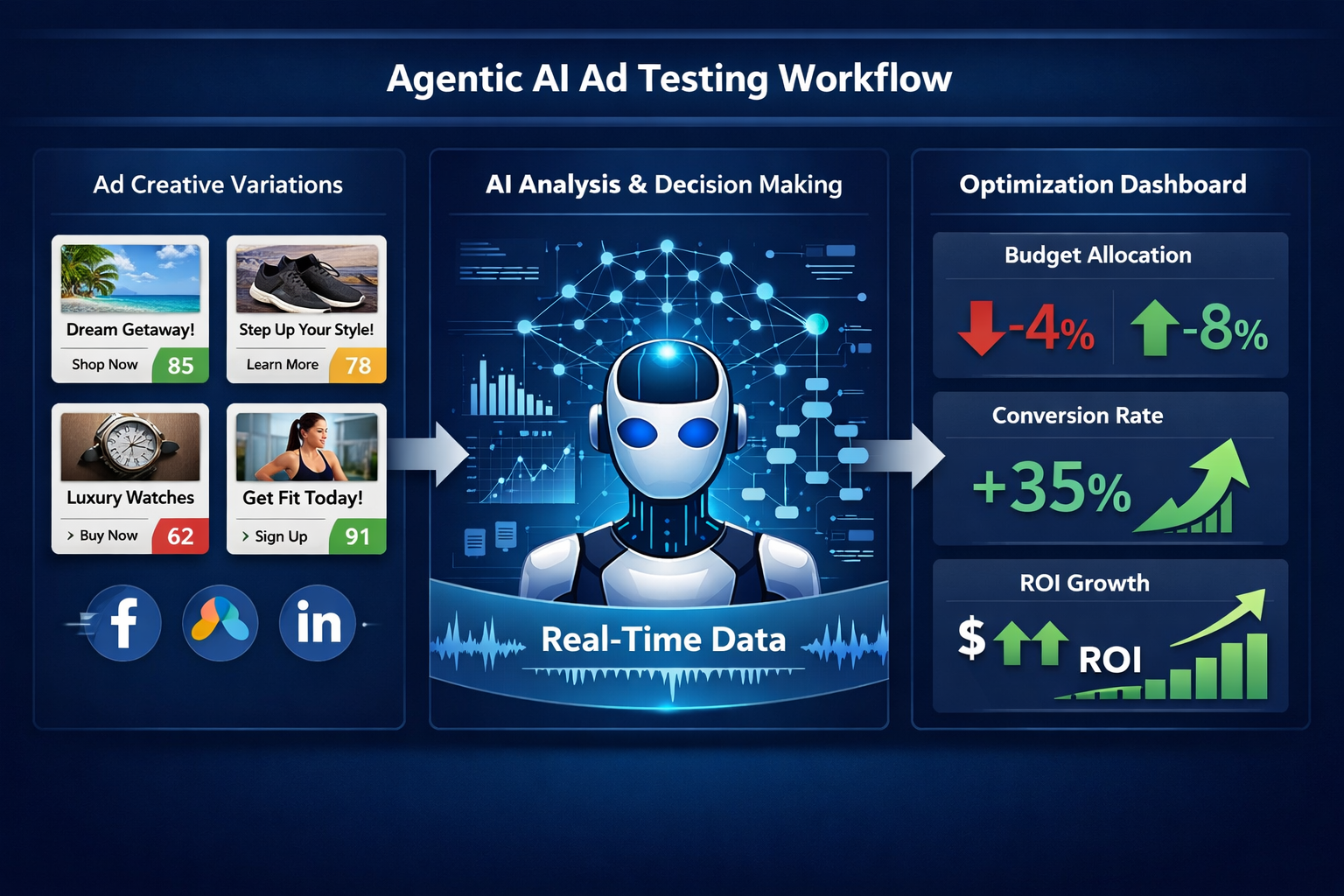
Traditional A/B testing requires marketers to manually set up experiments, wait for statistical significance, analyze results, and implement changes. Agentic ad testing flips this model entirely. These AI-powered systems operate autonomously, making decisions and taking actions without constant human oversight.
Agentic AI systems possess three critical capabilities:
- Autonomy: They make independent decisions based on predefined goals
- Reasoning: They analyze complex data patterns to determine optimal actions
- Action: They implement changes automatically across advertising platforms
For affiliate marketers, this means launching campaigns that continuously self-optimize. Ad Optimization Agents now monitor performance across Google Ads, Facebook, LinkedIn, and other platforms simultaneously, analyzing which ad creatives, copy variations, and audience segments deliver the best results [2].
The Technology Behind Dynamic Optimization
Modern agentic platforms leverage several advanced technologies:
- Machine learning algorithms that predict performance based on historical campaign data
- Natural language processing to analyze ad copy effectiveness and sentiment
- Computer vision to evaluate creative elements and visual appeal
- Real-time bidding integration for instant budget adjustments
- Multi-platform APIs enabling cross-channel optimization
These systems reduce "Time to Insight" from days to mere minutes, allowing marketers to build highly specific custom audiences—such as "High LTV shoppers who haven't purchased in 6 months"—and push them directly to programmatic platforms like Amazon DSP for immediate retargeting [4].
The Performance Revolution: ROI and Conversion Metrics
Documented Performance Improvements
The results from early adopters of Real-Time Agentic Ad Testing: Dynamic Optimization Platforms for Affiliate Campaigns are remarkable:
| Metric | Traditional Approach | Agentic Approach | Improvement |
|---|---|---|---|
| ROI | 100% baseline | 836% [2] | 8.4x increase |
| Conversion Rate | 1x baseline | 7x higher [3] | 7x increase |
| Cost Reduction | Baseline | 15-20% lower [3] | Significant savings |
| Efficiency Gains | Baseline | Up to 30% [3] | Substantial improvement |
| Time to Insight | Days | Minutes [4] | 99% faster |
A recent BCG study revealed that businesses adopting agentic marketing strategies saw their ROI triple, with 15-20% cost reductions while simultaneously increasing campaign speed and content output [3]. These aren't marginal improvements—they represent fundamental shifts in campaign economics.
Real-World Success Stories
Companies like Landbase highlight their AI marketing agents as capable of executing campaigns autonomously, achieving 7× higher conversion rates compared to traditional methods [3]. Some businesses leveraging agentic marketing report efficiency gains of up to 30%, with ROI returns reaching 544% [3].
For those exploring affiliate marketing programs, these performance metrics demonstrate the competitive advantage that agentic testing provides. The question is no longer whether to adopt these technologies, but how quickly you can implement them.
How Real-Time Agentic Ad Testing Works in Practice
The Continuous Optimization Cycle
Agentic platforms operate through a continuous feedback loop:
- Launch Phase: Deploy multiple ad variations across platforms simultaneously
- Monitoring Phase: AI agents track performance metrics in real time (clicks, conversions, cost-per-acquisition)
- Analysis Phase: Machine learning models identify patterns and predict optimal combinations
- Optimization Phase: Agents automatically adjust budgets, pause underperformers, and scale winners
- Learning Phase: System incorporates new data to improve future predictions
This cycle repeats continuously, 24/7, without human intervention. The AI never sleeps, never takes breaks, and processes data far faster than any human team could manage.
Platform Integration and Automation
Modern agentic systems integrate seamlessly with major advertising platforms:
- Google Ads: Leveraging Performance Max campaigns combined with AI-powered Search using Broad Match and Smart Bidding for optimal coverage [4]
- Facebook/Meta: Automated audience targeting and creative testing across Facebook, Instagram, and Messenger
- LinkedIn: B2B campaign optimization with professional demographic targeting
- Programmatic Networks: Real-time bidding adjustments across display networks
Google Marketing Live 2025 introduced "Your Google Ads Expert," an agentic system in beta rollout that autonomously manages campaigns, proactively identifies performance anomalies (such as broken landing pages affecting conversion rates), and resolves issues or alerts users instantly [4].
Implementing Agentic Testing for Affiliate Campaigns
Getting Started with Dynamic Optimization
For marketers wondering how to do affiliate marketing with agentic tools, the implementation process follows these steps:
Step 1: Define Clear Objectives 📊
Establish specific, measurable goals such as target cost-per-acquisition, minimum ROI thresholds, or conversion rate benchmarks. Agentic systems need clear parameters to optimize effectively.
Step 2: Select Your Platform
Choose an agentic optimization platform that integrates with your existing advertising channels. Popular options include Google's native agentic tools, third-party platforms like Yeti Agent, and specialized affiliate marketing solutions.
Step 3: Prepare Creative Variations
Develop multiple ad creative variations including different headlines, images, calls-to-action, and landing pages. The AI will test these combinations to identify winners.
Step 4: Set Guardrails and Budgets
Establish spending limits, brand safety parameters, and approval workflows. While agents operate autonomously, they should work within defined boundaries.
Step 5: Launch and Monitor
Deploy your campaigns and monitor the AI's decisions initially. Most platforms provide transparency dashboards showing why specific optimization decisions were made.
Best Practices for Maximum Performance
To maximize results from Real-Time Agentic Ad Testing: Dynamic Optimization Platforms for Affiliate Campaigns, follow these proven strategies:
✅ Provide Sufficient Data: Agents need adequate traffic volume to make statistically valid decisions. Start with reasonable budgets that generate meaningful data quickly.
✅ Test Meaningfully Different Variations: Don't just change button colors—test fundamentally different value propositions, audience segments, and creative approaches.
✅ Review Agent Decisions Regularly: While agents operate autonomously, periodic human review ensures alignment with business objectives and catches potential issues.
✅ Combine with Human Creativity: AI excels at optimization but still benefits from human creative input. The best results come from human-AI collaboration.
✅ Maintain Brand Consistency: Set clear brand guidelines to prevent agents from making changes that conflict with your brand identity.
Overcoming Challenges and Building Trust
The Transparency Barrier
Despite impressive performance metrics, adoption faces significant hurdles. 60% of US ad industry professionals cite concerns about accuracy and transparency as a top barrier to AI adoption in media campaigns [5]. Marketers require more trust in how agents make autonomous decisions before full deployment.
"The challenge isn't whether agentic AI works—the data proves it does. The challenge is building trust in systems that make decisions we don't immediately understand." – Industry Expert
To address these concerns, leading platforms are implementing:
- Explainable AI dashboards that show the reasoning behind optimization decisions
- Human-in-the-loop options requiring approval for major budget reallocations
- Performance guarantees with rollback capabilities if results decline
- Transparent reporting showing all changes made by the agent
Infrastructure and Protocol Development
New protocols including the Unified Context Protocol (UCP), Advertising Context Protocol (AdCP), and the Agentic RTB Framework (ARTF) are accelerating agentic AI adoption by providing shared infrastructure for AI agents to communicate and collaborate [5].
These protocols ensure that different agentic systems can work together, share insights, and coordinate optimizations across platforms—creating a more cohesive advertising ecosystem.
The Future of Affiliate Campaign Optimization
Emerging Trends for 2026 and Beyond
The evolution of Real-Time Agentic Ad Testing: Dynamic Optimization Platforms for Affiliate Campaigns continues to accelerate:
Multi-Agent Collaboration: Future systems will deploy specialized agents for different tasks (creative optimization, audience targeting, budget management) that collaborate to achieve campaign goals.
Predictive Campaign Planning: AI agents will move beyond reactive optimization to predictive planning, forecasting campaign performance before launch and recommending optimal strategies.
Cross-Channel Attribution: Advanced agents will track customer journeys across multiple touchpoints, optimizing the entire funnel rather than individual ads.
Voice and Visual Search Integration: As search evolves, agentic systems will optimize for voice queries and visual search, expanding beyond traditional text-based advertising.
For those exploring opportunities in digital marketing, understanding these trends provides a competitive advantage in an increasingly AI-driven landscape.
Preparing for an Agentic Future
Success in this new environment requires:
- Continuous Learning: Stay updated on platform capabilities and best practices
- Data Quality: Invest in clean, comprehensive data that agents can leverage
- Strategic Thinking: Focus human effort on strategy while agents handle execution
- Experimentation Culture: Embrace testing and iteration as core business practices
- Technology Investment: Allocate resources to adopt and master agentic platforms
The marketers who thrive will be those who view AI agents as collaborative partners rather than replacement tools, combining human creativity and strategic thinking with machine speed and analytical power.
Conclusion
Real-Time Agentic Ad Testing: Dynamic Optimization Platforms for Affiliate Campaigns represents a fundamental shift in how affiliate marketing operates in 2026. The evidence is clear: companies implementing these autonomous systems achieve ROI improvements of 836%, conversion rates 7× higher than traditional methods, and efficiency gains up to 30%—all while reducing costs by 15-20%.
The technology has moved beyond experimental to essential. Agentic platforms now monitor campaigns 24/7, analyze performance across multiple channels simultaneously, and make optimization decisions in minutes that previously took days or weeks. With Google, Meta, and other major platforms rolling out native agentic tools, the barrier to entry continues to fall.
However, success requires more than simply activating an AI agent. Marketers must define clear objectives, prepare diverse creative variations, establish appropriate guardrails, and maintain strategic oversight. The most successful implementations combine autonomous AI optimization with human creativity and strategic direction.
Take Action Today
Ready to transform your affiliate campaigns with agentic testing? Start with these immediate steps:
- Audit your current testing processes to identify optimization delays and bottlenecks
- Research agentic platforms compatible with your advertising channels and budget
- Develop a pilot campaign with clear success metrics and learning objectives
- Invest in creative development to provide agents with diverse variations to test
- Join the conversation by following industry developments and sharing learnings
The future of affiliate marketing belongs to those who embrace autonomous optimization while maintaining strategic human oversight. The question isn't whether to adopt agentic testing—it's how quickly you can implement it to stay competitive in an AI-driven marketplace.
Start small, test thoroughly, and scale what works. Your autonomous optimization agent is ready to work 24/7 to maximize your affiliate campaign performance. The only question remaining is: are you ready to let it? 🎯
References
[1] Marketing Trends – https://www.kantar.com/campaigns/marketing-trends
[2] Ai Agentic Workflows Marketing – https://thesmarketers.com/blogs/ai-agentic-workflows-marketing/
[3] Agentic Marketing Complete Guide 2026 – https://www.enrichlabs.ai/blog/agentic-marketing-complete-guide-2026
[4] Ai Marketing Guide – https://www.yotpo.com/blog/ai-marketing-guide/
[5] Genai Will Take Over Programmatic Advertising 2026 Agentic Ai Isn T Far Behind – https://www.emarketer.com/content/genai-will-take-over-programmatic-advertising-2026-agentic-ai-isn-t-far-behind